
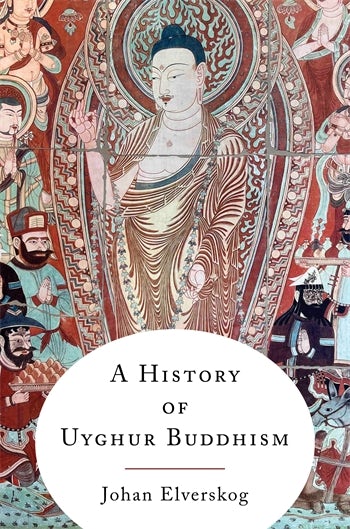
Pub Date: June 2024
296 Pages
===
A History of Uyghur Buddhi
Columbia University Press
Winner, 2026 Joseph Levenson Prize (China, pre-1900), Association for Asian Studies
===
Today, most Uyghurs are Muslims. For centuries, however, Uyghurs were Buddhists. By around 1000 CE, they, like many of their neighbors, had decisively turned toward the Dharma, and a golden age of Uyghur Buddhism flourished under the Mongol empire. Dwelling along the Silk Road in what is now northwestern China, they stood at the center of Buddhist Eurasia, linking far-flung regions and traditions. But as Muslim power grew, Uyghur Buddhists converted to Islam, rewriting their past and erasing their Buddhist history.
This book presents the first comprehensive history of Buddhism among the Uyghurs from the ninth to the seventeenth century. Johan Elverskog traces how the Uyghurs forged their distinctive tradition, considering a variety of social, political, cultural, and religious contexts. He argues that the religious history of the Uyghurs challenges conventional narratives of the meeting of Buddhism and Islam, showing that conversion took place gradually and was driven by factors such as geopolitics, climate change, and technological innovation. Elverskog also provides a nuanced understanding of lived Buddhism, focusing on ritual practices and materiality as well as the religion’s entanglements with economics, politics, and violence. A groundbreaking history of Uyghur Buddhism, this book makes a compelling case for the importance of the Uyghurs in shaping the course of both Buddhist and Asian history.
About the AuthorJohan Elverskog is Dedman Family Distinguished Professor, professor of religious studies, and, by courtesy, professor of history at Southern Methodist University in Dallas, Texas. He is the author or editor of ten books, including, most recently, The Precious Summary: A History of the Mongols from Chinggis Khan to the Qing Dynasty (Columbia, 2023).
Acknowledgments
Introduction
1. Becoming Buddhist
2. Buddhist Politics
3. Buddhist Economics
4. Uyghur Buddhisms
5. Becoming Muslim
Conclusion
Notes
Bibliography
Index
Constance Kassor’s review from the Summer 2024 Buddhadharma:
Centuries ago, the Uyghur people of northwestern China were largely Buddhist. Before that, they were Christian and Manichaean. But in the face of expanding Muslim power, they were eventually converted to Islam, severing ties with their past religious alliances. In A History of Uyghur Buddhism (Columbia), Johan Elverskog explores the history of the Uyghur Kingdom and its people, and the evolution of their religious alliances. Elverskog sheds new light on common perceptions about the meeting between Buddhism and Islam in Asia, explores what it means to be Buddhist, and highlights the importance of both Uyghurs and Buddhism in shaping Asian history more broadly. Lucidly written and accompanied by maps and images, this book offers fascinating insight into a region and people who have been largely overlooked in the field of Buddhist Studies.
[Please note that the text from which this excerpt derives makes use of Chinese characters and diacriticals; these are not represented in this excerpt.]
The Excerpt:
Buddhism is anchored by two myths. The first is that the Dharma is so profound and human ignorance and greed are so vast that the comprehension and practice of Buddhism will be lost and disappear. The second myth, however, tempers this claim by asserting that a new buddha will appear in the world and teach the Dharma anew, and the cycle of rise and decline will be set in motion again. Early Buddhist texts claim that seven buddhas have appeared through history: Vipasyin, Sikhin, Visvabhu, Krakucchanda, Kanakamuni, Kasyapa, and Sakyamuni (the Buddha of the contemporary era, on whom the clock is ticking). When Buddhism will actually end has animated Buddhist thought for two millennia, and it has also driven Buddhists across Asia to transform both their religious tradition and its political realities. In China, for example, fears about the “end of the Dharma” were instrumental in the development of both the Zen and Pure Land traditions and in various millenarian political movements over the centuries.
Central to many of these movements, and indeed the entire apocalyptic narrative of the Dharma, is the myth of the Buddha Maitreya. Buddhist texts tell us that he currently resides in Tusita heaven and will, messiah-like, eventually return when the Dharma has been totally forgotten to revive the Buddhist dispensation. For Buddhists, of course, the question has always been when this would actually happen. For those partaking in the East Asia-wide Buddhist turn in the tenth and eleventh centuries, the answer was that the end times would start in 1052 CE.
Why and how this date was determined is unclear, but it has been suggested that the advance of Islam into Buddhist India and especially the fall of Khotan to the Qarakhanids may have been a factor. These events had given rise to the myth of Shambhala among Buddhists in what is now northwest India and Pakistan. Shambhala is first found in the early eleventh-century Kalacakratantra, which prophesies a world where the Dharma is under relentless assault. In particular, it claims that Buddhism will be threatened in the future by Muslims, and the final eschatological battle will take place between them and the twenty-fifth (and final) ruler of Shambhala, Kulika Rudracakrin, who will ride forth with his Buddhist army from the hidden realm, annihilate the Muslims, and usher in a new golden age of the Dharma.
Although this myth was animated by real-world events, it also drew upon the Buddhist tradition’s deep well of apocalyptic narratives concerning the rise and fall of the Dharma. It became a readily accepted model to explain the contemporary world for Buddhists in northwest India, and through the burgeoning relations between India and China and the Song dynasty’s Kaibao Buddhist canon project, made its way east as well. One such conduit was the Kashmiri monk Devasantika (Ch. Tianxizai, d. 1000), who translated a text into Chinese detailing such apocalyptic language and visions. This work was followed by others, such as the Essential Readings for Buddhists (Ch. Shishi yaolan), a dictionary compiled in 1019 by the monk Daocheng that included timetables for the end times.
Chinese concern about the Dharma’s demise and Maitreya worship spread to Japan on account of the interconnected Khitan Liao Buddhist world. Ten catastrophic outbreaks of smallpox, measles, influenza, and plague between 995 and 1030 had occurred in Japan, fueling the apocalyptic vision. In addition, “the appearance of SN 1006 on Kyoto’s southern horizon in May of 1006—the largest supernova in history—contributed to the growing sense of doom.” The supernova was followed by meteor showers in 1007; a triple conjunction of Jupiter and Saturn in 1007–8; the Kamo river flooding in 1017; a Jurchen fleet attacking Hakata in 1019; typhoons in 1028 and 1034; and the main sanctuary at Toyouke Shrine in Ise collapsing in heavy wind in 1040 and the palace burning down a month later. With such a concatenation of catastrophes, the Japanese practiced ritual actions such as placing scriptures—most often the Lotus Sutra—in caskets and then burying them in mounds. As D. Max Moerman explains:
The process required that sutras be transcribed according to strict ritual protocols, enclosed within reliquary-shaped containers, and buried underground to protect and preserve the teachings until the arrival of the next Buddha, Miroku (Skt. Maitreya), some 5.67 billion years in the future. . . .The primary motivation was the concern to preserve the sutras throughout the age of mappo [the end times] until the coming of Miroku, who will use the buried sutras in his three inaugural sermons beneath the Dragon Flower Tree. The location of the major sutra mounds—such as the mountains of Hiei, Koya, and Kinpusen—were, like Hiko, believed to be the sites of Miroku’s future descent.
The Japanese were not the only ones to take ritual action to deal with the end times and the coming of Maitreya. The Khitan Liao, for example, revived the cutting of the Buddhist canon into stone at Yunju monastery on Fang Mountain near Beijing. The cutting had been initiated by the monk Jingwan in the seventh century when the fear of the Dharma’s demise was also rampant. By the end of the eighth century the project had faltered, and in 964–965 it was revived under Liao patronage. Mimi Yiengpruksawan describes the new project:
Extant stone tablets were reorganized, and subsequent carving went forward based on the Liao edition of the canon. It was a massive project, eventually yielding thousands of tablets, whose impetus clearly lay in Jingwan’s pledge. Indeed, his vow to preserve the Buddhist scriptures is echoed in the inscription by a Liao official and his monastic advisor on a stele commemorating the restoration of Yanjunsi in 965. They seek, through the durability of stone, to safeguard Buddha’s teachings in the many worlds and ages that lie ahead. In 1005 the stele was recut and another inscription added, which states that through the medium of stone the teachings will be preserved until the coming of Maitreya—that is, Future Buddha who appears after the eschaton.
The Khitan also rebuilt the northern pagoda at Chaoyang, and when they installed relics inside it, they memorialized them with an inscription: “deposited at noon of the 8th day of the 4th moon of the 12th year of the Chongxi reign (May 19, 1043) of the Great Khitan State, with eight years remaining of Xiangfa (Semblance Dharma) followed by entry into Mofa (Latter Dharma).” Moreover, as Youn-mi Kim has shown, “these relics and texts suggest that the upper cella was intended to function as a ‘miniature ritual altar related to the Buddhist incantation known as Usnisavijaya dharani (Superlative Spell of the Buddha’s Crown),’ which would generate protective powers of the spell in perpetuity. By 1052 there were five Chinese versions of the dharani in circulation . . . [that] explained its efficacy during the Semblance and Latter Dharma.” Such texts and ideas made their way to Dunhuang, where in the tenth century “the most grandiose and important restoration project” was the repair of Cave 130, which featured a large statue of Maitreya Buddha as its main icon.
The worship of Maitreya and its links with an “age of anxiety” was pervasive across Asia around the time of the Uyghur conversion, and the cult of Maitreya became the most important element of early Uyghur Buddhism. Yet unlike the Japanese and Khitan, who had only recently adopted this tradition from the Chinese, the Uyghurs had long been involved with the worship of Maitreya on account of their engagement with the Tokharians. The Tokharians focused on Maitreya and had already in the fifth century begun representing the so-called pranidhi scene—the prediction of future buddhahood—in their artwork. This scene would become central to early Uyghur Buddhist art.
The earliest extant Uyghur text—a trilingual Sanskrit, Tokharian, and Uyghur fragment from the ninth century—mentions Maitreya. Another important and early Uyghur text, the Maitrisimit, which was translated from a Tokharian original and probably dates to the second half of the tenth century, is a twenty-seven-chapter teaching about Maitreya. In the colophon of the earliest version of the Maitrisimit, the lay brother Boz Bay Tiräk and lay sister Yidläk, who commissioned the work, state their wish: “Later may it happen that we meet Buddha Maitreya, attain the blessing of Buddhahood and . . . Buddhahood.” Similarly, in another version from 1067, the colophon records: “In order that . . . I, lay brother [Čuu] Taš Yegän Totok, who believes in the Three Jewels, and [my wife] Tözün will meet the coming Buddha Maitreya, we have arranged for the painting of this image of Maitreya and the copying of the Maitrisimit Sūtra.”
Central to the Uyghur cult of Maitreya was the desire to be reborn at the time of the future Buddha—or in Tusita heaven—in order to receive a blessing or prophecy of future buddhahood. In a stake inscription commemorating the founding of a Buddhist monastery in 1019, for example, the two donors express their hope for such a prediction from Maitreya. From the Sanskrit inscriptions that top the Uyghur pranidhi scenes in the Bezeklik caves, we know that the mythology of this tradition goes back to the Mahavastu, which claims that there were actually fourteen (not six) buddhas between Dipamkara and Kasyapa. With the addition then of the present Buddha, Sakyamuni, the pranidhi murals in caves 20 and 15 at Bezeklik together depict fifteen buddhas, each of which iconographically confirms that in times of trouble the best hope for future buddhahood is not one’s effort in this life but being reborn at the time of a future buddha so as to acquire both the merit and the prophecy needed for salvation.
This desire to be reborn at the time of Maitreya’s earthly descent is found in the earliest texts of the so-called Nikaya schools. This was the tradition that the Tokharians followed and transmitted to the Uyghurs. Yet on account of the Maitreya fever in the tenth and eleventh centuries, new ideas and rituals relating to the future buddha were developing in other Buddhist traditions. In China, for example, the Yogacara school had long promoted not simply waiting for Maitreya to be reborn on earth but praying to be reborn directly into Tuṣita heaven, where Maitreya now resides. Leading Buddhists such as the pilgrim and translator Xuanzang promoted this idea. In the tenth century the Yogacara Faxiang school, which was then growing in popularity both in the Liao dynasty and in Dunhuang, revived it, and the Uyghurs subsequently adopted the tradition. They not only adopted its new ideas and rituals but also fused them with the original Tokharian practices to create a distinctive new ritual repertoire. One such practice was asking Maitreya directly to “eradicate ailments and the sufferings of the Uyghur people in the realm of Kocho.” Jens Wilkens describes another text that includes “a diagnosis of the present situation” as one of “degeneration, depravity and impurity, in which the Uyghur nobility tirelessly work to rebuild a thriving Buddhist community.” In these works the nobility are represented as the “‘charisma of the realm of Kočo’ (OU kočo ulušnung kuṭı kıvı), a term reminiscent of the protective deities guarding the land of the Uyghurs.”
The worship of Maitreya among the Uyghurs thus worked on multiple levels. By promoting the cult through textual and artistic production—including representations of themselves—the Uyghur elite were “shoring up the self in an age of anxiety” and grappling with the “idea of annihilation.”
Yet unlike all the other surrounding polities, even amid fear and upheaval, the Uyghur ruler himself did not take up these issues. He never claimed to be a cakravartin, a bodhisattva, a new Aśoka, or any of the other standard ideological models available for Buddhist rulers. Rather, the Uyghur nobility were the “charisma of the realm of Kočo.” Their support of the Dharma was both protecting the Uyghur state and making salvation possible.
=====
Excerpted from A History of Uyghur Buddhism by Johan Elverskog. Copyright (c) 2024 Columbia University Press. Used by arrangement with the Publisher. All rights reserved. We thank Columbia University Press for providing this excerpt, and we thank our readers for supporting dharma publishers.
For more on the latest dharma books, read this issue’s edition of Buddhadharma on Books. Or see more excerpts and other digital exclusives for Buddhadharma readers here.
==
<위구르 불교사> 요약과 평론
1. 서론: 망각된 실크로드의 주인공을 복원하다
오늘날 위구르족은 대다수가 이슬람교를 신봉하는 민족으로 인식된다. 그러나 중앙아시아 전역을 호령하던 이들의 역사에서 8세기부터 14세기에 이르는 수백 년간은 불교가 정신적, 물질적 근간을 이루었던 유구한 <불교의 시대>였다. 요한 엘버스코그의 <위구르 불교사>는 민족국가적 관점과 종교적 본질주의에 가려져 오랫동안 잊혔던 위구르 불교의 역사를 종합적으로 복원해 낸 기념비적 저작이다. 저자는 위구르인들이 단순히 외래 종교인 불교를 수용하는 데 그치지 않고, 유목민 특유의 개방성과 유연성을 바탕으로 동서양 문명을 융합하여 독창적인 유라시아 불교 네트워크를 구축했음을 실증적으로 논증한다.
2. 핵심 요약
유목 제국에서 정주 국가로: 마니교에서 불교로의 전환
744년 오르콘강 유역에서 발흥한 위구르 제국(소그드 문자의 영향을 받은 위구르 문자를 사용함)은 본래 소그드 상인들의 영향으로 마니교를 국교로 삼았다. 그러나 840년 키르기스족의 침공으로 제국이 붕괴하면서, 위구르인들은 남쪽과 서쪽으로 대이동을 감행했다. 이 중 타림 분지의 투르판과 쿠차 일대에 정착한 이들이 세운 국가가 바로 <고창회골(高昌回鶻)>로 불리는 서위구르 왕국이다.
정주 농경 사회로 진입한 위구르인들은 기존의 마니교가 지닌 배타성과 엄격한 금욕주의로는 새로운 통치 기반을 다지기 어렵다는 점을 간파했다. 반면, 당시 타림 분지에 오랫동안 뿌리내리고 있던 토착 토하라 문명과 중국 당나라의 불교는 정주 국가를 조직하고 다민족을 통합하는 데 훨씬 유용한 이데올로기였다. 위구르 엘리트층은 생존과 번영을 위해 과감한 종교적 전환을 단행했으며, 이 과정에서 불교는 위구르인의 새로운 정체성으로 자리 잡았다.
문화적 번역과 융합: 다원주의적 불교 세계관
위구르 불교의 가장 큰 특징은 <도종(道種, 현지화)>과 <번역>의 역동성이다. 위구르인들은 산스크리트어, 토하라어, 소그드어, 한문으로 된 방대한 불교 경전들을 위구르어로 번역했다. 이는 단순한 언어적 치환이 아니었다. 그들은 기존의 유목민적 세계관과 샤머니즘적 요소, 그리고 마니교적 개념들을 불교 교리와 결합했다. 예를 들어, 불교의 신들을 투르크 전통의 천신( Tengri ) 개념으로 해석하거나, 왕권의 신성함을 불교의 전륜성왕( Chakravartin ) 사상과 연결해 통치 정당성을 확보했다. 투르판의 베제클리크 석굴에 그려진 화려한 벽화들은 위구르, 중국, 인도, 소그드 양식이 기묘하게 융합된 위구르 불교 미술의 정수를 보여준다.
몽골 제국과의 만남: 팍스 몽골리카의 지적 관료들
13세기 칭기즈칸이 발흥했을 때, 서위구르 왕국의 군주(이디쿠트)는 자발적으로 몽골에 복속했다. 이 선택은 위구르 불교가 유라시아 전역으로 확장하는 결정적 계기가 되었다. 글자가 없던 몽골인들은 위구르 문자를 채택해 자신들의 언어를 기록했으며, 고도의 행정 능력과 세련된 불교적 소양을 지닌 위구르 승려와 관료들은 몽골 제국의 핵심 브레인으로 중용되었다.
위구르 불교는 원나라 황실에 티베트 불교(탄트라 불교)가 수용되는 과정에서 중요한 가교 역할을 수행했다. 그들은 중앙아시아의 경제적, 지적 네트워크를 장악하며 몽골 제국의 코스모폴리탄 문화 형성에 깊은 흔적을 남겼다.
쇠퇴와 이슬람화: 문명의 축이 이동하다
14세기 들어 몽골 제국이 분열되고 차가타이 칸국이 이슬람교를 국교로 수용하면서 위구르 불교는 점진적인 쇠퇴의 길을 걸었다. 중앙아시아의 교역로가 육로에서 해로로 이동하고, 지역 사회의 지배 엘리트들이 정치적 이유로 이슬람으로 개종함에 따라 사원들은 경제적 기반을 상실했다. 결국 수백 년간 찬란하게 빛나던 위구르의 불교 문명은 역사 속으로 침묵하며 이슬람 문명 속으로 융화되었다.
3. 학술적 평론
일국사적 프레임을 깨부수는 유라시아적 지평
엘버스코그의 <위구르 불교사>가 지닌 가장 큰 미덕은 중국 중심주의나 인도 중심주의, 혹은 현대의 민족국가적 국경선에 갇혀 있던 동아시아 불교사를 유라시아라는 거대한 공간으로 확장했다는 점이다. 기존의 불교사 연구는 대개 인도의 발생기, 중국의 발전기, 그리고 한국과 일본으로의 전파라는 선형적 구도에 함몰되어 있었다. 저자는 이러한 구도가 실크로드라는 거대한 문명 교차로에서 일어난 역동적인 상호작용을 생략한 절반의 역사에 불과함을 폭로한다. 위구르 불교는 고립된 섬이 아니라, 동쪽의 한문 불교권과 서쪽의 인도 사상권, 북쪽의 유목 세계를 하나로 묶는 거대한 지적 허브( Hub )였음을 설득력 있게 보여준다.
종교적 본질주의에 대한 통렬한 반박
본 저작은 종교를 고정불변의 교리 체계로 바라보는 본질주의적 시각을 정면으로 반박한다. 저자의 렌즈를 통해 본 위구르 불교는 끊임없이 변형되고 재창조되는 가변적 유기체다. 위구르인들은 자신들의 생존 전략과 정치적 필요, 문화적 배경에 따라 불교를 도구화하고 재해석했다. 마니교의 우주론이 불교 경전 번역에 스며들고, 유목민의 역동성이 불교 사원 경영에 반영되는 모습은 순수한 종교란 존재하지 않으며, 모든 종교는 그것이 발을 딛고 있는 사회적 맥락 속에서만 생명력을 얻는다는 종교학적 명제를 완벽하게 증명한다.
텍스트와 물질문화의 입체적 결합
엘버스코그는 언어학적 엄밀성과 역사학적 상상력을 이상적으로 결합해 냈다. 위구르어로 된 단편적인 계약서, 경전 사본, 비문 등의 1차 사료를 꼼꼼히 해독하는 동시에, 이를 석굴 벽화나 고고학적 유물 같은 물질문화와 연결하여 입체적인 서사를 구축한다. 승려들의 단순한 교리 논쟁을 넘어, 사원이 어떻게 토지를 소유하고 교역을 주도했으며, 세속 권력과 어떤 경제적 이해관계를 맺었는지 밝혀낸 대목은 경제사 및 사회사로서의 가치도 매우 높다.
결론: 현대인에게 던지는 코스모폴리탄적 메시지
결론적으로 <위구르 불교사>는 단순히 사라진 옛 문명에 대한 고고학적 보고서가 아니다. 그것은 특정 국가나 혈통, 혹은 하나의 교리에 맹목적으로 충성하지 않고, 끊임없이 경계를 넘나들며 문명을 융합해 나갔던 세계인( Cosmopolitan )으로서의 위구르인들에 대한 기록이다. 배타적 민족주의와 종교적 극단주의가 다시금 고개를 드는 현대 사회에서, 서로 다른 문명의 언어를 번역하고 소통시키며 유라시아의 황금기를 이끌었던 위구르 불교의 유연성과 개방성은 오늘날을 살아가는 우리에게 깊고 묵직한 울림을 던져준다.
==
