
https://www.scribd.com/document/355392918/John-Fire-Lame-Deer-Richard-Erdoes-Lame-Deer-Seeker-of-Visions-1972
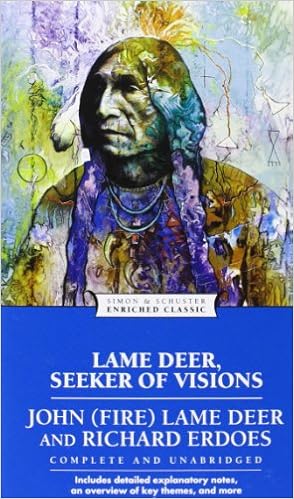
Lame Deer, Seeker of Visions Mass Market Paperback – Special Edition, 1 October 1994
by Richard Erdoes (Author)
4.8 out of 5 stars 308 rating
Enriched Classics offer readers accessible editions of great works of literature enhanced by helpful notes and commentary. Each book includes educational tools alongside the text, enabling students and readers alike to gain a deeper and more developed understanding of the writer and their work.
Storyteller, rebel, medicine man, Lame Deer was born almost a century ago on the Rosebud Reservation in South Dakota. A full-blooded Sioux, he was many things in the white man's world--rodeo clown, painter, prisoner. But, above all, he was a holy man. Lame Deer's story is one of a harsh youth and reckless manhood, a shotgun marriage and divorce, a history and folklore as rich today as when first published--and of his fierce struggle to keep his pride intact, living as a stranger in his own ancestral land.
===
Print length
352 pages
Product description
Review
Alvin M. Josephy, Jr., author of Indian Heritage of America Lame Deer is a magnificent American....He has demolished so much misinformation and so many stereotypes about Indians and their values and ways of life that we should be ashamed of how little we have actually known of all that he has to tell us. As an individual and as a representative of his people, he is someone whom all readers should get to know -- not just those who are interested in Indians, but every American. The book is destined to become a classic. It will be read, and reread, and quoted from through the years. Personally, I am enormously enriched by it.
Rober Brunett author of The Tortured Americans A masterpiece.
About the Author
Richard Erdoes is the author of more than twenty books, including Lame Deer: Seeker of Visions, and American Indian Myths and Legends. An Austrian-born historian, ethnographer, and artist, he has contributed to many publications, including the New York Times, Time, Life, Fortune, Smithsonian, and the Saturday Evening Post. He lives in New Mexico.
Product details
Publisher : Simon & Schuster; Enriched Classic ed. edition (1 October 1994)
Language : English
Mass Market Paperback : 352 pages
4.8 out of 5 stars 308 ratings
John Fire
Discover more of the author’s books, see similar authors, read author blogs, and more
See more on the author's page
Customer reviews
4.8 out of 5 stars
There are 0 reviews and 0 ratings from Australia
Top reviews from other countries

originalisa
5.0 out of 5 stars Lame Deer, medicine man of the Lakota tribe.Reviewed in the United Kingdom 🇬🇧 on 23 October 2015
Verified Purchase
Lame Deer (renamed John Fire by the invaders of his homeland) medicine man of the Lakota tribe. In this book we read about his observations and thoughts on modern Western culture and society.
An extract:
[우리의 백인 형제들이 우리를 문명화 시키려고 오기 전에는 우리에게는 감옥이 없었습니다. 그러므로 우리는 범죄자가 없었습니다. 감옥이 없으면 범죄자를 가질 수도 없습니다. 우리는 자물쇠 나 열쇠가 없었기 때문에 도둑도 없었습니다. 사람이 너무 가난해서 말, 티피 또는 담요가 없다면 누군가가 그에게 이런 것들을 주었답니다. 우리는 개인 소지품에 많은 가치를 부여하기에는 문명화되지 않았습니다. 우리는 물건을 나누어 주기 위해서만 갖고 싶었습니다. 우리는 돈이 없었기 때문에 사람의 가치를 측정 할 수 없었습니다. 우리는 서면 법과 변호사나 정치인도 없었으므로 속임수를 쓰지 못했습니다. 우리는 백인이 오기 전에는 문명 사회를 만들기 위해 절대적으로 필요하다고 생각되는 기본적인 것들이 없이 살아서 정말 힘들었다고 하는데, 어떻게 살아갔는지 정말 모르겠습니다.
Before our white brothers came to civilise us we had no jails. Therefore we had no criminals. You can’t have criminals without a jail. We had no locks or keys, and so we had no thieves. If a man was so poor that he had no horse, tipi or blanket, someone gave him these things. We were too uncivilised to set much value on personal belongings. We wanted to have things only in order to give them away. We had no money, and therefore a man’s worth couldn’t be measured by it. We had no written law, no attorney or politicians, therefore we couldn’t cheat. We were in a really bad way before the white man came, and I don’t know how we managed to get along without the basic things which, we are told, are absolutely necessary to make a civilised society.]
2 people found this helpfulReport abuse

Ainetheon
5.0 out of 5 stars Words from a wise old IndianReviewed in the United Kingdom 🇬🇧 on 1 October 2011
Verified Purchase
As I read this book I felt I was being taken along a journey by an old Indian. Here, in Lame Deer's book, we have an old Indian who is willing to take the reader on a journey of what it was like to be an Indian many years ago and how the values and skills known to this Native American race have been eroded through oppression and discrimination. This is not a book about self-pity or loathing or anger. In fact one gets the sense of a generous spirit who is trying to talk to and counsel humankind in the benefits of caring for the Earth that gives us life and sustenance. Lame Deer takes us on a journey that gives us glimpses of himself as he goes through his life. He makes no claims to being from a greater race or creed than anyone else but one gets the sense that spiritually he is far more advanced than the White Man who came to convert and 'civilise' the Red Man.
There is also humour throughout the book, Lame Deer's own individual sense of humour that is both generous and accommodating of difference. I have marked several passages in this book to go back to. I was going to write a few of them in here but I think the best thing I can do is to direct you to the book itself. It's worth reading, even if only to make friends with an old Indian.
Read less
3 people found this helpfulReport abuse
Charles
5.0 out of 5 stars The story of a true ShamanReviewed in the United Kingdom 🇬🇧 on 7 September 2010
Verified Purchase
I learned of this book through another Native American book and took the chance of ordering it - I was not disappointed.
This is a fascinating story of Lame Deers life and recollections told with natural humor. Throughout his story he tells of some of the history of his people told to him by eyewitnesses and who show a different history than that printed in the history books.
Some of the generals - such as Custer - were called hero's, whereas the 'marauding savages' he destroyed were actually groups of women, children and old men. His ruthless genocide lead to several tribes getting together with such great leaders as Crazy Horse, and the resulting battle at the Little Big Horn where - far from being his usual 'soft' target - Custer found himself in a real battle which he lost.
Lame Deer is one of the few 'True Blood' Shaman prepared to share his knowledge with non natives and the training he describes makes riveting reading and makes it difficult to put the book down.
2 people found this helpfulReport abuse

refugeewurzel
5.0 out of 5 stars This is a great readReviewed in the United Kingdom 🇬🇧 on 1 June 2013
Verified Purchase
I read the original print version on winter in Canada, it was a loan book was not keen to return it but a promise is a promise and this is a prize I understand someone wanting to keep. This mans story is a great insight into the culture clash and the disenfranchising intransigence of white supremis cultural imposition on the indigenous peoples of Turtle island. There is no mistaking the loss and desolation that affected the rose bud nation reserve and its catastrophic inheritance that visits the people even today. This mans life was full of the celebrations and knowledge of his people, their well being and a history that represented health.
A book of ambassadorial information and an honour to the first nation peoples and their ways. In spite of the injustices they were subjugated beneath. Put today strife into context, And offers insight rather than judgement for the people of the Rose bud nation.
Report abuse

SteveB.
5.0 out of 5 stars Remarkable Wonderful IncredibleReviewed in the United Kingdom 🇬🇧 on 11 April 2016
Verified Purchase
Enchanting, Amazing, Educational. This is an exceptional book. The content is enough to stretch your brain cells in its magnificence as well as being a high class piece of writing. The stories of a native culture struggling for survival against overwhelming odds is recounted with honesty and pride.
The faith and trust in the Great Spirit is so deep rooted that one can only cry for the lost civilisation and a way of life that was sinned against.
One person found this helpfulReport abuse
See all reviews
==

Want to Read
Rate this book
1 of 5 stars2 of 5 stars3 of 5 stars4 of 5 stars5 of 5 stars
Lame Deer, Seeker of Visions
by
John Fire Lame Deer,
Richard Erdoes
4.28 · Rating details · 1,835 ratings · 128 reviews
Lame Deer
Storyteller, rebel, medicine man, Lame Deer was born almost a century ago on the Rosebud Reservation in South Dakota. A full-blooded Sioux, he was many things in the white man's world -- rodeo clown, painter, prisioner. But, above all, he was a holy man of the Lakota tribe.
Seeker of Vision
The story he tells is one of harsh youth and reckless manhood, shotgun marriage and divorce, history and folklore as rich today as ever -- and of his fierce struggle to keep pride alive, though living as a stranger in his own ancestral land.(less)
GET A COPYKobo
Online Stores ▾
Book Links ▾
Paperback, Enriched Classic, 352 pages
Published October 1st 1994 by Simon Schuster (first published 1976)

Mar 17, 2012Robyn rated it it was amazing
Shelves: religion-and-spirituality, reviewed, old-faves
I've read a lot of mystically minded, "authentic" native american stories, and while I have enjoyed a lot of them, this one really hit me where it counts.
There's humor and wisdom and pain in this, but more interesting is what it doesn't have. Unlike many spiritually inclined texts, I don't get a feeling of... well... Smugness from Lame Deer. So many of the new age mystical texts I've read have this feeling, like "Well, this is just how the universe works, and I the author, must educate you poor souls about it. Now, you're not going to like hearing this, but this is the way things are, and if you don't believe me, then it's just because your puny unenlightened mind can't handle it. If you doubt me it's because you're too stupid to see a good thing..." etc etc. Then I picture the author sitting in front of the TV at home, eating a jar of marshmallow fluff and scoffing at all the unenlightened souls, and feeling so freaking proud of saving them.
Maybe that's a bit cynical of me. Ah, well.
The point is, I have no doubt that Lamedeer walks the walk. Something about the way this book is written, it just oozes authenticity. He tells us every thing about his life, the times he was victimized as well as the times he was wrong. He doesn't glorify all of his own actions, nor does he apologize for them. This has always felt real to me, and manages to be spiritual without being new-agey and fake feeling.
If you're having any kind of spiritual uncertainty or crisis, this is probably one of the best things anyone could suggest to you. Read it. (less)
flag18 likes · Like · comment · see review

Jul 31, 2013Erin Moore rated it it was amazing
To me, this summarizes Lame Deer's narrative:
"You've seen me drunk and broke. You've heard me curse or tell a dirty joke. You know I'm not better and wiser than other men. But I've been up on the hilltop, got my vision and power; the rest is just trimmings."
I was raised Catholic, and I didn't realize how much I still looked back on that upbringing until reading this book and thinking "THIS is what a priest should be like." Any one who hasn't walked the dark side, who hasn't questioned their existence, doesn't deserve to educate people on spiritual matters.
But John Lame Deer is more than a simple seer. He explains the narrative of his people and their history with the white man in eloquent but simple language. His lack of drama makes the words even more tragic in telling, and I dare anyone not to be moved by the plight of the Indians, both in the past and now.
He clearly recognizes the challenges ahead of his people - and the white man's. But he is positive and upbeat and funny throughout the book, even while delivering some deep messages about life and spirituality.
"Insight does not come cheaply, and we want no angel or saint to gain it for us and give it to us secondhand."
Amen.
(less)
flag14 likes · Like · 1 comment · see review

Apr 13, 2008Matt rated it it was amazing
Shelves: non-fiction
I can not recommend this book highly enough. As someone from a predominantly (and proudly) american indian family it helped me come to terms with a lot of the things I've always felt in my life that have led to me making somewhat self-defeating choices. I don't want to make it sound like this is some sort of self-help bullshit. Becuase it's not. It's an un-apologetic autobiography of a man (and his people) who is displaced from his culture and forced to adopt a new (more destructive, angry and ultimately doomed) one by force.
I'm just saying it helped me realize that the way I feel--have always felt--is often completely at odds to the civilization I'm living in and that I'm not a weirdo for feeling this way.
Even if you ignore all of the information pertaining to that, it's still a really good, informative, and often dryly humorous look at growing up indian in a white world. (less)
flag8 likes · Like · 1 comment · see review

Jan 10, 2009Mark rated it it was amazing
I was skeptical at first with this book. I read a lot of Native American legend and trickster tales, histories and so forth. I had always lumped this one in with the " Mystical Indian" books that surround the gems I had come to find over the years. This became one of those gems. It was refreshing to see it was not some hokum over a shaman, but a book about a man growing up in the early 20th century and finding his voice among many, as well as a voice in his society. He reminds me of how my grandfather was, whihc made me appreciate the book that much more. A person that I am not sure exists anymore today...but one that is sorely missed. (less)
flag5 likes · Like · comment · see review

May 10, 2013Nancy Bevilaqua rated it really liked it
I have a Lakota friend (he's full-blooded, although he likes to say that he's 5/4 Lakota) who lives just off one of the reservations in South Dakota (housing on the reservations is apparently in short supply these days). Lame Deer, Seeker of Visions would probably send him off the deep end (I'm not sure if he's read it or not). He is adamantly against the "romanticization" of his people and their culture, particularly (and he is certainly not alone in this among other Lakota with whom I've spoken) when it's presented through a "wasicu" (a not particularly flattering term for white guys) lens. He's also very concerned that the Lakota language, as it was spoken before the arrival of the Europeans, is becoming anglicized by young Lakota and "wannabes" (an even less flattering term). (One example of the latter in the book is someone's use of the phrase "hinhanni waste"--very literally "good morning". It's not, he says, a phrase that would ever be used in "real" Lakota.) Quite understandably, he and others are very cagey about revealing details of native traditions and spiritual world-view to wasicu, no matter how well-meaning they may be.
So it was to some extent with my friend's slant on the subject influencing me that I read Lame Deer, Seeker of Visions. However, the book is beautifully written (although I couldn't help but think that much of Lame Deer's words were paraphrased by Richard Erdoes, who "co-wrote" the book, and that some liberties may have been taken). And the world-view/spiritual vision that it presents--regardless of whether it is entirely or authentically Lakota and not the product of some of that romanticization, and inadvertent though it may be--is very appealing to me. Very often I would read passages and say, "YES!" I am of the opinion these days that the source of certain ways of perceiving and being in the world is very often irrelevant, as long as the outcome is positive and compassionate, although mine may be the minority opinion.
John (Fire) Lame Deer is a very appealing character, particularly as he relates his bad-ass younger days. He's funny and irreverent and insightful, and happy to describe what he sees as his own shortcomings. He almost never comes off as a one-dimensional cliche of a "noble Indian". Probably because of my Lakota friends' influences, I was fully prepared to dismiss Richard Erdoes as a "wannabe wasicu", yet when I came to his epilogue at the end of the book I found him likable, credible, and interesting on his own terms as well. I don't know if Lame Deer, Seeker of Visions is entirely true to Lakota culture as it is practiced by the Lakota themselves, but I do believe that Erdoes has made a sincere, good-faith effort to transmit what he learned from his Indian friends as faithfully as a white guy could manage. (less)
flag4 likes · Like · comment · see review

May 09, 2011Nick rated it it was amazing
I think I have wound up reading this book 6 times. Lame Deer is one of the few people whose social, economic and political criticisms are not purely ideologically or politically driven. This is one of the few books that will force you to bend your mind in a new way. No, this is not a complex Continental philosophy tract. This is something better. Lame Deer makes no pretense to be an intellectual. This book is about how a dying Lakota shaman sees the world. You can accept or reject Lame Deer's social critique on the merits of his education, but you can't reject them on the basis of ideology or interest. (less)
flag3 likes · Like · comment · see review

Jul 19, 2020Matthew rated it it was amazing · review of another edition
Shelves: biography-and-memoir
To say that American Indians are stuck between two worlds is, at this point, something of a tired cliché, but in order to increase our understanding, it's a cliché that Lame Deer invokes. On one hand, Lame Deer is a rebel and a rogue, an ex-con, a thief, a womanizer, a partisan to the Black Panthers-inspired American Indian Movement, a dirty old man who likes to make white people squirm with occasional provocative comments about Indians eating dogs and suchlike. On the other, he is a cleric; he has reams of Lakota mythology memorized in great detail, he professes to have powers of healing, he receives visions and hallucinations and treats them with prophetic reverence, and he believes that somewhere in the sky is the domain of the Wakinyan, the Thunderbeings, great and terrible birds which guide all the actions of men on Earth.
There is no contradiction between these two parts of Lame Deer. He says, after all, that a holy man has to appreciate all aspects of life in order to commune with people from all walks of life.
One also gets the impression that Lame Deer's faith is itself an act of protest and dissent. If the Lakota stop practicing their religion, it will simply disappear; there are far too few of them, and far too many forces arrayed against them for them to say, “okay, you win, you've twisted my arm and I won't practice this anymore.”
The largess of Lakota cultural history as shared by Lame Deer is wonderful food for thought. You're enthralled when you read of the Heyoka, a strange combination of village idiot and court jester who receives a dream-vision to behave foolishly, antisocially, satirically, in opposition to sense and sobriety and order, a kind of holy fool who will go out stark nude in a blizzard and complain that it's too hot, or will take a hammer to a hillside in an attempt to flatten it out. Lame Deer calls this kind of person a “two-faced, backwards-forwards, upside-down, contrary fool,” yet also powerfully states that “He has the power. He has the honor. He has the shame. He pays for it all.” Such is the ironic burden of the Heyoka.
There's also the Winkte, who's thought by the Lakota be to a man with a woman's spirit, who behaves and dresses like a woman. A Winkte is born when a male twin and a female twin combine in the womb into one child. The Winkte is thought to have powers of prophecy; all kinds of Lakota come to the Winkte for advice and divination. Newborn children are brought to the Winkte to be given secret names; Sitting Bull and Crazy Horse had names given to them by Winkte that very few people knew.
Yet the best writing in this book has to do with Lame Deer's young adulthood in the 1920s and 30s. He was a hellraiser, full of virility and righteous anger. He loved to sleep with the wives of white men, as a small revenge against them (“guarding an unwilling girl,” he would say to these cuckolded husbands, “is like watching a sockful of fleas: hopeless.”) He drank hard and it would get him into trouble, such as on one crazy weekend, when he went on a long spree hiding from the police after a series of botched car thefts (this chapter is the best in the book, and one of the best things I'll read in a book all year). He was a drifter and held a series of strange, dead-end jobs, including work as a rodeo clown, a cop, a soldier, and a shepherd who, believe it or not, had to watch over a flock of sheep who were bred to be so helplessly dependent on the white man that they would fall on their backs and die if there was no one there to put them rightside up.
Sensing innately that his right to be an Indian was being taken away from him, feeling forced to enter a white world that didn't care if he lived or died, Lame Deer puts it better than I ever could:
“I didn't need a house then, or a pasture. Somewhere there would be a cave, a crack in the rocks, where I could hole up during a rain. I wanted the plants and the stones to tell me their secrets. I talked to them. I roamed. I was like a part of the earth. Everything was taken from me except myself. Now and then, in some place or other, I looked at my face in a mirror to remind myself who I was. Poverty, hardship, laughter, shame, adventure-- I wanted to experience them all. At times I felt like one of those modern declawed cats, like a lone coyote with traps, poisoned meat, and a ranger's gun waiting for him, but this did not worry me. I was neither happy nor sad. I just was.”
This book was first published in 1972, and the hippies and intellectuals of that era probably identified with Lame Deer's free-spiritedness, his counterculturalism, his wandering, the uncertainty of his fate. He died in 1976. He must've been heartened to see the advancements of the young person's American Indian Movement, but I hope he also took pride in this candid book, which chronicled not only his brave life well-lived, but what he knew of the Lakota he loved. The Lakota, and others, for he writes...
"It is a good thing for Indians to look upon all Indian religions as a common treasure house, as something that binds us together in our outlook toward nature, towards ourselves, making us one, no longer just Sioux, Cheyennes, Navajos, Pueblos, Iroquois, Haidas, but something much bigger, grander-- Indians." (less)
flag2 likes · Like · comment · see review

Apr 25, 2022Dominick Vukic rated it it was amazing
Shelves: најдраже
what a journey it’s been with this book. i have no words to say other than that i’m gonna truly remember the period of my life when these stories and lessons were by my side.
flag2 likes · Like · comment · see review

Dec 22, 2018Jeff rated it it was amazing
I am an atheist. To be more specific, though, I am an anti-colonialism atheist. That's different. This book was recommended to me by a dear Buddhist friend as an alternative to Western Religion and Spirituality. It was a fantastic recommendation.
Many reviews of this book comment on how authentic and humorous and accessible these stories are. They are very rich in insight into life and the world in general. They reveal so much about the differences between the Lakota Way of Life and the typical settler colonial (that means us white people) way of life here under US Capitalism.
Lame Deer's life story spans from the Model T Ford to the Vietnam War. He doesn't try to sanctify himself. He stresses that a Lakota Medicine Man has to experience all of life--what it's like to be good and what it's like to be bad--and he tells it all. It is a fun story.
There was much to inspire me and to learn from, like the practice of giving possessions away to honor a birth or a wedding or a funeral. The Lakota do not purchase presents on these occasions like we do during Christmas shopping season. The family gives away their own personal possessions--the more things given away, the more honored are those who are being celebrated. Sometimes the family is so moved to give away all their things--tables, chairs, beds, everything, until their house is empty. Of course, this becomes an occasion for the folks of their village to meet their needs in return by giving them their possessions. What an amazing tradition! That is just one example. This book is a treasure trove.
Also there were stories and beliefs that challenged me as an atheist. One example is his claim that Medicine Men can influence the weather. I appreciated the insights he gave into why they believe this. I feel no need to pass judgment one way or the other. I have grown accustomed to accepting the weather as one of those things that cannot be controlled. I see no reason for me to change now. Of course, Lame Deer wasn't asking me to believe him. He certainly wasn't expecting me to try to influence the weather. He was merely describing the way of a Lakota Medicine Man. I respect and appreciate that.
Lame Deer was not reluctant to point out that sometimes the medicine just doesn't work. This is no slight against the power of the Medicine Man. Since they did not take money for their services, there is no ill will when it doesn't work. But if a Lakota person pretends to have had a vision calling them to be a Medicine Man when in reality they had not, that always ends badly, he says, bringing shame to the individual and to their family.
I was intrigued by how significant the role of dreams and visions is for the Lakota. He speaks extensively about the importance of extreme hunger, thirst, pain, bodily mutilation, light deprivation, heat and cold in evoking such visions. He sharply contrasts the quality of visions procured "the old way" with visions experienced under the influence of drugs or even peyote.
This was the first book I have read by Lakota Medicine Man. It is certainly the most detailed account I have read of Indigenous life by an Indigenous narrator. Lame Deer's warm and trusting relationship with Richard Erdoes, his Austrian amanuensis, comes through strongly and adds a great deal of warmth to the joy of reading this delightful little volume. It also conveys the hope that the devastating wounds of settler-colonialism can be healed, if we White people could only humble ourselves enough to admit the terrible reality that allows us to live here.
Every USA resident should read something by an Indigenous author. I recommend this book highly. Thank you, Anita Fix, for sharing it with me. We do need a fix for this broken world. LAME DEER SEEKER OF VISIONS offers an insight into what that might look like. (less)
flag2 likes · Like · comment · see review

Jan 16, 2012Ainetheon rated it it was amazing
Shelves: native-american
As I read this book I felt I was being taken along a journey by an old Indian. Not the grumpy old Indian, One Feather, whom I met on my only successful meditation. For a long time I have wondered about the connectedness I feel inside with the Native American Indian. I've never had the desire to visit America (although I am slowly changing my mind - I guess that's allowed). Strange that I have never wanted to see the country a (real live self-confessed) witch on the Isle of Man told me that had some connection for me. What she said was that there was someone over there who will be important to me or will have some strong meaning in my life. I can't remember exactly the words she used (I was 18 at the time - long time ago!). However that does not belong to this entry.
So here, in Lame Deer's book, we have an old Indian who is willing to take the reader on a journey of what it was like to be an Indian many years ago and how the values and skills known to this Native American race have been eroded through oppression and discrimination. This is not a book about self-pity or loathing or anger. In fact one gets the sense of a generous spirit who is trying to talk to and counsel humankind in the benefits of caring for the Earth that gives us life and sustenance. Lame Deer takes us on a journey that gives us glimpses of himself as he goes through his life. He makes no claims to being from a greater race or creed than anyone else but one gets the sense that spiritually he is far more advanced than the White Man who came to convert and 'civilise' the Red Man.
There is also humour throughout the book, Lame Deer's own individual sense of humour that is both generous and accommodating of difference. I have marked several passages in this book to go back to. I was going to write a few of them in here but I think the best thing I can do is to direct you to the book itself. It's worth reading, even if only to make friends with an old Indian.
(less)
flag2 likes · Like · comment · see review

Nov 06, 2007Jason rated it really liked it
Lame Deer was many things in his life. He was an outlaw, lawman, rodeo clown, and Indian medicine man. At a later point in his life Lame Deer came to meet an artist living in NY named Richard Erdoes. The men decided to collaborate together to write a book about the life of Lame Deer. Lame Deer himself was a Sioux medicine man trained in the ways of the old ones. This book is gripping and humorous. The first part recounts many funny personal stories about Lame Deer's life and his run-ins with the law, his personal feelings about the present state of the US, and his own thoughts about what it means to be an Indian. The latter part of the book focuses on ceremonies like the sundance, sweatlodge gatherings and also discussion about the sacred pipe. Lame Deer explains how important symbolism is to the Indian and also explains a good deal of Indian mythology in the latter part of the book which helps the average reader get inside the minds of these people and their beliefs. Throughout this book the reader will come to develop an emotional affinity with Lame Deer. You find yourself feeling how he does about pollution, broken promises, and disregard for sacred beliefs. It's very compelling. Sadly, we are also told much about how Indians faired badly at the hands of white guns, diseases and white "instant gratification" attitudes. I don't think the book was perfect because Erdoes was not an actual writer at the time although he did a decent job putting the book in literary form. I suppose he should at least be lauded for helping us to interpret Indian mysteries. My only major gripe about this book was that it wasn't longer. (less)
flag2 likes · Like · comment · see review

Sep 12, 2018Lindsey Smith rated it liked it
This book was eye opening and thought provoking, though I did not particularly enjoy it. While I understand and sympathize with the points the narrator makes about the sad and tragic history of the Lakota people, his point of view feels narrow and unfair at times. An interesting read, though more for facts and understanding rather than personal enjoyment.
flag2 likes · Like · comment · see review

May 05, 2019Alina rated it it was amazing
Shelves: philosophy
This book was a pleasure to read, and leaves a deep impression, which I hope will stay. In the form of storytelling, Lame Deer conveys an outline of Sioux philosophy. This medium for philosophy allows readers to viscerally feel certain principles of Sioux philosophy and to be able to view their own lives, transformed, in terms of those principles. Particularly, Lame Deer shows that symbols, or the meanings that objects hold for us, determine the possible ways we can live and become. It is very s ...more
flag1 like · Like · comment · see review

Mar 22, 2015Richard Reese rated it it was amazing
Tahca Ushte (Lame Deer) was a Lakota medicine man from a land now known as South Dakota (“Sioux” is a white name that insults the Lakota). His government-issued name was John Fire. He was born some time between 1895 and 1903, and died in 1976. His parents were of the last generation to be born wild and free. Two of his grandfathers had been at the battle of Little Big Horn, Custer’s last stand, and one of them survived the massacre at Wounded Knee.
Lame Deer’s early years were spent in a remote location, where they had no contact with the outside world. He never saw a white man until he was five. At 14, he was taken away to a boarding school, where he was prohibited from speaking his language or singing his songs. The class work never went beyond the level of third grade, so Lame Deer spent six years in the third grade. He eventually gained renown for being a rebellious troublemaker. When he was 16, he went on a vision quest, and discovered that he was to become a medicine man.
Sons destined to become medicine men were often removed from school by their families, because schooling was harmful to the growth of someone walking a spiritual path. One father drove away truancy officers with a shotgun. For medicine men, the skills of reading and writing had absolutely no value.
When Lame Deer was 17, his mother died, and the family fell apart. The white world was closing in, making it hard for his father to survive as a rancher. He gave his children some livestock and wished them good luck. By that time, the buffalo were dead, their land was gone, many lived on reservations, and the good old days for the Lakota were behind them.
Lame Deer straddled two worlds, the sacred path of Lakota tradition, and the pure madness of the “frog-skinners” — people who were driven by an insatiable hunger for green frog-skins (dollar bills). The frog-skinners were bred to be consumers, not human beings, so they were not enjoyable company.
Lame Deer spent maybe 20 years wandering. He made money as a rodeo rider, clown, square dance caller, potato picker, shepherd, and so on. He always avoided work in factories or offices, “because any human being is too good for that kind of no-life, even white people.” He enjoyed many women, did more than a little drinking, stole a few cars, and shunned the conventional civilized life.
Between jobs he would return to his reservation and spend time with the elders. During World War II, just before Normandy, he was thrown out of the Army when they discovered that he was 39, too old. Soon after, he abandoned the frog-skin world and became a full time Indian, walking on the sacred path of a medicine man.
For the Lakota, the Black Hills were the most sacred place in their world. To retain possession of them, they surrendered much of what became Montana, Wyoming, and the Dakotas. The treaty declared that the Black Hills would remain Indian territory “for as long as the sun shined.” Soon after, whites discovered gold in the Black Hills, and flooded into the holy lands with drills, dynamite, whiskey, and prostitutes. The Lakota were horrified by the behavior of these civilized Christians.
The frog-skinners exterminated the buffalo, and replaced them with imported livestock. Buffalo were beings of great power and intelligence. They even had a sense of humor. Lame Deer said that if buffalo were used in bullfighting, the cocky matadors would promptly be trampled and gored into extinction. Cattle were dullards that had the power bred out of them. Sheep and goats would stand calmly while you cut their throats.
To provide additional vegetation for the dim-witted livestock, the prairie dogs had to go. Ranchers launched an intensive poisoning campaign that also killed more than a few children and pets. With the prairie dogs gone, there was far less prey for the wolves, coyotes, bobcats, foxes, badgers, hawks, and eagles. A diverse, thriving prairie ecosystem was replaced with monocultures of destructive sub-intelligent exotic species.
Sheep were amazingly frail. They often fell over, with their feet in the air, and couldn’t get back up again. If the shepherd didn’t rescue them, they would bloat up and die. Lambs often had to be hand-raised because their mothers didn’t recognize them or feed them.
“There was great power in a wolf, even in a coyote. You have made him into a freak — a toy poodle, a Pekingese, a lap dog. … You have not only altered, declawed, and malformed your winged and four-legged cousins; you have done it to yourselves. … You live in prisons which you have built for yourselves, calling them homes, offices, factories.”
In the 1880s, the Indians of the west were in despair, and the Ghost Dance movement was spreading from tribe to tribe. It was a grand magic act intended to bring a new world into existence via sacred song and dance. The dead would come back to life, the buffalo herds would return, the whites would get sent back home, and the civilized world would be rolled up like a dirty old carpet — the cities, mines, farms, and factories. This would reveal a healthy unspoiled land, with many teepees and animals, as it once had been.
Dancers were not allowed to possess things from the white world: liquor, guns, knives, kettles, or metal ornaments. They would dance for four days. Whites feared an armed uprising, so they attacked the dancers. Hundreds of unarmed Indians were murdered at the Wounded Knee massacre.
The magic dancing did not succeed, but today many can see that a great healing is badly needed. Obviously, the devastating madness cannot continue forever. Lame Deer was clear: “The machine will stop.” He said that one day, before the end of the century, a young man would come who would know how to turn it off. “It won’t be bad, doing without many things you are now used to, things taken out of the earth and wasted foolishly.” We will have to learn how to live more simply, and this will be good for one and all.
Lame Deer asked Richard Erdoes to help write his story, to pass along important information. He included several chapters describing the sacred culture of the Lakota. He wanted hold up a mirror for us, to give us a different perspective, to feed a sane voice into our lost and confused world. “We must try to save the white man from himself. This can be done if only all of us, Indians and non-Indians alike, can once again see ourselves as part of this earth.”
(less)
flag1 like · Like · comment · see review

Jul 24, 2018Kevin rated it really liked it · review of another edition
I college theology I only read the chapters that were going to be on the test. Some of the religious element fades into the background when the work is taken as a whole. Still, it's funny, infuriating, and thought-provoking. (less)
flag1 like · Like · comment · see review

Sep 29, 2019Helena rated it really liked it
A fascinating story indeed!
https://helenaroth.com/lame-deer-seek... (less)
flag1 like · Like · comment · see review

Aug 25, 2014Stefan Emunds rated it it was amazing
Lame Deer, Seeker of Visions by Richard Erdoes and John (Fire) Lame Deer is a great example of Visionary Fiction with the sub-genre autobiography, like the books of Carlos Castaneda.
The Lakota, John Lame Deer, tells key stories of his life and makes fun of the white man’s culture. To put this into perspective, John was born at the end of the 19th century, meaning his parents fought in the American Indian Wars that ended around 1890.
Particularly interesting for Visionary Fiction fans, John details how he sought enlightenment. Enlightenment comes to us in a series of revelations or visions and John was an active seeker.
John had his first vision when he was sixteen. His medicine man took him to a vision pit in the wilderness, where John remained for four days and nights without food and water. The Great Spirit granted him a vision, which earned him his adult name Lame Deer and confirmed his heart’s desire - to become a medicine man.
John had a turbulent life. He worked as a shepherd, a potato picker, a rodeo clown, a square dance caller, a painter, and a medicine man. He joined the army and even went to jail for a while. He reminds me of the prophets of the Old Testament, who were vision seekers too, and, like John, no saints. Abraham disowned his wife, Ham committed incest, Elisha summoned two bears to maul kids that mocked his bald head, David killed Uriah because he wanted to bed Uriah’s wife Bathsheba, and Solomon was a fornicator of a thousand women. Still, God granted them visions and accomplished great things with them.
John also sought visions also through hallucinogens - by partaking in the Peyote religion. What follows, is an account of a vision of the oneness of life that John experienced during a Yuwipi ceremony. Quote:
Imagine darkness so intense and so complete that it is almost solid, flowing around you like ink, covering you like a velvet blanket. A blackness which cuts you off from the everyday world, which forces you to withdraw deep into yourself, which makes you see with your heart instead of with your eyes. You can’t see, but your eyes are opened.You are isolated, but you know that you are part of the Great Spirit, united with all living beings. – Page 191
Peyote plays a great role in Carlos Castaneda’s books too, but, as Carlos pointed out, drugs are only a means of inducing a first vision, which establishes the fact that there are other realities. From there on, it is hard enlightenment work. John agrees. Quote:
I mistrust visions come by in the easy way - by swallowing something. The real insight, the great ecstasy does not come from this. … To my thinking that’s part of the white man’s “instant” culture. Peyote is a natural part of the religion of many Indian tribes. At the core of all Indian beliefs are visions gotten in various ways. The Christian and Jewish religion, the great religions of the East, are based on the same thing, only white people have forgotten this. - Page 228
Visions can be had on many levels and some levels are treacherous. The seeker needs to verify visions with enlightenment principles. For the same reason, he needs to go to a medicine man or guru to have his vision dream interpreted. The Ghost Dance is a good example. Quote:
Eighty years ago our people danced the Ghost Dance, singing and dancing until they dropped from exhaustion, swooning, fainting, seeing visions. - Page 124
According to John, many dancers saw the dead coming back to life, the buffalo herds returning, the white men sent back home, and the civilized world rolled up like a dirty old carpet. Nah, that didn’t happen. These visions were astral projections at best, and wishful hallucination at worst.
A true Lakota, John pursued visions the hard way. We’re talking Sun Dance now. Quote:
Staring open-eyed at the blazing sun, the blinding rays burning deep into your skull, filling it with unbearable brightness…
Blowing an eagle-bone whistle clenched between your teeth unto its shrill sound becomes the only sound in the world…
Dancing, dancing, dancing from morning to night without food or water until you are close to dropping in a dead faint…
Pulling, pulling away at a rawhide thong which is fastened to a skewer embedded deeply in your flesh, until your skin stretches and rips apart as you finally break free with blood streaming down your chest…
This is what some of us must endure during the sun dance. – Page 208
Lame Deer, Seeker of Visions, was one of my favorite teenage books. I even found myself a vision pit in the forest, but I didn’t last more than a night. Neither did I have a vision. For that reason, I envied John for being a Native American and having a talent for visions, until I came across vision seekers of my own, white folk. (less)
flag2 likes · Like · comment · see review
Feb 20, 2018Bob Newman rated it really liked it
Shelves: native-americans, biography
The life and philosophy of a wise man
I once lived on the Yakima Reservation for a couple weeks, back in 1964. This constituted my entire experience with Native Americans until thirty years later I met a few Navajo and Pueblo people on a trip to the Southwest. So even though I worked as an anthropologist for many years, I had absolutely zip to do with Native Americans. I was aware that there is a huge amount of junk written and shown in movies about them; that they have been either lionized or demonized out of all proportion in America and in the world beyond. I always felt that "ethnic cleansing" was not invented in the Balkans. Only when such writers as Silko, Momaday, Alexie, and Erdrich emerged did I discover the other world of the Indian people, only the film "Smoke Signals" rang true to me. So, I wasn't sure, when I picked up LAME DEER: SEEKER OF VISIONS, co-authored by John (Fire) Lame Deer and Richard Erdoes, whether I was getting some kind of phony, "awesome-dude !" worshipful portrait of a Lakota "medicine man" or not.
Not to keep you waiting any longer---this is a wonderful book on several levels. First, it contains the life story of Lame Deer, a Lakota man born in South Dakota in 1903 at the absolute nadir of Lakota history. It tells how he grew up, surviving relentless hostility by local whites, went through many ways of life, had numerous escapades, and finally turned towards the traditional wisdom of his people, becoming a wise elder, knowledgeable in many aspects of life. He has that wry Indian humor, so different a personality to what was always presented by Hollywood. Nobody can read this book and not be impressed by this man. The second level of this book is that it presents Lakota culture from the point of view of a Lakota steeped in it over many decades, not the interpretation of it by an outside scholar. You will find chapters on the sacred sweat bath, on the holy pipes of red stone, on the meaningful symbols, on the yuwipi ceremony, the sun dance, the peyote church which came from elsewhere, the heyoka (sacred clowns) and more. Lame Deer wanted to tell the world about Lakota ways and get this all written down to preserve it for the generations to come of his own people. On a third level, this book reflects a very attractive cooperation between two people from backgrounds that could not have been more different: a Lakota man from the prairies of South Dakota and a Vienna-born refugee from Nazism, an Austro-Hungarian in the true sense of that multi-cultural empire. Richard Erdoes only introduces himself at the end; Lame Deer talks throughout the whole book.
The editing and proofreading could have been tighter in my 1972 edition-a lot of passages appear twice or more, for example-and that's why I gave this book four stars, but it is a five star book for students who want to read about the inside view of the world of another culture, it is a five star book for someone particularly interested in knowing Lakota culture and thought, and for anyone who still thinks that Indians were or are "primitive" people. This is a book that speaks to the common humanity of all of us under the four corners of the sky. (less)
flag1 like · Like · comment · see review

Aug 07, 2021Kim rated it really liked it
Quotes:
Why do Indians drink? They drink to forget, I think, to forget the great days when this land was ours and when it was beautiful, without highways, billboards, fences and factories. They try to forget the pitiful shacks and rusting trailers which are their "homes". They try to forget that they are treated like children, not like grown-up people. In those new O.E.O. houses-instant slums I call them, because they fall apart even before they are finished-you can't have a visitor after ten o'clock, or have a relative staying overnight. We are even told what color we must paint them and what kind of curtains we must put up. Nor are we allowed to have our own money to spend as we see fit. So we drink because we are minors, not men. We try to forget that even our fenced-in reservations no longer belong to us. We have to lease them to white ranchers who fatten their cattle, and themselves, on our land. At Pine Ridge less than one per cent of the land is worked by Indians.
We drink to forget that we are beggars, living on handouts, eight different kinds of handouts...The mothers get more money by kicking their husbands out..."We'd rather have the money than him." In my town close to forty girls live that way.
We drink to forget that there is nothing worthwhile for a man to do, nothing that would bring honor or make him feel good inside. There are only a handful of jobs for a few thousand people. These are all Government jobs, tribal or federal. You have to be a good house Indian, or Uncle Tomahawk, a real apple-red outside, white inside-to get a job like this. You have to behave yourself, and never talk back, to keep it. If you have such a job, you drink to forget what kind of person it has made of you. If you don't have it, you drink because there's nothing to look forward to but a few weeks of spud-picking, if you are lucky. You drink because you don't live; you just exist. That may be enough for some people; it's not enough for us. (77)
A medicine man shouldn't be a saint. He should experience and feel all the ups and downs, the despair and joy, the magic and the reality, the courage and the fear, of his people. He should be able to sink as low as a bug, or soar as high as an eagle. Unless he can experience both, he is no good as a medicine man.
Sickness, jail, poverty, getting drunk-I had to experience all that myself. Sinning makes the world go round. You can't be so stuck up, so inhuman that you want to be pure, your soul wrapped up in a plastic bag, all the time. You have to be God and the devil, both of them. Being a good medicine man means being right in the midst of the turmoil, not shielding yourself from it. It means experiencing life in all its phases. It means not being afraid of cutting up and playing the fool now and then. That's sacred too.
Nature, the Great Spirit-they are not perfect. The world couldn't stand that perfection. The spirit has a good side and a bad side. Sometimes the bad side gives me more knowledge than the good side. (79)
More and more animals are dying out. The animals which the Great Spirit put here, they must go. The man-made animals are allowed to stay-at least until they are shipped out to be butchered. That terrible arrogance of the white man, making himself something more than God, more than nature, saying, "I will let this animal live, because it makes money"; saying "This animal must go, it brings no income, the space it occupies can be used in a better way. The only good coyote is a dead coyote." They are treating coyotes almost as badly as they used to treat Indians.
You are spreading death, buying and selling death...but you are afraid of its reality; you don't want to face up to it. You have sanitized death, put it under the rug, robbed it of its honor. But we Indians think a lot about death. I do. Today would be a perfect day to die-not too hot, not too cool. A day for a lucky man to come to the end of his trail. (123)
The wicasa wakan wants to be by himself. He wants to be away from the crowd, from everyday matters. He likes to meditate, leaning against a tree or rock, feeling the earth move beneath him, feeling the weight of that big flaming sky upon him. That way he can figure things out. Closing his eyes, he sees many things clearly. What you see with your eyes shut is what counts.
The wicasa wakan loves the silence, wrapping it around himself like a blanket-a loud silence with a voice like thunder which tells him of many things... He sits facing the west, asking for help. He talks to the plants and they answer him. He listens to the voices of the wama kaskan-all those who move upon the earth, the animals. He is one of them. From all living beings something flows into him all the time, and something flows from him. I don't know where or what, but it's there. I know.
This kind of medicine man is neither good or bad. He lives-and that's it, that's enough. White people pay a preacher to be "good", to behave himself in public, to wear a collar, to keep away from a certain kind of women. But nobody pays an Indian medicine man to be good, to behave himself and act respectable. The wicasa wakan just acts like himself. He has been given the freedom-the freedom of a tree or a bird. The freedom can be beautiful or ugly; it doesn't matter much. (155)
As I get older I do less and less curing and ceremonies and more and more thinking. I pass from one stage to another, trying to get a little higher up, praying for enough gas to make it up there.
I haven't told you all I know about the herbs and about the ways of our holy men. You understand that there are certain things one should not talk about, things that must remain hidden. If all was told, supposing there lived a person who could tell all, there would be no mysteries left, and that would be very bad. Man cannot live without mystery. He has a great need for it. (173)
Some white men shudder when I tell them these things. Yet the idea of enduring pain so that others may live should not strike you as strange. Do you not in your churches pray to one who is "pierced," nailed to a cross for the sake of his people? No Indian ever called a white man uncivilized for his beliefs or forbade him to worship as he pleased.
The difference between the white man and us is this: You believe in the redeeming powers of suffering, if this suffering was done by somebody else, far away, two thousand years ago. We believe that it is up to every one of us to help each other, even through the pain of our bodies. Pain to us is not "abstract," but very real. We do not lay this burden onto our god, nor do we want to miss being face to face with the spirit power. It is when we are fasting on the hilltop, or tearing our flesh at the sun dance, that we experience the sudden insight, come closest to the mind of the Great Spirit. Insight does not come cheaply, and we want no angel or saint to gain it for us and give it to us secondhand. (207)
But one thing is certain-desire killed that man, as desire has killed many before and after him. If this earth should ever be destroyed, it will be by desire, by the lust of pleasure and self-gratification, by greed for the green frog skin, by people who are mindful only of their own self, forgetting about the wants of others. (252)
When the buffalo disappeared, the old, wild Indian disappeared too. There are places set aside for a few surviving buffalo herds in the Dakotas, Wyoming and Montana. There they are watched over by Government rangers and stared at by tourists. If brother buffalo could talk he would say, "They put me on a reservation like the Indians." In life and death we and the buffalo have always shared the same fate. (255)
And so the last thing I can teach you, if you want to be taught by an old man living in a dilapidated shack, a man who went to the third grade for eight years, is this prayer, which I use when I am crying for a vision:
"Wakan Tanka, Tunkashila, onshimala...Grandfather Spirit, pity me, so that my people may live." (266) (less)
flagLike · comment · see review

Jun 03, 2013Jake The added it
Tahce Ushte is the main character in this story. He is a full-blooded Sioux indian. He is 72 years old. His name means John Lame Deer in indian. He has many useful attributes. This is a story about a man that wanted to represent native americans through speech and writing. He is a very diverse man. Has many talents and the main one he wanted to pursue was writing. Especially about his people. Throughout his life he met a man and they together wrote a book about Lame deers life story. It is a great story about a man pursuiung his dreams and going through with it. (less)
flag1 like · Like · comment · see review
Nov 11, 2017Pedro rated it it was ok
A series of anecdotes detailing the life of the Lakota Sioux medicine man Lame Deer and the rituals and beliefs of his people. He belongs to that generation that helped keep the tribe's customs alive from those particularly dark days after the conquest to the dawn of the modern Indian rights movement. The book really doesn't do much for me. It's informative and Lame Deer comes of as a decent guy, but I just found it rather dull. ...more
flag1 like · Like · comment · see review
Mar 20, 2016Jim rated it liked it
Shelves: biography, native-american
This book is about the life and times of John (Fire) Lame Deer, a Lakota holy man. It is based on talks and visits that Richard Erdoes had with Lame Deer, so it is a recorded oral history consisting of memories, experiences, observations of white culture, etc. My only complaint is that it rambles in places.
flag1 like · Like · comment · see review

May 07, 2012David McDannald rated it it was amazing
A classic. Lame Deer had a foot in the old world, and his insights into the modern world are humorous and important. The book can feel somewhat formless at times, but the messages within are worth the effort of reading. If you're open to it, Lame Deer's voice can change you.
(less)
===
Which response is more helpful?Your choice will help Gemini give you more helpful responses. Loading the response may take a moment.
Choice A
리차드 어도스(Richard Erdoes)와 라코타(Lakota)족의 주술사이자 '거룩한 사람(Wicasa Wakan)'인 존 파이어 레임 디어(John Fire Lame Deer)가 함께 쓴 <Lame Deer, Seeker of Visions> (1972)에 대한 요약과 평론입니다.
요청하신 대로 텍스트의 본문은 <해라체>로 작성하였으며, 강조를 위한 별표 대신 꺾쇠 괄호 < >를 사용했습니다.
<Lame Deer, Seeker of Visions>: 문명이라는 감옥을 비웃는 인디언의 해학
1. 책 소개 이 책은 1972년, 오스트리아 출신의 예술가이자 사진작가인 리차드 어도스가 사우스다코타의 로즈버드 보호구역(Rosebud Reservation)에 거주하던 라코타족 노인 레임 디어와의 대화를 기록하고 편집한 구술 자서전이다. 1932년에 출간된 존 네이하트의 <검은 엘크는 말한다(Black Elk Speaks)>가 엄숙하고 비극적인 어조로 붕괴해 가는 인디언의 영성을 다루었다면, 레임 디어의 이야기는 훨씬 더 거칠고, 유머러스하며, 현대적이다. 그는 백인 문명을 <초록색 개구리 가죽(Green Frog Skin: 달러 지폐)>에 미친 사회라고 조롱하며, 인디언의 영성이 현대 사회에 어떤 의미를 갖는지 웅변한다.
2. 요약: 방황과 귀환의 여정
[젊은 날의 방황과 로데오] 레임 디어는 처음부터 성인군자나 고고한 영적 지도자가 아니었다. 그의 젊은 시절은 술과 싸움, 로데오, 그리고 백인 사회에 대한 반항으로 점철되어 있다. 그는 보호구역의 가난과 절망 속에서 자라며 학교에서 강제로 머리를 깎이고 모국어 사용을 금지당하는 문화적 폭력을 경험한다. 청년 시절 그는 '완전한 인디언(Full-blood)'으로서의 정체성과 백인 사회의 주변부 인생 사이에서 갈등한다. 그는 로데오 광대, 페요테(환각 선인장) 숭배자, 양치기, 심지어 자동차 도둑으로 살아가며 미국 전역을 떠돈다. 이 시기의 묘사는 매우 인간적이며, 그가 훗날 주술사가 되었을 때 인간의 약함을 이해하는 밑거름이 된다.
[비전 탐구(Hanblecheya)와 각성] 책의 핵심은 그가 16살 때 겪은 <비전 탐구(Vision Quest)>의 경험이다. 그는 나흘간 음식과 물을 끊고 구덩이(비전 핏) 안에 홀로 앉아 영적 계시를 기다린다. 이 고통스러운 과정 끝에 그는 조상들의 영혼과 독수리의 환영을 보게 되고, 자신이 <위카사 와칸(거룩한 사람, Medicine Man)>이 될 운명임을 깨닫는다. 그는 증조할아버지의 이름을 이어받아 '레임 디어(Lame Deer)'가 된다. 이 체험은 그에게 모든 생명체가 연결되어 있다는 심오한 진리를 가르쳐 준다.
[원(Circle)과 네모(Square)의 철학] 레임 디어의 사상을 관통하는 가장 유명한 은유는 <원>과 <네모>의 대비다. 그는 자연과 우주의 힘은 항상 둥글게 작용한다고 말한다. 태양, 달, 지구, 새의 둥지, 계절의 순환, 인간의 삶과 죽음 모두가 원을 그린다. 반면 백인의 문명은 <네모>다. 네모난 집, 네모난 문, 네모난 지폐, 네모난 감옥. 그는 백인들이 자연의 흐름을 거스르고 모든 것을 각지게 만들며 스스로를 박스 안에 가두고 있다고 비판한다. "네모난 세상에는 힘(Power)이 머물 곳이 없다"는 그의 말은 산업 문명에 대한 통렬한 비판이다.
[초록색 개구리 가죽의 저주] 그는 현대 사회의 모든 문제가 <초록색 개구리 가죽>, 즉 돈에 대한 집착에서 비롯된다고 본다. 백인들은 이 종이조각을 위해 숲을 파괴하고, 물을 오염시키며, 형제들을 죽인다. 레임 디어는 백인들이 시계(시간)에 쫓겨 살며, 미래를 걱정하느라 현재를 즐기지 못한다고 꼬집는다. 그는 가난하지만 자연과 더불어 사는 인디언의 삶이, 물질적으로 풍요롭지만 정신적으로 빈곤한 백인의 삶보다 훨씬 더 인간답다고 주장한다.
[주술사의 역할] 후반부는 그가 주술사로서 행하는 의식들—유와피(Yuwipi) 치유 의식, 땀집(Sweat Lodge) 의식, 태양 춤(Sun Dance)—에 대해 상세히 설명한다. 그는 단순히 병을 고치는 의사가 아니라, 환자의 영혼을 달래고 공동체의 균형을 회복시키는 중재자로서의 역할을 수행한다. 그는 전통을 고수하면서도, 1960-70년대의 인디언 인권 운동(AIM)에 참여하며 젊은 세대와 소통하는 열린 태도를 보여준다.
3. 평론: 20세기 인디언 문학의 걸작
[엄숙주의를 벗어던진 '트릭스터'의 지혜] 이 책이 다른 인디언 관련 서적과 구별되는 가장 큰 특징은 <유머>다. 레임 디어는 자신을 신비화하지 않는다. 그는 술을 좋아하고 여자를 좋아했던 과거를 숨기지 않으며, 백인 문명을 비판할 때도 분노보다는 조롱과 풍자를 사용한다. 이는 북미 원주민 신화에 자주 등장하는 <트릭스터(Trickster, 장난꾸러기 신)>의 면모와 닮아 있다. 그는 성속(聖俗)을 넘나들며 독자를 웃기다가도, 어느 순간 폐부를 찌르는 통찰을 던진다. 이러한 솔직함은 그의 영적 메시지에 더욱 강력한 호소력을 부여한다.
[편집자 리차드 어도스의 공로] 구술 자서전의 성공은 듣고 쓰는 사람의 역량에 달려 있다. 리차드 어도스는 레임 디어의 독특한 말투, 비속어, 뚝뚝 끊어지는 화법을 세련된 문어로 다듬지 않고 최대한 날것 그대로 살려냈다. 덕분에 독자는 마치 모닥불 앞에서 레임 디어의 이야기를 직접 듣는 듯한 현장감을 느낄 수 있다. 어도스는 관찰자이자 제자로서 레임 디어를 존중했고, 레임 디어 역시 그를 신뢰했기에 깊은 내면의 이야기까지 털어놓을 수 있었다.
[현대 문명에 대한 시의적절한 경고] 출간된 지 50년이 넘었지만, 이 책의 메시지는 오늘날 더욱 유효하다. 기후 위기, 정신 건강의 붕괴, 극단적인 물질만능주의는 레임 디어가 경고했던 <네모난 세상>의 폐해 그 자체다. "우리는 바위를 사람으로, 나무를 형제로 대한다"는 그의 세계관은 현대 생태학이나 환경 윤리가 도달하고자 하는 지점과 맞닿아 있다.
[한계와 의의] 물론 이 책은 1970년대라는 시대적 한계와 남성 중심적인 시각을 일부 포함하고 있다. 또한 백인 문명을 지나치게 단순화하여 악으로 규정한다는 비판도 가능하다. 그러나 레임 디어는 멸망해 가는 종족의 슬픈 기록자가 되기를 거부했다. 그는 "우리는 아직 살아있고, 우리의 영혼은 죽지 않았다"고 외친다. <Lame Deer, Seeker of Visions>는 잃어버린 과거에 대한 향수가 아니라, 병든 현대 사회를 치유할 수 있는 대안적 삶의 방식을 제시하는 예언서이자, 한 인간의 유쾌하고도 치열한 투쟁기다.
마무리하며
이 책은 단순히 인디언의 역사를 다루는 것을 넘어, 자본주의와 물질문명 속에서 우리가 잃어버린 '인간성'과 '자연과의 연결'을 되돌아보게 합니다. 특히 호주의 원주민(First Nations) 역사나 문화와도 연결 지어 생각해보면 흥미로운 지점이 많을 것 같습니다.
이 책과 비교해서 읽어볼 만한 책으로, 앞서 언급된 **<검은 엘크는 말한다(Black Elk Speaks)>**의 내용을 간략히 비교해 드릴까요, 아니면 레임 디어가 활동했던 **미국 인디언 운동(AIM)**에 대한 다큐멘터리 정보를 찾아봐 드릴까요?
Choice B
앞으로는 < >를 절대로 쓰지 않겠습니다.
리처드 어도스(Richard Erdoes)와 존 파이어 레임 디어(John Fire Lame Deer)가 함께 쓴 <Lame Deer, Seeker of Visions(한국어판 제목: 절름발이 사슴, 비전을 찾는 사람)>에 대한 1,000단어 분량의 요약 및 평론입니다.
요청하신 대로 요약과 평론 부분은 나를 향하지 않은 글이므로 <해라체>로 작성했습니다.
<Lame Deer, Seeker of Visions>: 문명이라는 사각형 감옥을 부수는 원(Circle)의 지혜
1. 요약 (Summary)
이 책은 라코타(Lakota) 족의 '위카사 와칸(Wicasa Wakan)', 즉 거룩한 사람(Holy Man)인 존 파이어 레임 디어의 구술 자서전이다. 오스트리아 출신의 예술가이자 작가인 리처드 어도스가 녹음하고 엮었지만, 책의 목소리는 온전히 레임 디어의 것이다. 그는 현대 문명에 길들여지지 않은 야생의 지혜와 통렬한 유머, 그리고 깊은 영성을 통해 백인 사회의 모순을 고발하고 인디언의 세계관을 설파한다.
<반항아에서 성자(Holy Man)로> 레임 디어의 삶은 전형적인 성인의 모습과는 거리가 멀다. 그는 젊은 시절 로데오 광대, 군인, 죄수, 페요테(환각 선인장) 숭배자, 술주정뱅이 등 파란만장한 삶을 살았다. 그는 백인들이 만든 학교에서 강제로 머리를 깎이고 영어를 배웠지만, 결코 그들의 방식에 동화되지 않았다. 오히려 그는 백인 문명의 허위의식을 일찍이 간파하고, 거칠고 반항적인 삶을 통해 세상을 배웠다. 그의 깨달음은 도덕 교과서가 아니라, 흙먼지 날리는 길 위와 유치장의 차가운 바닥에서 시작되었다.
<비전 퀘스트(Vision Quest)와 영적 각성> 책의 핵심적인 전환점은 그가 '비전 핏(Vision Pit)'에 들어가 겪는 영적 체험이다. 그는 음식과 물을 끊고 며칠 동안 구덩이 속에 홀로 앉아 위대한 정령(Wakan Tanka)의 계시를 구한다. 이 과정에서 그는 조상들의 영혼을 만나고, 자연 만물과 대화하며 자신이 '레임 디어(절름발이 사슴)'라는 이름을 계승하고 치유자가 되어야 할 운명임을 깨닫는다. 이 체험은 그를 단순한 반항아에서 라코타 전통을 수호하고 병든 영혼을 치유하는 메디신 맨(Medicine Man)으로 변화시킨다.
<녹색 개구리 가죽(Green Frog Skin)과 사각형의 세계> 레임 디어는 백인 문명을 날카롭게 비판하는데, 그 중심에는 '돈'과 '사각형'에 대한 혐오가 있다. 그는 달러 지폐를 <녹색 개구리 가죽>이라고 부르며 조롱한다. 백인들은 이 종이조각을 위해 자연을 파괴하고, 형제를 죽이며, 자신의 영혼마저 팔아넘긴다. 또한 그는 백인의 문명을 <사각형>의 세계로 규정한다. 집도 사각형, 방도 사각형, 돈도 사각형, 시간조차 사각형(달력과 시계)에 가둔다. 반면 인디언의 세계는 <원(Circle)>이다. 해와 달, 새 둥지, 계절의 순환, 삶과 죽음의 고리 모두가 둥글다. 그는 사각형은 사람을 가두고 분리하지만, 원은 모든 것을 하나로 연결한다고 역설한다.
<전통의 수호와 썬 댄스(Sun Dance)> 책의 후반부에서 그는 금지되었던 인디언 의식인 '썬 댄스'를 부활시키고 주재하는 과정을 묘사한다. 자신의 살을 뚫어 나무에 매다는 이 고통스러운 의식은 단순한 자해 행위가 아니라, 부족의 안녕을 위해 자신의 육체를 제물로 바치는 숭고한 희생이다. 그는 현대화된 세상 속에서도 땀집(Sweat Lodge) 의식과 유파(Yuwipi) 의식을 행하며, 잃어버린 라코타의 정신을 젊은 세대에게 전승하려 노력한다.
2. 평론 (Critique)
<블랙 엘크(Black Elk)를 넘어서는 날것의 목소리> 흔히 아메리카 원주민 문학의 고전으로 존 네이하르트의 <블랙 엘크는 말한다(Black Elk Speaks)>를 꼽는다. 블랙 엘크가 경건하고 시적이며 비극적인 예언자의 모습이라면, 레임 디어는 훨씬 더 인간적이고, 유머러스하며, 때로는 충격적일 만큼 솔직하다. 그는 성스러운 이야기 중간에 화장실 유머를 섞거나, 자신의 타락했던 과거를 가감 없이 드러낸다. 이러한 <날것(Raw)>의 목소리는 이 책을 단순한 종교 서적이 아니라, 피와 살이 있는 한 인간의 생생한 투쟁기로 만든다. 그는 박제된 '고귀한 야만인'이 아니라, 20세기의 혼란 속을 살아가는 '현대인'으로서 인디언의 정체성을 고민한다.
<문명 비판: 생태주의적 선구안> 레임 디어의 문명 비판은 1970년대(이 책이 출간된 시기)를 넘어 오늘날 더욱 유효하다. <녹색 개구리 가죽>에 대한 그의 일갈은 자본주의의 탐욕이 극에 달한 현대 사회에 서늘한 경종을 울린다. 자연을 정복의 대상이 아니라 형제로 여기는 그의 세계관은 현대의 생태주의(Ecology)와 맞닿아 있다. 그는 동물이 우리보다 더 많은 것을 알고 있으며, 돌멩이 하나에도 영혼이 깃들어 있다고 말한다. 이는 미신이 아니라, 인간이 생태계의 지배자가 아닌 구성원임을 자각하라는 겸손의 가르침이다.
<트릭스터(Trickster)로서의 메디신 맨> 이 책의 가장 큰 매력은 레임 디어의 유머 감각이다. 그는 자신을 너무 심각하게 받아들이지 않는다. 인디언 신화에 등장하는 <코요테(Coyote)>나 <이크토미(Iktomi)> 같은 트릭스터(장난꾸러기 영웅)처럼, 그는 농담과 장난을 통해 진리를 전달한다. 그는 백인 인류학자들을 골탕 먹이기도 하고, 관광객들에게 엉터리 춤을 보여주기도 한다. 이러한 유머는 백인들의 억압과 가난이라는 비극적 현실을 버텨내게 하는 라코타 족의 생존 방식이자 저항의 무기다. 웃음은 두려움을 없애고, 권위를 해체하기 때문이다.
<치유와 통합의 메시지> 결국 레임 디어가 추구하는 것은 분리가 아닌 통합이다. 그는 백인을 무조건 배척하지 않는다. 리처드 어도스와의 우정이 증명하듯, 그는 마음을 열고 다가오는 자에게는 기꺼이 지혜를 나누어 준다. 그는 백인들이 잃어버린 자신의 '원'을 되찾기를, 즉 자연과의 연결 고리를 회복하기를 바란다. 그의 이야기는 인디언만을 위한 것이 아니라, 콘크리트 감옥(사각형)에 갇혀 영혼이 메말라가는 현대인 모두를 위한 치유의 처방전이다.
<결론: 영혼을 위한 해독제> <Lame Deer, Seeker of Visions>는 읽는 책이라기보다 듣는 책에 가깝다. 페이지를 넘기다 보면 모닥불가에 앉아 레임 디어의 걸걸한 목소리를 듣는 듯한 착각에 빠진다. 그는 우리에게 묻는다. "당신의 영혼은 어디에 있는가? 당신은 돈을 먹고살 수 있는가?" 이 책은 물질적 풍요 속에서 영적 빈곤을 겪고 있는 현대인들에게, 잃어버린 야성과 순수, 그리고 삶의 진정한 의미를 되찾게 해주는 강력한 해독제다. 사각형의 세상에서 길을 잃은 사람이라면 반드시 읽어야 할 필독서다.
다음에 제가 해드릴 수 있는 것은...
이 책에서 레임 디어가 말한 '가장 인상 깊은 어록(Quotes)' 5가지를 뽑아서 원문과 함께 정리해 드리거나, 그가 비판한 **'현대 문명의 구체적인 사례들'**을 더 자세히 분석해 드릴 수 있습니다. 원하시는 방향을 말씀해 주세요.
===
===
===
Want to Read
Rate this book
1 of 5 stars2 of 5 stars3 of 5 stars4 of 5 stars5 of 5 stars
Lame Deer, Seeker of Visions
by
John Fire Lame Deer,
Richard Erdoes
4.28 · Rating details · 1,835 ratings · 128 reviews
Lame Deer
Storyteller, rebel, medicine man, Lame Deer was born almost a century ago on the Rosebud Reservation in South Dakota. A full-blooded Sioux, he was many things in the white man's world -- rodeo clown, painter, prisioner. But, above all, he was a holy man of the Lakota tribe.
Seeker of Vision
The story he tells is one of harsh youth and reckless manhood, shotgun marriage and divorce, history and folklore as rich today as ever -- and of his fierce struggle to keep pride alive, though living as a stranger in his own ancestral land.(less)
GET A COPYKobo
Online Stores ▾
Book Links ▾
Paperback, Enriched Classic, 352 pages
Published October 1st 1994 by Simon Schuster (first published 1976)
Mar 17, 2012Robyn rated it it was amazing
Shelves: religion-and-spirituality, reviewed, old-faves
I've read a lot of mystically minded, "authentic" native american stories, and while I have enjoyed a lot of them, this one really hit me where it counts.
There's humor and wisdom and pain in this, but more interesting is what it doesn't have. Unlike many spiritually inclined texts, I don't get a feeling of... well... Smugness from Lame Deer. So many of the new age mystical texts I've read have this feeling, like "Well, this is just how the universe works, and I the author, must educate you poor souls about it. Now, you're not going to like hearing this, but this is the way things are, and if you don't believe me, then it's just because your puny unenlightened mind can't handle it. If you doubt me it's because you're too stupid to see a good thing..." etc etc. Then I picture the author sitting in front of the TV at home, eating a jar of marshmallow fluff and scoffing at all the unenlightened souls, and feeling so freaking proud of saving them.
Maybe that's a bit cynical of me. Ah, well.
The point is, I have no doubt that Lamedeer walks the walk. Something about the way this book is written, it just oozes authenticity. He tells us every thing about his life, the times he was victimized as well as the times he was wrong. He doesn't glorify all of his own actions, nor does he apologize for them. This has always felt real to me, and manages to be spiritual without being new-agey and fake feeling.
If you're having any kind of spiritual uncertainty or crisis, this is probably one of the best things anyone could suggest to you. Read it. (less)
flag18 likes · Like · comment · see review
Jul 31, 2013Erin Moore rated it it was amazing
To me, this summarizes Lame Deer's narrative:
"You've seen me drunk and broke. You've heard me curse or tell a dirty joke. You know I'm not better and wiser than other men. But I've been up on the hilltop, got my vision and power; the rest is just trimmings."
I was raised Catholic, and I didn't realize how much I still looked back on that upbringing until reading this book and thinking "THIS is what a priest should be like." Any one who hasn't walked the dark side, who hasn't questioned their existence, doesn't deserve to educate people on spiritual matters.
But John Lame Deer is more than a simple seer. He explains the narrative of his people and their history with the white man in eloquent but simple language. His lack of drama makes the words even more tragic in telling, and I dare anyone not to be moved by the plight of the Indians, both in the past and now.
He clearly recognizes the challenges ahead of his people - and the white man's. But he is positive and upbeat and funny throughout the book, even while delivering some deep messages about life and spirituality.
"Insight does not come cheaply, and we want no angel or saint to gain it for us and give it to us secondhand."
Amen.
(less)
flag14 likes · Like · 1 comment · see review
Apr 13, 2008Matt rated it it was amazing
Shelves: non-fiction
I can not recommend this book highly enough. As someone from a predominantly (and proudly) american indian family it helped me come to terms with a lot of the things I've always felt in my life that have led to me making somewhat self-defeating choices. I don't want to make it sound like this is some sort of self-help bullshit. Becuase it's not. It's an un-apologetic autobiography of a man (and his people) who is displaced from his culture and forced to adopt a new (more destructive, angry and ultimately doomed) one by force.
I'm just saying it helped me realize that the way I feel--have always felt--is often completely at odds to the civilization I'm living in and that I'm not a weirdo for feeling this way.
Even if you ignore all of the information pertaining to that, it's still a really good, informative, and often dryly humorous look at growing up indian in a white world. (less)
flag8 likes · Like · 1 comment · see review
Jan 10, 2009Mark rated it it was amazing
I was skeptical at first with this book. I read a lot of Native American legend and trickster tales, histories and so forth. I had always lumped this one in with the " Mystical Indian" books that surround the gems I had come to find over the years. This became one of those gems. It was refreshing to see it was not some hokum over a shaman, but a book about a man growing up in the early 20th century and finding his voice among many, as well as a voice in his society. He reminds me of how my grandfather was, whihc made me appreciate the book that much more. A person that I am not sure exists anymore today...but one that is sorely missed. (less)
flag5 likes · Like · comment · see review
May 10, 2013Nancy Bevilaqua rated it really liked it
I have a Lakota friend (he's full-blooded, although he likes to say that he's 5/4 Lakota) who lives just off one of the reservations in South Dakota (housing on the reservations is apparently in short supply these days). Lame Deer, Seeker of Visions would probably send him off the deep end (I'm not sure if he's read it or not). He is adamantly against the "romanticization" of his people and their culture, particularly (and he is certainly not alone in this among other Lakota with whom I've spoken) when it's presented through a "wasicu" (a not particularly flattering term for white guys) lens. He's also very concerned that the Lakota language, as it was spoken before the arrival of the Europeans, is becoming anglicized by young Lakota and "wannabes" (an even less flattering term). (One example of the latter in the book is someone's use of the phrase "hinhanni waste"--very literally "good morning". It's not, he says, a phrase that would ever be used in "real" Lakota.) Quite understandably, he and others are very cagey about revealing details of native traditions and spiritual world-view to wasicu, no matter how well-meaning they may be.
So it was to some extent with my friend's slant on the subject influencing me that I read Lame Deer, Seeker of Visions. However, the book is beautifully written (although I couldn't help but think that much of Lame Deer's words were paraphrased by Richard Erdoes, who "co-wrote" the book, and that some liberties may have been taken). And the world-view/spiritual vision that it presents--regardless of whether it is entirely or authentically Lakota and not the product of some of that romanticization, and inadvertent though it may be--is very appealing to me. Very often I would read passages and say, "YES!" I am of the opinion these days that the source of certain ways of perceiving and being in the world is very often irrelevant, as long as the outcome is positive and compassionate, although mine may be the minority opinion.
John (Fire) Lame Deer is a very appealing character, particularly as he relates his bad-ass younger days. He's funny and irreverent and insightful, and happy to describe what he sees as his own shortcomings. He almost never comes off as a one-dimensional cliche of a "noble Indian". Probably because of my Lakota friends' influences, I was fully prepared to dismiss Richard Erdoes as a "wannabe wasicu", yet when I came to his epilogue at the end of the book I found him likable, credible, and interesting on his own terms as well. I don't know if Lame Deer, Seeker of Visions is entirely true to Lakota culture as it is practiced by the Lakota themselves, but I do believe that Erdoes has made a sincere, good-faith effort to transmit what he learned from his Indian friends as faithfully as a white guy could manage. (less)
flag4 likes · Like · comment · see review
May 09, 2011Nick rated it it was amazing
I think I have wound up reading this book 6 times. Lame Deer is one of the few people whose social, economic and political criticisms are not purely ideologically or politically driven. This is one of the few books that will force you to bend your mind in a new way. No, this is not a complex Continental philosophy tract. This is something better. Lame Deer makes no pretense to be an intellectual. This book is about how a dying Lakota shaman sees the world. You can accept or reject Lame Deer's social critique on the merits of his education, but you can't reject them on the basis of ideology or interest. (less)
flag3 likes · Like · comment · see review
Jul 19, 2020Matthew rated it it was amazing · review of another edition
Shelves: biography-and-memoir
To say that American Indians are stuck between two worlds is, at this point, something of a tired cliché, but in order to increase our understanding, it's a cliché that Lame Deer invokes. On one hand, Lame Deer is a rebel and a rogue, an ex-con, a thief, a womanizer, a partisan to the Black Panthers-inspired American Indian Movement, a dirty old man who likes to make white people squirm with occasional provocative comments about Indians eating dogs and suchlike. On the other, he is a cleric; he has reams of Lakota mythology memorized in great detail, he professes to have powers of healing, he receives visions and hallucinations and treats them with prophetic reverence, and he believes that somewhere in the sky is the domain of the Wakinyan, the Thunderbeings, great and terrible birds which guide all the actions of men on Earth.
There is no contradiction between these two parts of Lame Deer. He says, after all, that a holy man has to appreciate all aspects of life in order to commune with people from all walks of life.
One also gets the impression that Lame Deer's faith is itself an act of protest and dissent. If the Lakota stop practicing their religion, it will simply disappear; there are far too few of them, and far too many forces arrayed against them for them to say, “okay, you win, you've twisted my arm and I won't practice this anymore.”
The largess of Lakota cultural history as shared by Lame Deer is wonderful food for thought. You're enthralled when you read of the Heyoka, a strange combination of village idiot and court jester who receives a dream-vision to behave foolishly, antisocially, satirically, in opposition to sense and sobriety and order, a kind of holy fool who will go out stark nude in a blizzard and complain that it's too hot, or will take a hammer to a hillside in an attempt to flatten it out. Lame Deer calls this kind of person a “two-faced, backwards-forwards, upside-down, contrary fool,” yet also powerfully states that “He has the power. He has the honor. He has the shame. He pays for it all.” Such is the ironic burden of the Heyoka.
There's also the Winkte, who's thought by the Lakota be to a man with a woman's spirit, who behaves and dresses like a woman. A Winkte is born when a male twin and a female twin combine in the womb into one child. The Winkte is thought to have powers of prophecy; all kinds of Lakota come to the Winkte for advice and divination. Newborn children are brought to the Winkte to be given secret names; Sitting Bull and Crazy Horse had names given to them by Winkte that very few people knew.
Yet the best writing in this book has to do with Lame Deer's young adulthood in the 1920s and 30s. He was a hellraiser, full of virility and righteous anger. He loved to sleep with the wives of white men, as a small revenge against them (“guarding an unwilling girl,” he would say to these cuckolded husbands, “is like watching a sockful of fleas: hopeless.”) He drank hard and it would get him into trouble, such as on one crazy weekend, when he went on a long spree hiding from the police after a series of botched car thefts (this chapter is the best in the book, and one of the best things I'll read in a book all year). He was a drifter and held a series of strange, dead-end jobs, including work as a rodeo clown, a cop, a soldier, and a shepherd who, believe it or not, had to watch over a flock of sheep who were bred to be so helplessly dependent on the white man that they would fall on their backs and die if there was no one there to put them rightside up.
Sensing innately that his right to be an Indian was being taken away from him, feeling forced to enter a white world that didn't care if he lived or died, Lame Deer puts it better than I ever could:
“I didn't need a house then, or a pasture. Somewhere there would be a cave, a crack in the rocks, where I could hole up during a rain. I wanted the plants and the stones to tell me their secrets. I talked to them. I roamed. I was like a part of the earth. Everything was taken from me except myself. Now and then, in some place or other, I looked at my face in a mirror to remind myself who I was. Poverty, hardship, laughter, shame, adventure-- I wanted to experience them all. At times I felt like one of those modern declawed cats, like a lone coyote with traps, poisoned meat, and a ranger's gun waiting for him, but this did not worry me. I was neither happy nor sad. I just was.”
This book was first published in 1972, and the hippies and intellectuals of that era probably identified with Lame Deer's free-spiritedness, his counterculturalism, his wandering, the uncertainty of his fate. He died in 1976. He must've been heartened to see the advancements of the young person's American Indian Movement, but I hope he also took pride in this candid book, which chronicled not only his brave life well-lived, but what he knew of the Lakota he loved. The Lakota, and others, for he writes...
"It is a good thing for Indians to look upon all Indian religions as a common treasure house, as something that binds us together in our outlook toward nature, towards ourselves, making us one, no longer just Sioux, Cheyennes, Navajos, Pueblos, Iroquois, Haidas, but something much bigger, grander-- Indians." (less)
flag2 likes · Like · comment · see review
Apr 25, 2022Dominick Vukic rated it it was amazing
Shelves: најдраже
what a journey it’s been with this book. i have no words to say other than that i’m gonna truly remember the period of my life when these stories and lessons were by my side.
flag2 likes · Like · comment · see review
Dec 22, 2018Jeff rated it it was amazing
I am an atheist. To be more specific, though, I am an anti-colonialism atheist. That's different. This book was recommended to me by a dear Buddhist friend as an alternative to Western Religion and Spirituality. It was a fantastic recommendation.
Many reviews of this book comment on how authentic and humorous and accessible these stories are. They are very rich in insight into life and the world in general. They reveal so much about the differences between the Lakota Way of Life and the typical settler colonial (that means us white people) way of life here under US Capitalism.
Lame Deer's life story spans from the Model T Ford to the Vietnam War. He doesn't try to sanctify himself. He stresses that a Lakota Medicine Man has to experience all of life--what it's like to be good and what it's like to be bad--and he tells it all. It is a fun story.
There was much to inspire me and to learn from, like the practice of giving possessions away to honor a birth or a wedding or a funeral. The Lakota do not purchase presents on these occasions like we do during Christmas shopping season. The family gives away their own personal possessions--the more things given away, the more honored are those who are being celebrated. Sometimes the family is so moved to give away all their things--tables, chairs, beds, everything, until their house is empty. Of course, this becomes an occasion for the folks of their village to meet their needs in return by giving them their possessions. What an amazing tradition! That is just one example. This book is a treasure trove.
Also there were stories and beliefs that challenged me as an atheist. One example is his claim that Medicine Men can influence the weather. I appreciated the insights he gave into why they believe this. I feel no need to pass judgment one way or the other. I have grown accustomed to accepting the weather as one of those things that cannot be controlled. I see no reason for me to change now. Of course, Lame Deer wasn't asking me to believe him. He certainly wasn't expecting me to try to influence the weather. He was merely describing the way of a Lakota Medicine Man. I respect and appreciate that.
Lame Deer was not reluctant to point out that sometimes the medicine just doesn't work. This is no slight against the power of the Medicine Man. Since they did not take money for their services, there is no ill will when it doesn't work. But if a Lakota person pretends to have had a vision calling them to be a Medicine Man when in reality they had not, that always ends badly, he says, bringing shame to the individual and to their family.
I was intrigued by how significant the role of dreams and visions is for the Lakota. He speaks extensively about the importance of extreme hunger, thirst, pain, bodily mutilation, light deprivation, heat and cold in evoking such visions. He sharply contrasts the quality of visions procured "the old way" with visions experienced under the influence of drugs or even peyote.
This was the first book I have read by Lakota Medicine Man. It is certainly the most detailed account I have read of Indigenous life by an Indigenous narrator. Lame Deer's warm and trusting relationship with Richard Erdoes, his Austrian amanuensis, comes through strongly and adds a great deal of warmth to the joy of reading this delightful little volume. It also conveys the hope that the devastating wounds of settler-colonialism can be healed, if we White people could only humble ourselves enough to admit the terrible reality that allows us to live here.
Every USA resident should read something by an Indigenous author. I recommend this book highly. Thank you, Anita Fix, for sharing it with me. We do need a fix for this broken world. LAME DEER SEEKER OF VISIONS offers an insight into what that might look like. (less)
flag2 likes · Like · comment · see review
Jan 16, 2012Ainetheon rated it it was amazing
Shelves: native-american
As I read this book I felt I was being taken along a journey by an old Indian. Not the grumpy old Indian, One Feather, whom I met on my only successful meditation. For a long time I have wondered about the connectedness I feel inside with the Native American Indian. I've never had the desire to visit America (although I am slowly changing my mind - I guess that's allowed). Strange that I have never wanted to see the country a (real live self-confessed) witch on the Isle of Man told me that had some connection for me. What she said was that there was someone over there who will be important to me or will have some strong meaning in my life. I can't remember exactly the words she used (I was 18 at the time - long time ago!). However that does not belong to this entry.
So here, in Lame Deer's book, we have an old Indian who is willing to take the reader on a journey of what it was like to be an Indian many years ago and how the values and skills known to this Native American race have been eroded through oppression and discrimination. This is not a book about self-pity or loathing or anger. In fact one gets the sense of a generous spirit who is trying to talk to and counsel humankind in the benefits of caring for the Earth that gives us life and sustenance. Lame Deer takes us on a journey that gives us glimpses of himself as he goes through his life. He makes no claims to being from a greater race or creed than anyone else but one gets the sense that spiritually he is far more advanced than the White Man who came to convert and 'civilise' the Red Man.
There is also humour throughout the book, Lame Deer's own individual sense of humour that is both generous and accommodating of difference. I have marked several passages in this book to go back to. I was going to write a few of them in here but I think the best thing I can do is to direct you to the book itself. It's worth reading, even if only to make friends with an old Indian.
(less)
flag2 likes · Like · comment · see review
Nov 06, 2007Jason rated it really liked it
Lame Deer was many things in his life. He was an outlaw, lawman, rodeo clown, and Indian medicine man. At a later point in his life Lame Deer came to meet an artist living in NY named Richard Erdoes. The men decided to collaborate together to write a book about the life of Lame Deer. Lame Deer himself was a Sioux medicine man trained in the ways of the old ones. This book is gripping and humorous. The first part recounts many funny personal stories about Lame Deer's life and his run-ins with the law, his personal feelings about the present state of the US, and his own thoughts about what it means to be an Indian. The latter part of the book focuses on ceremonies like the sundance, sweatlodge gatherings and also discussion about the sacred pipe. Lame Deer explains how important symbolism is to the Indian and also explains a good deal of Indian mythology in the latter part of the book which helps the average reader get inside the minds of these people and their beliefs. Throughout this book the reader will come to develop an emotional affinity with Lame Deer. You find yourself feeling how he does about pollution, broken promises, and disregard for sacred beliefs. It's very compelling. Sadly, we are also told much about how Indians faired badly at the hands of white guns, diseases and white "instant gratification" attitudes. I don't think the book was perfect because Erdoes was not an actual writer at the time although he did a decent job putting the book in literary form. I suppose he should at least be lauded for helping us to interpret Indian mysteries. My only major gripe about this book was that it wasn't longer. (less)
flag2 likes · Like · comment · see review
Sep 12, 2018Lindsey Smith rated it liked it
This book was eye opening and thought provoking, though I did not particularly enjoy it. While I understand and sympathize with the points the narrator makes about the sad and tragic history of the Lakota people, his point of view feels narrow and unfair at times. An interesting read, though more for facts and understanding rather than personal enjoyment.
flag2 likes · Like · comment · see review
May 05, 2019Alina rated it it was amazing
Shelves: philosophy
This book was a pleasure to read, and leaves a deep impression, which I hope will stay. In the form of storytelling, Lame Deer conveys an outline of Sioux philosophy. This medium for philosophy allows readers to viscerally feel certain principles of Sioux philosophy and to be able to view their own lives, transformed, in terms of those principles. Particularly, Lame Deer shows that symbols, or the meanings that objects hold for us, determine the possible ways we can live and become. It is very s ...more
flag1 like · Like · comment · see review
Mar 22, 2015Richard Reese rated it it was amazing
Tahca Ushte (Lame Deer) was a Lakota medicine man from a land now known as South Dakota (“Sioux” is a white name that insults the Lakota). His government-issued name was John Fire. He was born some time between 1895 and 1903, and died in 1976. His parents were of the last generation to be born wild and free. Two of his grandfathers had been at the battle of Little Big Horn, Custer’s last stand, and one of them survived the massacre at Wounded Knee.
Lame Deer’s early years were spent in a remote location, where they had no contact with the outside world. He never saw a white man until he was five. At 14, he was taken away to a boarding school, where he was prohibited from speaking his language or singing his songs. The class work never went beyond the level of third grade, so Lame Deer spent six years in the third grade. He eventually gained renown for being a rebellious troublemaker. When he was 16, he went on a vision quest, and discovered that he was to become a medicine man.
Sons destined to become medicine men were often removed from school by their families, because schooling was harmful to the growth of someone walking a spiritual path. One father drove away truancy officers with a shotgun. For medicine men, the skills of reading and writing had absolutely no value.
When Lame Deer was 17, his mother died, and the family fell apart. The white world was closing in, making it hard for his father to survive as a rancher. He gave his children some livestock and wished them good luck. By that time, the buffalo were dead, their land was gone, many lived on reservations, and the good old days for the Lakota were behind them.
Lame Deer straddled two worlds, the sacred path of Lakota tradition, and the pure madness of the “frog-skinners” — people who were driven by an insatiable hunger for green frog-skins (dollar bills). The frog-skinners were bred to be consumers, not human beings, so they were not enjoyable company.
Lame Deer spent maybe 20 years wandering. He made money as a rodeo rider, clown, square dance caller, potato picker, shepherd, and so on. He always avoided work in factories or offices, “because any human being is too good for that kind of no-life, even white people.” He enjoyed many women, did more than a little drinking, stole a few cars, and shunned the conventional civilized life.
Between jobs he would return to his reservation and spend time with the elders. During World War II, just before Normandy, he was thrown out of the Army when they discovered that he was 39, too old. Soon after, he abandoned the frog-skin world and became a full time Indian, walking on the sacred path of a medicine man.
For the Lakota, the Black Hills were the most sacred place in their world. To retain possession of them, they surrendered much of what became Montana, Wyoming, and the Dakotas. The treaty declared that the Black Hills would remain Indian territory “for as long as the sun shined.” Soon after, whites discovered gold in the Black Hills, and flooded into the holy lands with drills, dynamite, whiskey, and prostitutes. The Lakota were horrified by the behavior of these civilized Christians.
The frog-skinners exterminated the buffalo, and replaced them with imported livestock. Buffalo were beings of great power and intelligence. They even had a sense of humor. Lame Deer said that if buffalo were used in bullfighting, the cocky matadors would promptly be trampled and gored into extinction. Cattle were dullards that had the power bred out of them. Sheep and goats would stand calmly while you cut their throats.
To provide additional vegetation for the dim-witted livestock, the prairie dogs had to go. Ranchers launched an intensive poisoning campaign that also killed more than a few children and pets. With the prairie dogs gone, there was far less prey for the wolves, coyotes, bobcats, foxes, badgers, hawks, and eagles. A diverse, thriving prairie ecosystem was replaced with monocultures of destructive sub-intelligent exotic species.
Sheep were amazingly frail. They often fell over, with their feet in the air, and couldn’t get back up again. If the shepherd didn’t rescue them, they would bloat up and die. Lambs often had to be hand-raised because their mothers didn’t recognize them or feed them.
“There was great power in a wolf, even in a coyote. You have made him into a freak — a toy poodle, a Pekingese, a lap dog. … You have not only altered, declawed, and malformed your winged and four-legged cousins; you have done it to yourselves. … You live in prisons which you have built for yourselves, calling them homes, offices, factories.”
In the 1880s, the Indians of the west were in despair, and the Ghost Dance movement was spreading from tribe to tribe. It was a grand magic act intended to bring a new world into existence via sacred song and dance. The dead would come back to life, the buffalo herds would return, the whites would get sent back home, and the civilized world would be rolled up like a dirty old carpet — the cities, mines, farms, and factories. This would reveal a healthy unspoiled land, with many teepees and animals, as it once had been.
Dancers were not allowed to possess things from the white world: liquor, guns, knives, kettles, or metal ornaments. They would dance for four days. Whites feared an armed uprising, so they attacked the dancers. Hundreds of unarmed Indians were murdered at the Wounded Knee massacre.
The magic dancing did not succeed, but today many can see that a great healing is badly needed. Obviously, the devastating madness cannot continue forever. Lame Deer was clear: “The machine will stop.” He said that one day, before the end of the century, a young man would come who would know how to turn it off. “It won’t be bad, doing without many things you are now used to, things taken out of the earth and wasted foolishly.” We will have to learn how to live more simply, and this will be good for one and all.
Lame Deer asked Richard Erdoes to help write his story, to pass along important information. He included several chapters describing the sacred culture of the Lakota. He wanted hold up a mirror for us, to give us a different perspective, to feed a sane voice into our lost and confused world. “We must try to save the white man from himself. This can be done if only all of us, Indians and non-Indians alike, can once again see ourselves as part of this earth.”
(less)
flag1 like · Like · comment · see review
Jul 24, 2018Kevin rated it really liked it · review of another edition
I college theology I only read the chapters that were going to be on the test. Some of the religious element fades into the background when the work is taken as a whole. Still, it's funny, infuriating, and thought-provoking. (less)
flag1 like · Like · comment · see review
Sep 29, 2019Helena rated it really liked it
A fascinating story indeed!
https://helenaroth.com/lame-deer-seek... (less)
flag1 like · Like · comment · see review
Aug 25, 2014Stefan Emunds rated it it was amazing
Lame Deer, Seeker of Visions by Richard Erdoes and John (Fire) Lame Deer is a great example of Visionary Fiction with the sub-genre autobiography, like the books of Carlos Castaneda.
The Lakota, John Lame Deer, tells key stories of his life and makes fun of the white man’s culture. To put this into perspective, John was born at the end of the 19th century, meaning his parents fought in the American Indian Wars that ended around 1890.
Particularly interesting for Visionary Fiction fans, John details how he sought enlightenment. Enlightenment comes to us in a series of revelations or visions and John was an active seeker.
John had his first vision when he was sixteen. His medicine man took him to a vision pit in the wilderness, where John remained for four days and nights without food and water. The Great Spirit granted him a vision, which earned him his adult name Lame Deer and confirmed his heart’s desire - to become a medicine man.
John had a turbulent life. He worked as a shepherd, a potato picker, a rodeo clown, a square dance caller, a painter, and a medicine man. He joined the army and even went to jail for a while. He reminds me of the prophets of the Old Testament, who were vision seekers too, and, like John, no saints. Abraham disowned his wife, Ham committed incest, Elisha summoned two bears to maul kids that mocked his bald head, David killed Uriah because he wanted to bed Uriah’s wife Bathsheba, and Solomon was a fornicator of a thousand women. Still, God granted them visions and accomplished great things with them.
John also sought visions also through hallucinogens - by partaking in the Peyote religion. What follows, is an account of a vision of the oneness of life that John experienced during a Yuwipi ceremony. Quote:
Imagine darkness so intense and so complete that it is almost solid, flowing around you like ink, covering you like a velvet blanket. A blackness which cuts you off from the everyday world, which forces you to withdraw deep into yourself, which makes you see with your heart instead of with your eyes. You can’t see, but your eyes are opened.You are isolated, but you know that you are part of the Great Spirit, united with all living beings. – Page 191
Peyote plays a great role in Carlos Castaneda’s books too, but, as Carlos pointed out, drugs are only a means of inducing a first vision, which establishes the fact that there are other realities. From there on, it is hard enlightenment work. John agrees. Quote:
I mistrust visions come by in the easy way - by swallowing something. The real insight, the great ecstasy does not come from this. … To my thinking that’s part of the white man’s “instant” culture. Peyote is a natural part of the religion of many Indian tribes. At the core of all Indian beliefs are visions gotten in various ways. The Christian and Jewish religion, the great religions of the East, are based on the same thing, only white people have forgotten this. - Page 228
Visions can be had on many levels and some levels are treacherous. The seeker needs to verify visions with enlightenment principles. For the same reason, he needs to go to a medicine man or guru to have his vision dream interpreted. The Ghost Dance is a good example. Quote:
Eighty years ago our people danced the Ghost Dance, singing and dancing until they dropped from exhaustion, swooning, fainting, seeing visions. - Page 124
According to John, many dancers saw the dead coming back to life, the buffalo herds returning, the white men sent back home, and the civilized world rolled up like a dirty old carpet. Nah, that didn’t happen. These visions were astral projections at best, and wishful hallucination at worst.
A true Lakota, John pursued visions the hard way. We’re talking Sun Dance now. Quote:
Staring open-eyed at the blazing sun, the blinding rays burning deep into your skull, filling it with unbearable brightness…
Blowing an eagle-bone whistle clenched between your teeth unto its shrill sound becomes the only sound in the world…
Dancing, dancing, dancing from morning to night without food or water until you are close to dropping in a dead faint…
Pulling, pulling away at a rawhide thong which is fastened to a skewer embedded deeply in your flesh, until your skin stretches and rips apart as you finally break free with blood streaming down your chest…
This is what some of us must endure during the sun dance. – Page 208
Lame Deer, Seeker of Visions, was one of my favorite teenage books. I even found myself a vision pit in the forest, but I didn’t last more than a night. Neither did I have a vision. For that reason, I envied John for being a Native American and having a talent for visions, until I came across vision seekers of my own, white folk. (less)
flag2 likes · Like · comment · see review
Feb 20, 2018Bob Newman rated it really liked it
Shelves: native-americans, biography
The life and philosophy of a wise man
I once lived on the Yakima Reservation for a couple weeks, back in 1964. This constituted my entire experience with Native Americans until thirty years later I met a few Navajo and Pueblo people on a trip to the Southwest. So even though I worked as an anthropologist for many years, I had absolutely zip to do with Native Americans. I was aware that there is a huge amount of junk written and shown in movies about them; that they have been either lionized or demonized out of all proportion in America and in the world beyond. I always felt that "ethnic cleansing" was not invented in the Balkans. Only when such writers as Silko, Momaday, Alexie, and Erdrich emerged did I discover the other world of the Indian people, only the film "Smoke Signals" rang true to me. So, I wasn't sure, when I picked up LAME DEER: SEEKER OF VISIONS, co-authored by John (Fire) Lame Deer and Richard Erdoes, whether I was getting some kind of phony, "awesome-dude !" worshipful portrait of a Lakota "medicine man" or not.
Not to keep you waiting any longer---this is a wonderful book on several levels. First, it contains the life story of Lame Deer, a Lakota man born in South Dakota in 1903 at the absolute nadir of Lakota history. It tells how he grew up, surviving relentless hostility by local whites, went through many ways of life, had numerous escapades, and finally turned towards the traditional wisdom of his people, becoming a wise elder, knowledgeable in many aspects of life. He has that wry Indian humor, so different a personality to what was always presented by Hollywood. Nobody can read this book and not be impressed by this man. The second level of this book is that it presents Lakota culture from the point of view of a Lakota steeped in it over many decades, not the interpretation of it by an outside scholar. You will find chapters on the sacred sweat bath, on the holy pipes of red stone, on the meaningful symbols, on the yuwipi ceremony, the sun dance, the peyote church which came from elsewhere, the heyoka (sacred clowns) and more. Lame Deer wanted to tell the world about Lakota ways and get this all written down to preserve it for the generations to come of his own people. On a third level, this book reflects a very attractive cooperation between two people from backgrounds that could not have been more different: a Lakota man from the prairies of South Dakota and a Vienna-born refugee from Nazism, an Austro-Hungarian in the true sense of that multi-cultural empire. Richard Erdoes only introduces himself at the end; Lame Deer talks throughout the whole book.
The editing and proofreading could have been tighter in my 1972 edition-a lot of passages appear twice or more, for example-and that's why I gave this book four stars, but it is a five star book for students who want to read about the inside view of the world of another culture, it is a five star book for someone particularly interested in knowing Lakota culture and thought, and for anyone who still thinks that Indians were or are "primitive" people. This is a book that speaks to the common humanity of all of us under the four corners of the sky. (less)
flag1 like · Like · comment · see review
Aug 07, 2021Kim rated it really liked it
Quotes:
Why do Indians drink? They drink to forget, I think, to forget the great days when this land was ours and when it was beautiful, without highways, billboards, fences and factories. They try to forget the pitiful shacks and rusting trailers which are their "homes". They try to forget that they are treated like children, not like grown-up people. In those new O.E.O. houses-instant slums I call them, because they fall apart even before they are finished-you can't have a visitor after ten o'clock, or have a relative staying overnight. We are even told what color we must paint them and what kind of curtains we must put up. Nor are we allowed to have our own money to spend as we see fit. So we drink because we are minors, not men. We try to forget that even our fenced-in reservations no longer belong to us. We have to lease them to white ranchers who fatten their cattle, and themselves, on our land. At Pine Ridge less than one per cent of the land is worked by Indians.
We drink to forget that we are beggars, living on handouts, eight different kinds of handouts...The mothers get more money by kicking their husbands out..."We'd rather have the money than him." In my town close to forty girls live that way.
We drink to forget that there is nothing worthwhile for a man to do, nothing that would bring honor or make him feel good inside. There are only a handful of jobs for a few thousand people. These are all Government jobs, tribal or federal. You have to be a good house Indian, or Uncle Tomahawk, a real apple-red outside, white inside-to get a job like this. You have to behave yourself, and never talk back, to keep it. If you have such a job, you drink to forget what kind of person it has made of you. If you don't have it, you drink because there's nothing to look forward to but a few weeks of spud-picking, if you are lucky. You drink because you don't live; you just exist. That may be enough for some people; it's not enough for us. (77)
A medicine man shouldn't be a saint. He should experience and feel all the ups and downs, the despair and joy, the magic and the reality, the courage and the fear, of his people. He should be able to sink as low as a bug, or soar as high as an eagle. Unless he can experience both, he is no good as a medicine man.
Sickness, jail, poverty, getting drunk-I had to experience all that myself. Sinning makes the world go round. You can't be so stuck up, so inhuman that you want to be pure, your soul wrapped up in a plastic bag, all the time. You have to be God and the devil, both of them. Being a good medicine man means being right in the midst of the turmoil, not shielding yourself from it. It means experiencing life in all its phases. It means not being afraid of cutting up and playing the fool now and then. That's sacred too.
Nature, the Great Spirit-they are not perfect. The world couldn't stand that perfection. The spirit has a good side and a bad side. Sometimes the bad side gives me more knowledge than the good side. (79)
More and more animals are dying out. The animals which the Great Spirit put here, they must go. The man-made animals are allowed to stay-at least until they are shipped out to be butchered. That terrible arrogance of the white man, making himself something more than God, more than nature, saying, "I will let this animal live, because it makes money"; saying "This animal must go, it brings no income, the space it occupies can be used in a better way. The only good coyote is a dead coyote." They are treating coyotes almost as badly as they used to treat Indians.
You are spreading death, buying and selling death...but you are afraid of its reality; you don't want to face up to it. You have sanitized death, put it under the rug, robbed it of its honor. But we Indians think a lot about death. I do. Today would be a perfect day to die-not too hot, not too cool. A day for a lucky man to come to the end of his trail. (123)
The wicasa wakan wants to be by himself. He wants to be away from the crowd, from everyday matters. He likes to meditate, leaning against a tree or rock, feeling the earth move beneath him, feeling the weight of that big flaming sky upon him. That way he can figure things out. Closing his eyes, he sees many things clearly. What you see with your eyes shut is what counts.
The wicasa wakan loves the silence, wrapping it around himself like a blanket-a loud silence with a voice like thunder which tells him of many things... He sits facing the west, asking for help. He talks to the plants and they answer him. He listens to the voices of the wama kaskan-all those who move upon the earth, the animals. He is one of them. From all living beings something flows into him all the time, and something flows from him. I don't know where or what, but it's there. I know.
This kind of medicine man is neither good or bad. He lives-and that's it, that's enough. White people pay a preacher to be "good", to behave himself in public, to wear a collar, to keep away from a certain kind of women. But nobody pays an Indian medicine man to be good, to behave himself and act respectable. The wicasa wakan just acts like himself. He has been given the freedom-the freedom of a tree or a bird. The freedom can be beautiful or ugly; it doesn't matter much. (155)
As I get older I do less and less curing and ceremonies and more and more thinking. I pass from one stage to another, trying to get a little higher up, praying for enough gas to make it up there.
I haven't told you all I know about the herbs and about the ways of our holy men. You understand that there are certain things one should not talk about, things that must remain hidden. If all was told, supposing there lived a person who could tell all, there would be no mysteries left, and that would be very bad. Man cannot live without mystery. He has a great need for it. (173)
Some white men shudder when I tell them these things. Yet the idea of enduring pain so that others may live should not strike you as strange. Do you not in your churches pray to one who is "pierced," nailed to a cross for the sake of his people? No Indian ever called a white man uncivilized for his beliefs or forbade him to worship as he pleased.
The difference between the white man and us is this: You believe in the redeeming powers of suffering, if this suffering was done by somebody else, far away, two thousand years ago. We believe that it is up to every one of us to help each other, even through the pain of our bodies. Pain to us is not "abstract," but very real. We do not lay this burden onto our god, nor do we want to miss being face to face with the spirit power. It is when we are fasting on the hilltop, or tearing our flesh at the sun dance, that we experience the sudden insight, come closest to the mind of the Great Spirit. Insight does not come cheaply, and we want no angel or saint to gain it for us and give it to us secondhand. (207)
But one thing is certain-desire killed that man, as desire has killed many before and after him. If this earth should ever be destroyed, it will be by desire, by the lust of pleasure and self-gratification, by greed for the green frog skin, by people who are mindful only of their own self, forgetting about the wants of others. (252)
When the buffalo disappeared, the old, wild Indian disappeared too. There are places set aside for a few surviving buffalo herds in the Dakotas, Wyoming and Montana. There they are watched over by Government rangers and stared at by tourists. If brother buffalo could talk he would say, "They put me on a reservation like the Indians." In life and death we and the buffalo have always shared the same fate. (255)
And so the last thing I can teach you, if you want to be taught by an old man living in a dilapidated shack, a man who went to the third grade for eight years, is this prayer, which I use when I am crying for a vision:
"Wakan Tanka, Tunkashila, onshimala...Grandfather Spirit, pity me, so that my people may live." (266) (less)
flagLike · comment · see review
Jun 03, 2013Jake The added it
Tahce Ushte is the main character in this story. He is a full-blooded Sioux indian. He is 72 years old. His name means John Lame Deer in indian. He has many useful attributes. This is a story about a man that wanted to represent native americans through speech and writing. He is a very diverse man. Has many talents and the main one he wanted to pursue was writing. Especially about his people. Throughout his life he met a man and they together wrote a book about Lame deers life story. It is a great story about a man pursuiung his dreams and going through with it. (less)
flag1 like · Like · comment · see review
Nov 11, 2017Pedro rated it it was ok
A series of anecdotes detailing the life of the Lakota Sioux medicine man Lame Deer and the rituals and beliefs of his people. He belongs to that generation that helped keep the tribe's customs alive from those particularly dark days after the conquest to the dawn of the modern Indian rights movement. The book really doesn't do much for me. It's informative and Lame Deer comes of as a decent guy, but I just found it rather dull. ...more
flag1 like · Like · comment · see review
Mar 20, 2016Jim rated it liked it
Shelves: biography, native-american
This book is about the life and times of John (Fire) Lame Deer, a Lakota holy man. It is based on talks and visits that Richard Erdoes had with Lame Deer, so it is a recorded oral history consisting of memories, experiences, observations of white culture, etc. My only complaint is that it rambles in places.
flag1 like · Like · comment · see review
May 07, 2012David McDannald rated it it was amazing
A classic. Lame Deer had a foot in the old world, and his insights into the modern world are humorous and important. The book can feel somewhat formless at times, but the messages within are worth the effort of reading. If you're open to it, Lame Deer's voice can change you.
(less)
===
Which response is more helpful?Your choice will help Gemini give you more helpful responses. Loading the response may take a moment.
Choice A
리차드 어도스(Richard Erdoes)와 라코타(Lakota)족의 주술사이자 '거룩한 사람(Wicasa Wakan)'인 존 파이어 레임 디어(John Fire Lame Deer)가 함께 쓴 <Lame Deer, Seeker of Visions> (1972)에 대한 요약과 평론입니다.
요청하신 대로 텍스트의 본문은 <해라체>로 작성하였으며, 강조를 위한 별표 대신 꺾쇠 괄호 < >를 사용했습니다.
<Lame Deer, Seeker of Visions>: 문명이라는 감옥을 비웃는 인디언의 해학
1. 책 소개 이 책은 1972년, 오스트리아 출신의 예술가이자 사진작가인 리차드 어도스가 사우스다코타의 로즈버드 보호구역(Rosebud Reservation)에 거주하던 라코타족 노인 레임 디어와의 대화를 기록하고 편집한 구술 자서전이다. 1932년에 출간된 존 네이하트의 <검은 엘크는 말한다(Black Elk Speaks)>가 엄숙하고 비극적인 어조로 붕괴해 가는 인디언의 영성을 다루었다면, 레임 디어의 이야기는 훨씬 더 거칠고, 유머러스하며, 현대적이다. 그는 백인 문명을 <초록색 개구리 가죽(Green Frog Skin: 달러 지폐)>에 미친 사회라고 조롱하며, 인디언의 영성이 현대 사회에 어떤 의미를 갖는지 웅변한다.
2. 요약: 방황과 귀환의 여정
[젊은 날의 방황과 로데오] 레임 디어는 처음부터 성인군자나 고고한 영적 지도자가 아니었다. 그의 젊은 시절은 술과 싸움, 로데오, 그리고 백인 사회에 대한 반항으로 점철되어 있다. 그는 보호구역의 가난과 절망 속에서 자라며 학교에서 강제로 머리를 깎이고 모국어 사용을 금지당하는 문화적 폭력을 경험한다. 청년 시절 그는 '완전한 인디언(Full-blood)'으로서의 정체성과 백인 사회의 주변부 인생 사이에서 갈등한다. 그는 로데오 광대, 페요테(환각 선인장) 숭배자, 양치기, 심지어 자동차 도둑으로 살아가며 미국 전역을 떠돈다. 이 시기의 묘사는 매우 인간적이며, 그가 훗날 주술사가 되었을 때 인간의 약함을 이해하는 밑거름이 된다.
[비전 탐구(Hanblecheya)와 각성] 책의 핵심은 그가 16살 때 겪은 <비전 탐구(Vision Quest)>의 경험이다. 그는 나흘간 음식과 물을 끊고 구덩이(비전 핏) 안에 홀로 앉아 영적 계시를 기다린다. 이 고통스러운 과정 끝에 그는 조상들의 영혼과 독수리의 환영을 보게 되고, 자신이 <위카사 와칸(거룩한 사람, Medicine Man)>이 될 운명임을 깨닫는다. 그는 증조할아버지의 이름을 이어받아 '레임 디어(Lame Deer)'가 된다. 이 체험은 그에게 모든 생명체가 연결되어 있다는 심오한 진리를 가르쳐 준다.
[원(Circle)과 네모(Square)의 철학] 레임 디어의 사상을 관통하는 가장 유명한 은유는 <원>과 <네모>의 대비다. 그는 자연과 우주의 힘은 항상 둥글게 작용한다고 말한다. 태양, 달, 지구, 새의 둥지, 계절의 순환, 인간의 삶과 죽음 모두가 원을 그린다. 반면 백인의 문명은 <네모>다. 네모난 집, 네모난 문, 네모난 지폐, 네모난 감옥. 그는 백인들이 자연의 흐름을 거스르고 모든 것을 각지게 만들며 스스로를 박스 안에 가두고 있다고 비판한다. "네모난 세상에는 힘(Power)이 머물 곳이 없다"는 그의 말은 산업 문명에 대한 통렬한 비판이다.
[초록색 개구리 가죽의 저주] 그는 현대 사회의 모든 문제가 <초록색 개구리 가죽>, 즉 돈에 대한 집착에서 비롯된다고 본다. 백인들은 이 종이조각을 위해 숲을 파괴하고, 물을 오염시키며, 형제들을 죽인다. 레임 디어는 백인들이 시계(시간)에 쫓겨 살며, 미래를 걱정하느라 현재를 즐기지 못한다고 꼬집는다. 그는 가난하지만 자연과 더불어 사는 인디언의 삶이, 물질적으로 풍요롭지만 정신적으로 빈곤한 백인의 삶보다 훨씬 더 인간답다고 주장한다.
[주술사의 역할] 후반부는 그가 주술사로서 행하는 의식들—유와피(Yuwipi) 치유 의식, 땀집(Sweat Lodge) 의식, 태양 춤(Sun Dance)—에 대해 상세히 설명한다. 그는 단순히 병을 고치는 의사가 아니라, 환자의 영혼을 달래고 공동체의 균형을 회복시키는 중재자로서의 역할을 수행한다. 그는 전통을 고수하면서도, 1960-70년대의 인디언 인권 운동(AIM)에 참여하며 젊은 세대와 소통하는 열린 태도를 보여준다.
3. 평론: 20세기 인디언 문학의 걸작
[엄숙주의를 벗어던진 '트릭스터'의 지혜] 이 책이 다른 인디언 관련 서적과 구별되는 가장 큰 특징은 <유머>다. 레임 디어는 자신을 신비화하지 않는다. 그는 술을 좋아하고 여자를 좋아했던 과거를 숨기지 않으며, 백인 문명을 비판할 때도 분노보다는 조롱과 풍자를 사용한다. 이는 북미 원주민 신화에 자주 등장하는 <트릭스터(Trickster, 장난꾸러기 신)>의 면모와 닮아 있다. 그는 성속(聖俗)을 넘나들며 독자를 웃기다가도, 어느 순간 폐부를 찌르는 통찰을 던진다. 이러한 솔직함은 그의 영적 메시지에 더욱 강력한 호소력을 부여한다.
[편집자 리차드 어도스의 공로] 구술 자서전의 성공은 듣고 쓰는 사람의 역량에 달려 있다. 리차드 어도스는 레임 디어의 독특한 말투, 비속어, 뚝뚝 끊어지는 화법을 세련된 문어로 다듬지 않고 최대한 날것 그대로 살려냈다. 덕분에 독자는 마치 모닥불 앞에서 레임 디어의 이야기를 직접 듣는 듯한 현장감을 느낄 수 있다. 어도스는 관찰자이자 제자로서 레임 디어를 존중했고, 레임 디어 역시 그를 신뢰했기에 깊은 내면의 이야기까지 털어놓을 수 있었다.
[현대 문명에 대한 시의적절한 경고] 출간된 지 50년이 넘었지만, 이 책의 메시지는 오늘날 더욱 유효하다. 기후 위기, 정신 건강의 붕괴, 극단적인 물질만능주의는 레임 디어가 경고했던 <네모난 세상>의 폐해 그 자체다. "우리는 바위를 사람으로, 나무를 형제로 대한다"는 그의 세계관은 현대 생태학이나 환경 윤리가 도달하고자 하는 지점과 맞닿아 있다.
[한계와 의의] 물론 이 책은 1970년대라는 시대적 한계와 남성 중심적인 시각을 일부 포함하고 있다. 또한 백인 문명을 지나치게 단순화하여 악으로 규정한다는 비판도 가능하다. 그러나 레임 디어는 멸망해 가는 종족의 슬픈 기록자가 되기를 거부했다. 그는 "우리는 아직 살아있고, 우리의 영혼은 죽지 않았다"고 외친다. <Lame Deer, Seeker of Visions>는 잃어버린 과거에 대한 향수가 아니라, 병든 현대 사회를 치유할 수 있는 대안적 삶의 방식을 제시하는 예언서이자, 한 인간의 유쾌하고도 치열한 투쟁기다.
마무리하며
이 책은 단순히 인디언의 역사를 다루는 것을 넘어, 자본주의와 물질문명 속에서 우리가 잃어버린 '인간성'과 '자연과의 연결'을 되돌아보게 합니다. 특히 호주의 원주민(First Nations) 역사나 문화와도 연결 지어 생각해보면 흥미로운 지점이 많을 것 같습니다.
이 책과 비교해서 읽어볼 만한 책으로, 앞서 언급된 **<검은 엘크는 말한다(Black Elk Speaks)>**의 내용을 간략히 비교해 드릴까요, 아니면 레임 디어가 활동했던 **미국 인디언 운동(AIM)**에 대한 다큐멘터리 정보를 찾아봐 드릴까요?
Choice B
앞으로는 < >를 절대로 쓰지 않겠습니다.
리처드 어도스(Richard Erdoes)와 존 파이어 레임 디어(John Fire Lame Deer)가 함께 쓴 <Lame Deer, Seeker of Visions(한국어판 제목: 절름발이 사슴, 비전을 찾는 사람)>에 대한 1,000단어 분량의 요약 및 평론입니다.
요청하신 대로 요약과 평론 부분은 나를 향하지 않은 글이므로 <해라체>로 작성했습니다.
<Lame Deer, Seeker of Visions>: 문명이라는 사각형 감옥을 부수는 원(Circle)의 지혜
1. 요약 (Summary)
이 책은 라코타(Lakota) 족의 '위카사 와칸(Wicasa Wakan)', 즉 거룩한 사람(Holy Man)인 존 파이어 레임 디어의 구술 자서전이다. 오스트리아 출신의 예술가이자 작가인 리처드 어도스가 녹음하고 엮었지만, 책의 목소리는 온전히 레임 디어의 것이다. 그는 현대 문명에 길들여지지 않은 야생의 지혜와 통렬한 유머, 그리고 깊은 영성을 통해 백인 사회의 모순을 고발하고 인디언의 세계관을 설파한다.
<반항아에서 성자(Holy Man)로> 레임 디어의 삶은 전형적인 성인의 모습과는 거리가 멀다. 그는 젊은 시절 로데오 광대, 군인, 죄수, 페요테(환각 선인장) 숭배자, 술주정뱅이 등 파란만장한 삶을 살았다. 그는 백인들이 만든 학교에서 강제로 머리를 깎이고 영어를 배웠지만, 결코 그들의 방식에 동화되지 않았다. 오히려 그는 백인 문명의 허위의식을 일찍이 간파하고, 거칠고 반항적인 삶을 통해 세상을 배웠다. 그의 깨달음은 도덕 교과서가 아니라, 흙먼지 날리는 길 위와 유치장의 차가운 바닥에서 시작되었다.
<비전 퀘스트(Vision Quest)와 영적 각성> 책의 핵심적인 전환점은 그가 '비전 핏(Vision Pit)'에 들어가 겪는 영적 체험이다. 그는 음식과 물을 끊고 며칠 동안 구덩이 속에 홀로 앉아 위대한 정령(Wakan Tanka)의 계시를 구한다. 이 과정에서 그는 조상들의 영혼을 만나고, 자연 만물과 대화하며 자신이 '레임 디어(절름발이 사슴)'라는 이름을 계승하고 치유자가 되어야 할 운명임을 깨닫는다. 이 체험은 그를 단순한 반항아에서 라코타 전통을 수호하고 병든 영혼을 치유하는 메디신 맨(Medicine Man)으로 변화시킨다.
<녹색 개구리 가죽(Green Frog Skin)과 사각형의 세계> 레임 디어는 백인 문명을 날카롭게 비판하는데, 그 중심에는 '돈'과 '사각형'에 대한 혐오가 있다. 그는 달러 지폐를 <녹색 개구리 가죽>이라고 부르며 조롱한다. 백인들은 이 종이조각을 위해 자연을 파괴하고, 형제를 죽이며, 자신의 영혼마저 팔아넘긴다. 또한 그는 백인의 문명을 <사각형>의 세계로 규정한다. 집도 사각형, 방도 사각형, 돈도 사각형, 시간조차 사각형(달력과 시계)에 가둔다. 반면 인디언의 세계는 <원(Circle)>이다. 해와 달, 새 둥지, 계절의 순환, 삶과 죽음의 고리 모두가 둥글다. 그는 사각형은 사람을 가두고 분리하지만, 원은 모든 것을 하나로 연결한다고 역설한다.
<전통의 수호와 썬 댄스(Sun Dance)> 책의 후반부에서 그는 금지되었던 인디언 의식인 '썬 댄스'를 부활시키고 주재하는 과정을 묘사한다. 자신의 살을 뚫어 나무에 매다는 이 고통스러운 의식은 단순한 자해 행위가 아니라, 부족의 안녕을 위해 자신의 육체를 제물로 바치는 숭고한 희생이다. 그는 현대화된 세상 속에서도 땀집(Sweat Lodge) 의식과 유파(Yuwipi) 의식을 행하며, 잃어버린 라코타의 정신을 젊은 세대에게 전승하려 노력한다.
2. 평론 (Critique)
<블랙 엘크(Black Elk)를 넘어서는 날것의 목소리> 흔히 아메리카 원주민 문학의 고전으로 존 네이하르트의 <블랙 엘크는 말한다(Black Elk Speaks)>를 꼽는다. 블랙 엘크가 경건하고 시적이며 비극적인 예언자의 모습이라면, 레임 디어는 훨씬 더 인간적이고, 유머러스하며, 때로는 충격적일 만큼 솔직하다. 그는 성스러운 이야기 중간에 화장실 유머를 섞거나, 자신의 타락했던 과거를 가감 없이 드러낸다. 이러한 <날것(Raw)>의 목소리는 이 책을 단순한 종교 서적이 아니라, 피와 살이 있는 한 인간의 생생한 투쟁기로 만든다. 그는 박제된 '고귀한 야만인'이 아니라, 20세기의 혼란 속을 살아가는 '현대인'으로서 인디언의 정체성을 고민한다.
<문명 비판: 생태주의적 선구안> 레임 디어의 문명 비판은 1970년대(이 책이 출간된 시기)를 넘어 오늘날 더욱 유효하다. <녹색 개구리 가죽>에 대한 그의 일갈은 자본주의의 탐욕이 극에 달한 현대 사회에 서늘한 경종을 울린다. 자연을 정복의 대상이 아니라 형제로 여기는 그의 세계관은 현대의 생태주의(Ecology)와 맞닿아 있다. 그는 동물이 우리보다 더 많은 것을 알고 있으며, 돌멩이 하나에도 영혼이 깃들어 있다고 말한다. 이는 미신이 아니라, 인간이 생태계의 지배자가 아닌 구성원임을 자각하라는 겸손의 가르침이다.
<트릭스터(Trickster)로서의 메디신 맨> 이 책의 가장 큰 매력은 레임 디어의 유머 감각이다. 그는 자신을 너무 심각하게 받아들이지 않는다. 인디언 신화에 등장하는 <코요테(Coyote)>나 <이크토미(Iktomi)> 같은 트릭스터(장난꾸러기 영웅)처럼, 그는 농담과 장난을 통해 진리를 전달한다. 그는 백인 인류학자들을 골탕 먹이기도 하고, 관광객들에게 엉터리 춤을 보여주기도 한다. 이러한 유머는 백인들의 억압과 가난이라는 비극적 현실을 버텨내게 하는 라코타 족의 생존 방식이자 저항의 무기다. 웃음은 두려움을 없애고, 권위를 해체하기 때문이다.
<치유와 통합의 메시지> 결국 레임 디어가 추구하는 것은 분리가 아닌 통합이다. 그는 백인을 무조건 배척하지 않는다. 리처드 어도스와의 우정이 증명하듯, 그는 마음을 열고 다가오는 자에게는 기꺼이 지혜를 나누어 준다. 그는 백인들이 잃어버린 자신의 '원'을 되찾기를, 즉 자연과의 연결 고리를 회복하기를 바란다. 그의 이야기는 인디언만을 위한 것이 아니라, 콘크리트 감옥(사각형)에 갇혀 영혼이 메말라가는 현대인 모두를 위한 치유의 처방전이다.
<결론: 영혼을 위한 해독제> <Lame Deer, Seeker of Visions>는 읽는 책이라기보다 듣는 책에 가깝다. 페이지를 넘기다 보면 모닥불가에 앉아 레임 디어의 걸걸한 목소리를 듣는 듯한 착각에 빠진다. 그는 우리에게 묻는다. "당신의 영혼은 어디에 있는가? 당신은 돈을 먹고살 수 있는가?" 이 책은 물질적 풍요 속에서 영적 빈곤을 겪고 있는 현대인들에게, 잃어버린 야성과 순수, 그리고 삶의 진정한 의미를 되찾게 해주는 강력한 해독제다. 사각형의 세상에서 길을 잃은 사람이라면 반드시 읽어야 할 필독서다.
다음에 제가 해드릴 수 있는 것은...
이 책에서 레임 디어가 말한 '가장 인상 깊은 어록(Quotes)' 5가지를 뽑아서 원문과 함께 정리해 드리거나, 그가 비판한 **'현대 문명의 구체적인 사례들'**을 더 자세히 분석해 드릴 수 있습니다. 원하시는 방향을 말씀해 주세요.
===
===
===
