
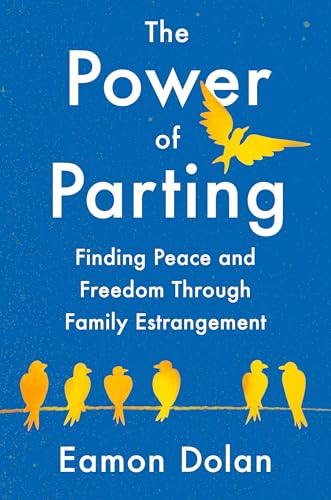
Eamon Dolan
4.12
270 ratings60 reviews
A myth-shattering, inspiring book that combines research, reportage, and memoir to explore the growing phenomenon of estrangement from toxic relatives—showing it not as a tragedy, but as an empowering and effective solution to the heartbreak of family abuse.
After decades of enduring his mother’s physical and psychological torment, after years of trying in vain to set boundaries, Eamon Dolan took a radical he cut his mother out of his life. No more phone calls, no more visits, no more contact. Parting with his abuser gave him immediate relief and set him on a path toward freedom, confidence, and joy like none he had ever felt before.
In The Power of Parting, Dolan has written the book he wishes he’d had when he was struggling to free himself from his mother’s abuse. In the process, he discovered how widespread estrangement really is. At least 27 percent of Americans are estranged from a parent, sibling, or other family member. He also learned why so much stigma surrounds this common—and often lifesaving—phenomenon. Even among therapists—the professionals who would seem most attuned to the pain relatives can inflict—there’s a bias toward reconciliation, when millions of their patients need instead to escape their abusers’ grip. Estrangement, Dolan realized, should be understood and embraced, not shrouded in shame.
Drawing on his own suffering and healing, as well as experts’ advice and the testimony of other courageous survivors, Dolan first explains why abuse is much different and more prevalent than we may think, how it harms us in childhood and beyond, and why limiting or eliminating contact might be our best possible choice. Then, he walks readers through the steps of a successful, positive estrangement: how to take crucial time for yourself; how to make sure no one can gaslight you into minimizing or forgetting; how to set rules for your abuser and—if they can’t or won’t respect your limits—how to end a toxic relationship. He also offers valuable counsel on how to ease the guilt and grief that often accompany parting, and how to break the cycle of abuse that was likely passed down to you through many generations.
With a convincing blend of clarity and empathy, Dolan encourages others to do what he ultimately did for determine whether the people in your life treat you with the care and concern you deserve—and part ways with them if they don’t.
GenresNonfictionSelf HelpPsychologyRelationshipsFamilyMental Health
304 pages, Hardcover
Published April 1, 2025
Book details & editions


87 people are currently reading


4207 people want to read
About the author

Eamon Dolan5 books6 followers
==
에이먼 돌런(Eamon Dolan)의 저서 <<단절의 힘: 가족 의절을 통해 찾는 평화와 자유>>(The Power of Parting: Finding Peace and Freedom Through Family Estrangement)에 대한 요약과 평론이다..
1. 요약: 당위적 화해의 신화를 깨는 단절의 선언
의절, 비극이 아닌 구원의 선택
전통적으로 가족 간의 의절(Estrangement)은 사회적 수치이자 불효, 혹은 개인의 성격적 결함으로 치부되어 왔다.
통계와 전문가들의 편향
돌런은 단절이 결코 드문 일이 아님을 지적한다. 통계에 따르면 미국 성인의 약 27%, 영국 가정의 5분의 1이 가족 구성원과 의절 상태에 놓여 있다.
건강한 단절을 위한 단계별 실천법
책은 단순히 절연을 부추기는 데 그치지 않고, 가밀하게 짜인 실천적 단계를 제시한다.
첫째, 학대의 실체 인정하기: 학대를 사소한 문제로 치부하려는 가해자의 가스라이팅에 휘둘리지 않도록 자기가 겪은 사실을 명확히 기록하고 객관화해야 한다.
둘째, 단호한 경계 설정과 최후통첩: 가해자에게 존중받아야 할 규칙을 제시하되, 상대가 이를 거부하거나 무시할 경우 관계를 완전히 끝낼 마음의 준비를 해야 한다.
셋째, 애도와 죄책감 관리: 가족을 잃었다는 근원적 슬픔과 사회가 주입한 죄책감을 다스리는 법을 배워야 한다. 단절 이후의 슬픔은 관계의 상실 때문이 아니라, '내가 가졌어야 할 정상적인 가족'에 대한 애도임을 깨달아야 한다.
넷째, 세대 간 학대 대물림 차단: 자신이 받은 상처를 직시함으로써 다음 세대에게 독성 관계가 이어지지 않도록 연결고리를 끊어내야 한다.
2. 평론: 해방의 매니페스토인가, 관계의 파편화인가
긍정적 평가: 피해자의 주체성 회복과 경계선의 정당화
<<단절의 힘>>이 지닌 가장 큰 미덕은 가족이라는 성역에 가려져 있던 학대의 피해자들에게 강력한 <면죄부>와 <서사적 권력>을 부여한다는 점이다. 사회는 늘 피는 물보다 진하다며 무조건적인 용서와 인내를 요구해 왔다. 돌런은 이러한 당위성이 도리어 피해자를 영원히 고통 속에 묶어두는 족쇄가 됨을 예리하게 간파한다.
이 책은 의절을 무책임한 도망이 아니라, 자기 존중을 위한 '급진적이고도 적극적인 선택'으로 바라보게 만든다. 특히 치료사들의 화해 편향을 비판한 대목은 정신의학계에도 신선한 경종을 울린다. 감당할 수 없는 독성 관계로부터 자신을 보호하기 위해 물리적·정서적 벽을 세우는 행위는 이기주의가 아니라 생존을 위한 필수적 자가 치료임을 설득력 있게 입증해 냈다. 저자의 유려하면서도 단호한 문체는 오랜 가스라이팅으로 자존감이 무너진 이들에게 강력한 연대의 손길을 내민다.
비판적 평가: 주관성에 함몰된 일반화와 단절의 도구화
그러나 이 책은 명백한 이론적·감정적 한계를 노출한다. 가장 우려스러운 부분은 저자 자신의 개인적 분노와 주관적 경험이 지나치게 투영되어 있어, 책 전반이 다분히 '화해 불가능론'에 치우쳐 있다는 점이다. 임상학적 진단 없이 독자가 스스로 C-PTSD를 진단하고, 심지어 치료사를 선택할 때 단절을 지지하는 이들만 골라 만나라는 저자의 조언은 대단히 위험한 발상이다.
또한 복잡다단한 가족 역동을 너무나 이분법적인 구도(절대적 가해자 대 무결한 피해자)로 단순화한다. 모든 가족 갈등이 돌런의 어머니처럼 극단적이고 영구적인 학대 유형은 아니다. 관계의 미숙함이나 오해에서 비롯된 갈등마저도 '단절이 가장 쉽고 효율적인 해결책'이라는 식으로 소비될 위험이 있다. 일각의 평론가들이 지적하듯, 이 책은 관계의 영속성이나 이타주의적 인내의 가치를 지나치게 거래적이고 무자비한 관점으로 격하하는 경향이 있다.
총평: 고통받는 소수를 위한 구원의 닻
결론적으로 <<단절의 힘>>은 모든 대중을 위한 보편적인 교양서라기보다는, 다른 대안이 전혀 워킹하지 않는 극단적 독성 가족 시스템 속에서 신음하는 '특정 소수'를 위한 생존 매니페스토다.
비록 객관적 거리두기에는 실패했을지언정, 천편일률적인 가족주의 신화 속에서 단절이라는 숨구멍을 공식적으로 열어주었다는 점만으로도 이 책의 가치는 결코 작지 않다. 우리가 부모를 선택할 수는 없지만, 어떻게 대접받을지는 스스로 선택할 수 있다는 돌런의 일갈은, 가족이라는 이름의 감옥에 갇힌 이들에게 던져진 가장 용감하고도 절박한 구원의 닻이다.
D
151 reviews
Follow
April 7, 2025
this is only sort of a book about estrangement. i would say it is primarily a book about childhood abuse and the resultant CPTSD symptoms. the author spends the whole first half of the book (48% to be exact, i listened to the audiobook version) reviewing basic research on child abuse, with many research studies to back up his statements. this has been done in many many books and in way better ways, IMO. if you want to learn about child abuse and C-PTSD, read The Body Keeps the Score by Bessel VanderKolk, who is an expert in the field, with decades of clinical and research experience. the author finally addresses estrangement significantly in chapter 4, but only very briefly and it takes him until chapter 5 to give any kind of useful advice to the reader on how to actually do it. for the rest of the book, he weaves in and out of speaking about estrangement (though again, IMO, not ever really diving deeply enough to be very helpful) and child abuse, as well as telling the stories of his own abuse at the hands of a cruel mother, and that of others. again, this has been done before, nothing new or groundbreaking here.
I would say this book is 10% about estrangement, 25% memoir & reflection on the authors own abusive childhood & 65% information on child abuse.
i'm a trauma therapist and have also been happily no contact with my family of origin for 10 years. i read this book hoping to find something that would help my clients as they navigate these complicated choices, and concluded that i would not recommend it to anyone. i've found estrangement (my own and that of my clients who are navigating it) to be a very complicated choice, & full of nuance. I think the author missed that nuance here in many ways. he doesn't say how long he was estranged from his mother before she died in 2020, but I do think if one is writing a self-help book based on lived experience, one ought to be many years out from the experience in order to have good perspective to offer others.
in many ways, the author seems to be unprocessed around his own trauma & choice to take space from his relationship with his mother. there's nothing wrong with that, i just think it makes for a not very helpful self-help book. This is also a very angry book, in my opinion. The title about finding “peace & freedom” doesn’t resonate with the energy of the book. There is a deep dive into allowing yourself to feel anger about abuse, a discussion around forgiveness & compassion that IMO again lacks nuance. I have had many new clients come to me stuck in anger over childhood abuse (many in their 50s & 60s with long-dead abusers). Of course it’s important to feel your anger if you’ve suffered maltreatment, and I believe that forgiveness/compassion can be a spiritual bypass if arrived at prior to allowing ALL the feelings to be expressed & felt & processed. But staying in anger (& blame) won’t lead anyone to peace or freedom, whether or not one chooses no contact. I noted also how deeply angry the author is about the Louise Hay book “you can heal your life.” He spouts a vitriolic review (& if you’re listening to him read the audiobook version, you can feel it in his voice) that goes on an uncomfortably long time. Hay’s book is a classic & has for 40+ years helped survivors & others out of a victim mindset loop of blame & anger. Her message is NOT “it was your fault you got abused as a child” it is “if you were abused as a child , but you’re now an independent adult & you still call your mom everyday (or see her once a week or ever) & she’s still abusing you, that’s definitely on you.” It’s a tough love idea to get yourself into taking responsibility for your own adult choices & many survivors, like this author, aren’t ready to hear that.
i also disagree with his basic idea of setting rules (i'd call these boundaries) for the abusive person as a way to hopefully get them to change their behavior so you can stay in the relationship. IMO, boundaries are for YOU, so that YOU can get clear with what kind of behavior you will tolerate. they should not be used to try to get someone to change, or to try to control someone's behavior, as this rarely happens and it can be even more painful for someone to keep trying and keep setting the boundary over and over again & opening themself to more abuse, just in new ways. freedom from abuse, IMO, is about accepting What Is, changing yourself, and then making courageous choices about who you want in your life and how that might look. trying to control others is just a set up for disappointment and despair (especially with those who have already shown themselves to be cruel or abusive).
i also didn't like the author's repeated use of the term "your abuser" to describe the person one wishes to go no contact with, IMO, other less aggressive words could have been chosen (he also very rarely uses the term "your relative" which is better but not always appropriate). most of the folks who i believe would be reading this book are probably not ready to label the person they wish to lessen contact with their abuser.
Additionally, in the attempt to validate the reader who has chosen no contact after a lifetime of terrible abuse, this book actually invalidates all the many others who were never physically, sexually or verbally abused, who do not meet criteria for C-PTSD, but whose lived experience of emotional abuse (which can be largely invisible & feels impossible to quantify in the same way as the others), repeated disrespect of reasonable boundaries, never being seen or heard, and just patterns of unkind communication over a lifetime led them to choose no contact. These folks are out there and already feel as though they must justify their choice to go no contact. Dolan doesn’t speak even once about this, and that’s probably because he’s not an expert on abuse or estrangement, just an expert on his own lived experience.
two stars for solid research, and for having the courage to share his own story (& to break away from abuse). i'd recommend the book "will i ever be good enough: healing the daughters of narcissistic mothers" (which is useful for daughters or sons, or nonbinary people, and for those with parents [not only mothers] who aren't necessarily narcissistic, but who were simply cruel, hurtful, hateful, or abusive in any way) by karyl mcbride. there is a good chapter on the choice to go low contact or no contact which IMO is far more useful than this book.
books-read-for-work
15 likes
Like
Comment
abi
535 reviews41 followers
Follow
April 13, 2025
gonna send this to my dad to see if he finally gets the message /hj
5 likes
1 comment
Like
Comment
Fatima Awada
25 reviews
Follow
September 23, 2025
This one was gifted to me by a friend. It allowed me to feel the validation of my decisions & important reminders that estrangement from family members should be more normalized than it is.
4 likes
Like
Comment

Ginger
385 reviews8 followers
Follow
May 8, 2025
IYKYK … and if you don’t know yet this book will help.
4 likes
Like
Comment
Kyra
146 reviews1 follower
Follow
April 17, 2026
3.5, I thought this was generally pretty good but it takes a lot for a self-help book to be really excellent to me. Enough references to other books (the body keeps the score, educated, maybe you should talk to someone, I’m glad my mom died, etc) to compile a pretty solid reading list for a curious reader!
3 likes
Like
Comment
Susan Lenz
59 reviews1 follower
Follow
September 24, 2025
I found this book when googling for titles that sought to explain estrangement in a positive light, not as some sort of tragedy in need of reconciliation. Almost every page gave me something to ponder, and the author seemed to know that some readers, including me, would doubt their own abusive upbringing or at least the severity of it. Gently, this issue was addressed. The examples of both abuse and healing were varied and often directly related to my own experiences. I found myself wondering about my formative years in ways I never allowed myself to question. The chapter on forgiveness was a confirmation of my own decision to completely part from my family. It's been more than nine years and it is especially nice to know that I'm not alone in feeling happier with the liberation from trauma.
3 likes
Like
Comment
Frederic
373 reviews23 followers
Follow
April 9, 2025
Eamon Dolan grew up with an abusive, Irish Catholic mother and a mostly absent father. His dad enabled his mother's psychological and physical abuse of Dolan and his sister by not protecting them from her.
Understandably, the author is very angry about his mother's decades of cruelty, built on the rotten foundation of her own abusive upbringing. His is a harrowing story that, mercifully, ends better for him than it has for many abuse victims.
Readers who were abused by their own parents will probably find the most value in this book, whose main focus is the freedom found through deliberate estrangement from abusive parents.
My potential estrangement involves no abuse, so Dolan's abuse anecdotes were hard to read. I have a conflict magnet of a sibling with a diagnosed and deliberately untreated mental illness, but I still found relevance in this book.
Most writing on the subject of estrangement focuses on how to avoid it. I was interested in exploring potential benefits of limited contact with my brother. There is some very good material here on the general case for estrangement as self preservation, our Judeo-Christian societal fetishization of forgiveness and the importance of applying the same or higher standards to family relationships than one would to friendships.
Dolan urges us to ask ourselves what benefit we derive from a family relationship that is so strained that we are considering estrangement. He bristles at maxims like "Blood is thicker than water" and "You can't choose your family". Dolan argues that we should indeed choose our family, when the family we were born into proves to be inadequate and/or toxic.
Another book I found somewhat helpful was Fern Schumer Chapman's "The Sibling Estrangement Journal"
3 likes
Like
Comment
Karen
2 reviews
Follow
January 22, 2025
An exhaustively researched book that is also brimming with humanity and warmth. A bible for those estranged from family, considering estrangement, or partially estranged. The book doesn't just provide information though; you will feel the author's compassion and empathy in every page. You'll come away feeling empowered, supported and nurtured, whatever decision about estrangement you decide is right for you.
3 likes
Like
Comment

Marsha
76 reviews22 followers
Follow
May 15, 2026
As a therapist, I was hoping to find a book to recommend to clients who are making this difficult decision and going through their own process. Unfortunately, I found many of the statements about mental health to be stigmatizing and demonizing. There is some good material here, but the writer is particularly critical of BPD while at the same time seeming to advocate for and address those "victims" suffering from CPTSD. In my experience, these are often actually the same issues called different things by different diagnosticians. I wouldn't want to subject my clients to the harsh attitudes towards personality disorders in general because it might add fuel to the already strong critical voice in their head.
I did read more than half the book before deciding I simply couldn't recommend it and should move on to find another alternative.
2 likes
Like
Comment

Joshua
15 reviews
Follow
April 30, 2025
Very good, besides the last 5% of the book which suddenly gets into partisan politics, which felt very out of place.
2 likes
Like
Comment
Displaying 1 - 10 of 60 reviews
