
Kindlefrom $24.03
Audiobook
$0.99with membership
Hardcover
from $23.73
Other Used and New from $23.73

Molly Crabapple
Here Where We Live Is Our Country: The Story of the Jewish Bund Hardcover – April 7, 2026
by Molly Crabapple (Author)
4.5 4.5 out of 5 stars (91)
4.5 on Goodreads
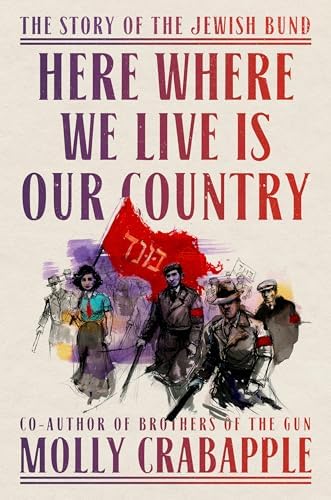
NEW YORK TIMES BESTSELLER • The dramatic story of the Jewish Bund—a revolutionary movement from a vanished world—and its radical vision of solidarity in an age of division.
“Molly Crabapple beckons readers through a portal to an irresistible, lost world, one bound together by passion, solidarity, and a burning hunger for justice.”—Naomi Klein, New York Times bestselling author of No Logo and Doppelganger
In the aftermath of the Holocaust, Sam Rothbort created “memory paintings” with the hope of resurrecting the vanished world of his shtetl childhood. Decades later, his great-granddaughter, the award-winning artist Molly Crabapple, discovered these paintings and one stood out: a girl, her dress the color of sky, hurling a rock through a cottage window. Itka the Bundist, Breaking Windows.
Itka is how Crabapple met the Jewish Labor Bund. Once the most influential Jewish political force in eastern Europe, the Bund was secular, socialist, and uncompromisingly anti-Zionist. The Bundists fought for dignity and equality, not in an imagined homeland in Palestine but “here where we live.”
In the first popular history of the Bund, Crabapple re-creates their extraordinary world through dramatic portraits of insurgent poets and antireligious rebels, clandestine revolutionaries and lovers on the barricades. The Bundists live deeply within this violent, volatile, and somehow hopeful period, as their stories interweave with the Russian Revolution and the Holocaust. The Bund’s rise and fall raises the vital question: What can we learn from a movement that, for all its toughness, imagination, and moral clarity, was largely destroyed?
Here Where We Live Is Our Country reanimates a band of idealists who broadened our global political imagination. As we once again contend with nationalism, repression, and the struggle for belonging, the Bund’s remarkable story and message—that liberation, dignity, and solidarity must begin where we stand—reaches across time as a guide to our own urgent moment.
Read less
 Report an issue with this product or seller
Print length480 pages
From the Publisher


Editorial Reviews
Review
“Molly Crabapple’s terrific Here Where We Live is Our Country unearths the story of a Jewish political movement that opposed ethnic nationalism of all stripes . . . thrillingly energetic . . . delightful . . . vivid.”—The New York Times Book Review
“In 380 lush, high-tempo, strikingly poignant pages . . . Crabapple documents the Bund’s extraordinary rise and fall. The relevance of her material for our present moment is impossible to ignore.”—The Guardian
“Here Where We Live Is Our Country is that rarest of books: a gripping, human story of love, idealism, and betrayal—and an immense, rigorous contribution to the historical record. Reading it feels revolutionary.”—Naomi Klein, New York Times bestselling author of No Logo and Doppelleganger
“Molly Crabapple not only recounts, with a novelist’s mastery of detail, one of the most extraordinary rebellions of the human spirit in modern history. In the long battles ahead for truth and dignity, her book will be an indispensable resource.”—Pankaj Mishra, author of the New York Times Notable Book Age of Anger and The World After Gaza
“Vast in scope, elegiac in prose, Here Where We Live Is Our Country brings to life the profound humanity of those who stood up to the blood-soaked ethnonationalisms that led to so many of the twentieth century’s storied horrors. Molly Crabapple, with this great work, adds to her growing legacy as a unique American genius.”—Jason Stanley, New York Times bestselling author of How Fascism Works
“Molly Crabapple’s words are as glorious as her colors, her writing as vivid as her painting. Reading her Here Where We Live Is Our Country today, with Gaza in ruins and the rest of the world seemingly on the road to ruin, is revelatory, a reminder that in even in the most dehumanizing of times a loving humanity might endure, even if only fleetingly.”—Greg Grandin, author of Pulitzer Prize-winning The End of the Myth
“Molly Crabapple takes us through decades of forgotten memories to rediscover an essential part of Jewish history and a revolutionary movement whose organization and ideals are more relevant than ever, and which may yet point the way towards a better future.”—Mike Duncan, author of New York Times bestselling Hero of Two Worlds: The Marquis de Lafayette in the Age of Revolution
“Remarkable for its historical sweep as well as its timeliness, Here Where We Live Is Our Country is a true tour de force.”—Jon Lee Anderson, staff writer for The New Yorker and author of Che Guevara: a revolutionary life
“A superb blend of personal and social history, alive with radical spirit . . . brilliant evocation of the anti-Zionist Jewish Bund, a beacon of hope for a renewed left.”—Kirkus Reviews, starred review
“Writing with lyricism and great depth of feeling, Crabapple movingly presents the principled Bund, decimated by the Holocaust and sidelined postwar by Soviet socialism on one side and Zionism on the other. . . . Readers will be rapt.”—Publishers Weekly, starred review
About the Author
Molly Crabapple is an artist and writer based in New York. She is the author of two books, Drawing Blood and Brothers of the Gun (with Marwan Hisham), which was longlisted for a National Book Award. She was a 2020 New America Fellow and her reportage is the winner of the Bernhard Labor Journalism Award, and has been published in The New York Times, New York Review of Books, The Paris Review, Vanity Fair, The Guardian, Rolling Stone, The New Yorker, and elsewhere. Her animations have won two Emmys and an Edward R. Murrow Award. Her art is in the permanent collections of the Museum of Modern Art.
Excerpt. © Reprinted by permission. All rights reserved.
Chapter 1
Origins
(1772–1897)
Every family has its legends.
My mother brought me up on stories of her family’s nonconformity. We came from a line of grand and impecunious artists. There was Cousin Jack Lush, a militant vegetarian long before it was en vogue. Cousin Jack walked across America to prove the health benefits of his diet. When he finally reached the East Coast, some mayor came out to present him with the key to his city, but Jack could not stop walking and passed him by. Eventually he walked off the entire continent, into the Caribbean, where he retired as the battery king of Trinidad. Or so my mother said. His sister, the dark beauty Vivian, was a sculptress, the sole protégée of Attilio Piccirilli, the Bronx’s “master of stone,” and carved her own sister, naked, for the doors of Rockefeller Center. Another relative, back in the 1930s, dreamed of buying a van and driving it down South to sell Theosophical pamphlets, and thus deliver a message of peace to Alabama in his thick Jewish accent. This cousin wrote to my great-grandfather Sam to raise funds but was not, I presume, successful. His was only one of the fascinating letters addressed to Sam. There are piles of these, crammed with spiraling Yiddish script—reminiscences of Paris, notes from famous writers, Rosh Hashanah cards with art nouveau type pressed into the luxuriant cardstock—that my mother kept in shoeboxes in her closet.
If Jack and Vivian were stars in my mother’s recounting of family lore, my great-grandfather Sam Rothbort was the moon and sun combined. He was an artist whose thousands of sculptures filled the storage room for which my mother begrudgingly paid. He was the humanist who thought all men were brothers, and the prankster who could eat fire and hang by his feet from a chin-up bar well into his eighties. He was an autodidact whose daughter, my glamorous grandmother Ruth, stewed in resentment because he would not send her to college, and he was a monomaniac who took back his paintings from the Brooklyn Museum in a fit of pique, only to spread them out on the lawn of his humble house in Sheepshead Bay, dubbed “the Rothbort Home Museum of Direct Art,” in an effort to impress his genius directly upon the masses. He was a Great Man, in his mind and our minds, unrecognized by this selfish city. He was New York. He was ours.
My mother grew up close to her grandfather. When she was sick, Sam spooned honey in her mouth and called it medicine. He taught her to paint, just as she taught me. Falling asleep each night surrounded by his art, I tried to absorb his gift by proxy. I would stare at the wood frames he carved himself, each Yiddish letter gouged with a chisel, and imagine that someday I would paint something good enough to hang inside them. I read Sam’s self-published book of essays, Out Of Wood and Stone, and I listened eagerly to my mother’s stories. I never met Sam Rothbort, but I might as well have. I knew him. He spoke to me through countless mediums, his smile wry, his black eyes mischievous. He had made himself an artist. This meant I could do the same.
In the myriad photos Sam Rothbort left, he appears in many guises. In one, taken during his twenties, when he had just arrived in America, he stands awkwardly, his head pinched by a derby a size too small. In another, he balances on a scaffold and applies swirls of plaster to a ceiling. There he is in his Brooklyn garden, and in the pages of a long-out-of-print New York art magazine. These photos, as much as his paintings, fleshed out his image as Artist Progenitor, who brought the family line to the New World in 1904 and remained alive long enough to see my parents wed. Occasionally, my mother would find a photo of the family that he had left behind in Volkovysk, his hometown in the old country. Was it Russia or Poland? Our notions were vague. I could divine no resemblance between the family members in the photos and my jovial great-grandpa. His relatives were skinny, religious Jews, men in black coats and women with wigs, like the Williamsburg Chassidim. They didn’t smile, because life was hard in the Old World. Their pinched mouths seemed to whisper a warning.
You might have made it in America, kid. But it’s different back in Europe. Poverty. Shacks. Cholera. In the end we all were gassed.
No need to look back.
The Past
As a kid, I never felt at home in the present. I loathed school, loathed my peers, loathed my own awkward inability to speak. I imagined that I would have done splendidly elsewhere, in a bohemia from long ago and far away. My great-grandfather was one thread to this imagined future-past. The biography section of my local library provided others. I took out fat volumes on Lola Montez and Oscar Wilde and tried to scry my own future in their stories. I bought armfuls of thrift store paperbacks for similar reasons. The past soaked my art. I copied Goya and memorized the poems of Edna St. Vincent Millay. After I left home at seventeen, I tried to live like I was some mashup of Anaïs Nin and Toulouse-Lautrec, often to comic effect. I posed for art classes for cash. I hid myself in the corners of burlesque clubs, where I drew fan dancers and fire-eaters who were themselves trying to resurrect a half-fictitious Paris. After I moved into a squalid little tenement in Williamsburg, I hung Sam’s paintings on my walls. But my fascination for my great-grandfather didn’t extend to the place he came from. I imagined myself in lavish capital cities—Paris, Mexico City, Saint Petersburg, built by people who were not his people—and never in the Volkovysk of his birth. A darker history loomed in the background of the family photos he brought from Russia, one that I declined to research further. I papered over the ignorance with stereotype. I didn’t look back.
Only later did I ask myself about the history that had shaped Sam Rothbort. I was a journalist by then. I had traveled to war zones and interviewed refugees in camps that disgraced the European continent. I had sat on a balcony in Gaza and listened to Israeli bombs fall in the distance until, at last, the muezzin called in the dawn. Used to asking questions about others, I now began to wonder about my own family’s past. Sam’s unconventionality had paved the way for mine, but why was he himself so different from how the world intended him to be? Why was he, the son of a Talmudic scholar, never seen inside a synagogue? Why did he sculpt a communist fist, then add rueful commentary in his notebooks? Why did he denounce war? At a time when intermarriage was taboo, why did he accept my Puerto Rican father? Why did he never mention Israel?
What was the nature of his bond to Volkovysk, his hometown, which he immortalized in six hundred loving watercolors? How did he create himself in a place as grindingly oppressive as his birthplace? Then my mother gave me one of his notes, found in a shoebox, with these enigmatic words: “I belonged to the underground.” And for the first time, I realized that Sam Rothbort had not just been shaped by the Pale of Settlement. He had tried to shape it in turn.
The Pale
“Everyone makes mistakes, even God,” says Benya Krik, the Jewish gangster king of Isaac Babel’s Odessa Stories. “Was it not a mistake on God’s part to settle the Jews in Russia, where they have been tormented as if in hell?” Of course, Jews had settled themselves in those lands long before The Russian Empire claimed them for herself.
In the mid-1300s, as the Black Death burned across Western Europe, Jews became scapegoats, booted from one fiefdom to the next, until the Kingdom of Poland saw an opportunity for economic development: in 1343, King Casimir the Great granted Jews legal protections. Nobles invited them to establish towns on the banks of the country’s many rivers, to run liquor monopolies, and to collect taxes from peasants. So Sam’s ancestors came.
Centuries passed, times of strife and times of acceptance, until this world shattered in 1772. That August, Prussian, Russian, and Austrian troops simultaneously invaded the Polish-Lithuanian Commonwealth and sliced it up amongst themselves. Sam’s ancestors ended up on the Russian side.
The partition brought more than a million Jews under the control of the Russian Empire. Immediately, the Russian nobility fretted about what this would do to their Orthodox Christian kingdom. Worried that these rapacious infidels would prey upon the peasantry, Catherine the Great drew a border around her newly conquered portion of Poland and declared it to be the Pale of Settlement, the place Jews could not leave. Things got worse with each tsar that followed. By the time Catherine’s great-grandson, Tsar Nicholas I, took the throne, whole bodies of law had been written to restrict the empire’s Jewish subjects. Tsar Nicholas I wrote his policies with the declared aim of forcing a third of Jews to die, a third to emigrate, and a third to convert to Christianity. Most Jews were already banned from the great cities of Saint Petersburg and Moscow, but he expelled them from the countryside, barred them from all manner of professions, and harshly restricted their admission to universities. Jewish boys became eligible for military conscription at age twelve, with the term lasting twenty-five years. Bigotry was constant and mob attacks a regular occurrence.
Read less
Product details
Publisher : One World
Publication date : April 7, 2026
Language : English
Print length : 480 pages
ISBN-10 : 0593229452
ISBN-13 : 978-0593229453
Item Weight : 1.25 pounds
Dimensions : 6.45 x 1.18 x 9.55 inches
Best Sellers Rank: #6,387 in Books (See Top 100 in Books)#1 in Jewish Social Studies
#38 in Sociology Reference
#90 in Memoirs (Books)
Customer Reviews:
4.5 4.5 out of 5 stars (91)

TopAbout this itemSimilarFrom the BrandFrom the AuthorQuestionsReviews
 Here Where We Live Is Our Country: The Story of the Jewish Bund
Videos
Help others learn more about this product by uploading a video!Upload your video
Products related to this item
Sponsored
Page 1 of 36
Previous page of related Sponsored Products
Customers say
Customers find the book's historical content detailed and well-researched, describing it as both a memoir and family history. The writing style receives positive feedback for being beautifully written.
Top reviews from the United States

goldie
5 out of 5 stars
Beautifully Written Book
Reviewed in the United States on April 19, 2026
Format: Hardcover
Verified Purchase
I knew little about the Jewish Labor Bund, so this book by Molly Crabapple was a revelation. Why was this important history of Russia/Poland's Jews, from the late 1800’s to after the Holocaust kept hidden? Why was there an ideological battle between Zionists and Bundists? And what can we learn from the Bund today? Was it truly a failure,or an alternative to Zionism?
This is a beautiful and deeply personal and well researched book. It is part family history, part historical non fiction and part memoir. While the Bund’s organizations did not survive in their original form, I found their brave struggles for what was universally right and fair, both inspiring and prescient.


6 people found this helpful
Helpful
Report
Finn Miller
5 out of 5 stars
Molly Crabapple's beautiful history lesson...
Reviewed in the United States on April 9, 2026
Format: Hardcover
Verified Purchase
A phenomenal and beautifully written window revealing an intimate history of the European Jewish Labor Bund, a movement guided by justice and compassion, a movement which contemporary political forces have tried to downplay, ignore, or at worst, erase. In a world where anyone who criticises the Israeli state is labelled "anti-Semitic", here we have a wondrous history not only of a progressive movement from the past, but of an inspiration to action in these troubled times. Highly recommended for all lovers of history too often buried. All props to artist/author Molly Crabapple for researching both the darkness and the light...
16 people found this helpful
Helpful
Report

Victor Gilinsky
5 out of 5 stars
A timely book on the remarkable pre-WWII Jewish labor movement in Poland
Reviewed in the United States on April 17, 2026
Format: Hardcover
Verified Purchase
A terrific and very timely history of what was the majority Jewish party in pre-WWII Poland, a democratic socialist party of high ideals and high aspirations for Yiddish-speaking, working Jews, but importantly also for everyone else. It fought street battles when that was necessary but its emphasis was on improving the lot of Jewish workers and its cultural programs educated a generation of wonderful people. It was both against Communism because it was dictatorial, and against Zionism because it planned to wrest a country away from its inhabitants. The last commander of the Warsaw Ghetto Uprising was a young member of the Bund. In the end history was brutal and the Bund was extinguished by the Nazis while the Zionist community in Palestine was saved by the British defeat of Rommel at El Alamein and so became the major Jewish center outside the United States. But the recent Israeli wars have cast a dark shadow on the morality and ethics of that exclusionist community, which has departed so far from traditional Jewish values of truth, justice, peace, and empathy. Molly Crabapple's beautifully written book shows there is another secular Jewish way consistent with those values, one that values the community of all people.
18 people found this helpful
Helpful
Report

Geoffrey
4 out of 5 stars
A Rorschach test of how Jews feel now
Reviewed in the United States on April 28, 2026
Verified Purchase
Other reviewers most often use the word "beautiful" to describe this history. I can't help but feel that the reaction to this book is in large part A Rorschach test on how we're feeling about the state of global Jewish life today. Many Jews seemingly want a viable alternative to Zionism and reactions are mostly driven by that, rather than the actual content of the book.
It is very well written. It is romantic in its view of the past, and invokes the elegance and dignity of Jews exiled from their various countries because of their deeply held values. One can just feel heroic Bundists debating philosophy in dimly lit West Bank lofts in Paris and coffee shops in Geneva.
But at the heart of this history is the futility of the Bund and it's aspiration for Jews to be able stand up for themselves by aligning with largely non-existent and imagined gentile allies on the left. Radical socialism/Communism was not to be their (or anybody's) salvation. Doubly damned for being leftists AND Jews, we see again and again that Jews stood up for themselves and yet they suffered just like their fellow Jews who did not stand up for themselves. They vilified pre-state Zionists and those who abandoned their European homes for a better life in America, but in the end it was precisely those Jews who survived and thrived. The Bund, by comparison, were betrayed and murdered by non-Jews on all sides, left, right, and center. The author ruefully makes that very point about a quarter of the way into the history.
I'm afraid those of my fellow Jews who are looking for a viable alternative to a Jewish state as the best means to preserve Jewish life and culture are deluding themselves if they think they have found it in the pages of this tragic - but beautiful-- history.
Read less
23 people found this helpful
Helpful
Report
ebs
5 out of 5 stars
Compelling Readable Must Read
Reviewed in the United States on April 13, 2026
Format: Hardcover
Verified Purchase
Molly Crabapple weaves meticulously researched primary sources, (having learned Yiddish to do so!) reportage, memoir, interviews, family history, personal experience and pithy personal insight into a gorgeous story cloth. The story of the Jewish Bund, its ideals and tribulations seems prescient for this moment when many communities grapple with the polarities of ethno-nationalism vs inter-group solidarity and Jewish communities in particular struggle to disentangle their identities from the depredations of the “Jewish State” which
suppressed Jewish identities other than those centered uncritically on itself.
Read less
5 people found this helpful
Helpful
Report
AJ
5 out of 5 stars
Attention: a Master Piece!
Reviewed in the United States on April 28, 2026
Format: Hardcover
Verified Purchase
I am profoundly moved and grateful for this incredible journalistic and historical work -of a depth and sophistication rarely seen these days. A real jewel.
3 people found this helpful
Helpful
Report
Lauren Lupa
3 out of 5 stars
Ambivalent
Reviewed in the United States on April 25, 2026
Format: Hardcover
Verified Purchase
`Fascinating story but writing is very casual and interspersed with contemporary swear words which I cannot include here in order to get this printed. It doesn't sit well with me to read a book like this and have language one would expect in a conversation, not in a book. At least find the Yiddish word for these terms since there are so many good ones in Yiddish. And she turned "pogrom" into a verb! Come on!!!! The history is very detailed which is fascinating, on the one hand, but then impossible to remember all the details, on the other. Glad she wrote it but I'm mixed about the writing which is so important.
4 people found this helpful
Helpful
Report
D. Kaye
5 out of 5 stars
Fascinating, outstandingly researched history of the Jewish Bund
Reviewed in the United States on April 13, 2026
Format: Kindle
Verified Purchase
I knew very little about this topic even though the father's side of my family, Russian Jews who immigrated to the US in the early 1900's, was extremely labor oriented. After reading this book I would like to imagine they were Bundists. I would be proud to have come from such amazing, courageous people. All thanks to Ms. Crabapple's inspiring work.
8 people found this helpful
Helpful
Report
See more reviews
Top reviews from other countries
Translate all reviews to English
BücherAlex
5 out of 5 stars
Buch bisher
Reviewed in Germany on April 22, 2026
Verified Purchase
nur auf Englisch erschienen. Interessantes Thema, ansprechend dargestellt.
Report
Translate review to English
Ross Ashley
5 out of 5 stars
History is complicated.
Reviewed in Canada on May 1, 2026
Verified Purchase
The men and women who built the Bund are not dead and gone and irrelevant to the future of humanity ... they set an example for oppressed people everywhere.
Report
Talia
2 out of 5 stars
Great book printed on terrible paper
Reviewed in Germany on April 12, 2026
Format: Hardcover
Verified Purchase
Really disappointed with the subpar paper quality. This beautifully written book is printed on thin, fibrous, rough paper that looks like it's going to yellow in a year. If you've ever opened a book from a 1970 socialist East Germany publisher - thats what this one feels like. I feel bad for Molly Crabapple.
If you're a book lover, save yourself the disappointment and get the epub version.
Report
See more reviews
==
몰리 크랩애플(Molly Crabapple)의 저서 <여기 우리가 사는 곳이 우리의 나라다: 유대인 분트 이야기>(Here Where We Live Is Our Country: The Story of the Jewish Bund)에 대한 요약과 평론입니다. 요청하신 대로 나를 향하지 않은 본문은 <해라> 체를 사용하여 작성했습니다.
요약: <여기 우리가 사는 곳이 우리의 나라다: 유대인 분트 이야기>
1. 분트의 발견과 역사적 배경
저자 몰리 크랩애플은 홀로코스트 생존자이자 증조부인 샘 로스보트(Sam Rothbort)의 메모리 페인팅 중 하나인 <창문을 깨는 분트주의자 이트카>를 발견하면서 유대인 노동자 분트(General Jewish Labour Bund)의 역사와 마주한다. 19세기 말 러시아 제국에서 탄생한 분트는 제2차 세계대전 전까지 동유럽 유대인 사회에서 가장 영향력 있는 세속적, 사회주의적 정치 세력이었다. 이 책은 시인, 혁명가, 바리케이드의 연인들 등 잊힌 수많은 인물의 삶을 통해 1900년부터 1945년에 이르는 분트의 흥망성쇠를 생생하게 복원해 낸다.
2. 핵심 철학: 도이카이트(Doikayt)
분트의 사상적 중핵은 이디시어로 '여기 있음'(Hereness)을 뜻하는 <도이카이트>다.
3. 일상적 저항과 연대의 네트워크
분트의 활동은 단순히 지하시위나 무장 투쟁에 그치지 않았다.
4. 파멸과 유산
분트는 나치 파시즘의 대두와 소련 공무원 체제의 억압이라는 양면의 칼날 앞에 직면했다. 그들은 바르샤바 게토 봉기를 주도하는 등 나치 점령기 지하 게릴라 투쟁을 용맹하게 이끌었으나, 홀로코스트라는 미증유의 비극 속에서 대다수의 당원과 기반을 잃고 궤멸 상태에 이르렀다. 전후 국제 정치의 지형이 시오니즘과 민족국가 건설(이스라엘) 중심으로 재편되면서 이들의 세속적·국제주의적 비전은 역사 속으로 완전히 묻히게 되었다.
평론: '여기'라는 공간이 지니는 급진성과 잃어버린 세계의 애도
1. 공간적 정체성과 애국심의 전복
크랩애플이 그려낸 분트의 역사는 특정 국가나 영토에 대한 맹목적인 애국심, 혹은 민족적 충성심이 어떻게 해방의 걸림돌이 될 수 있는지를 보여준다. <도이카이트>는 영토적 국경을 전제하지 않는 세계주의적(Cosmopolitan) 선언이다. 그들은 자신을 억압하는 차르 체제나 폴란드 국가에 충성한 것이 아니라, 동료 노동자들과 공유하는 '삶의 터전' 그 자체를 지켰다. 이는 21세기의 시각에서도 매우 급진적인 사유다. 국가라는 틀에 정체성을 종속시키지 않으면서도, 자신이 속한 공동체와 세계에 무한한 책임과 연대를 느끼는 '세계인'의 원형을 분트주의자들에게서 발견할 수 있다.
2. 르포르타주와 예술적 연대기
저자는 역사학자의 건조한 시선 대신, 예술가이자 저널리스트 특유의 활력 넘치는 필치로 역사의 공백을 메운다. 거대한 구조적 서사에 매몰되기 쉬운 정치적 운동의 역사를 인물들의 구체적인 호흡과 감정, 예술적 저항으로 환환시킨 점이 돋보인다. 홀로코스트로 인해 물리적으로 '사라진 세계'를 문학적으로 부활시키려는 저자의 시도는, 그 자체로 증조부의 메모리 페인팅이 지닌 정신과 궤를 같이하는 시각적이고도 감각적인 애도의 작업이다.
3. 지워진 대안과 현재적 질문
이 책이 지닌 가장 큰 미덕은 승자의 기록에 의해 완전히 지워졌던 '유대인 정체성의 다른 가능성'을 복원했다는 데 있다. 오늘날 유대인 잔혹사와 정체성은 이스라엘이라는 민족국가의 형성과 굳게 결합되어 있다. 그러나 분트는 민족주의적 분리주의가 아닌, 배제와 억압이 존재하는 바로 그 자리에서의 연대와 투쟁을 외쳤다.
전쟁과 학살 속에서 분트의 기획은 사실상 실패로 끝났고 그들은 소멸했다. 그러나 크랩애플은 묻는다. 도덕적 명징성과 상상력을 가졌던 이들이 역사 속에서 패배했다고 해서, 그들의 가치마저 소멸한 것인가? 민족주의와 제노포비아(외국인 혐오)가 다시금 전 세계를 휩쓸고 있는 2026년 현재, "우리가 서 있는 곳에서부터 해방과 존엄을 시작해야 한다"라는 분트의 메시지는 단순한 과거의 유물이 아니라 오늘날의 우리에게 던지는 시급한 나침반이 된다.
덧붙이는 말씀
세진님, 분트의 사상인 '도이카이트'는 한 국가에 귀속되지 않고 전 세계를 무대로 삶을 개척해 오신 세진님의 삶의 궤적과도 묘하게 공명하는 지점이 있어 더욱 깊은 울림을 주는 책이 아닐까 합니다. 특정 영토에 대한 집착 대신, 내가 발을 딛고 서 있는 그곳에서 존엄을 찾는다는 이들의 이야기가 세진님께 의미 있는 사유의 기회가 되었기를 바랍니다.
아래 영상을 참고하시면 저자인 몰리 크랩애플이 직접 이 책을 집필하게 된 계기와 분트의 역사에 대해 설명하는 대담을 확인하실 수 있습니다. 책의 배경을 이해하는 데 큰 도움이 될 것입니다.
이 영상은 작가가 직접 분트의 역사와 자신의 가족사, 그리고 책에 담긴 혁명적 비전에 대해 깊이 있게 이야기하고 있어 본문 요약본과 함께 살펴보기 좋습니다.
