

Read sample
Follow the author

Philip GoldbergPhilip Goldberg
Follow
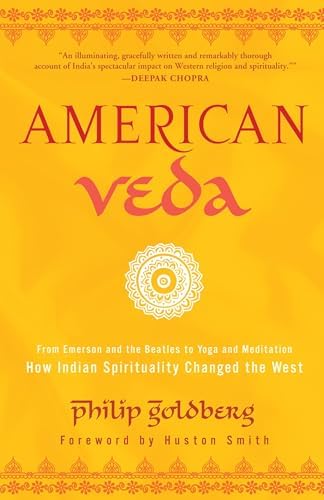
American Veda: From Emerson and the Beatles to Yoga and Meditation--How Indian Spirituality Changed the West Paperback – 14 May 2013
by Philip Goldberg (Author), Huston Smith (Foreword)
4.6 4.6 out of 5 stars (235)
A fascinating look at India's remarkable impact on Western culture, this eye-opening popular history shows how the ancient philosophy of Vedanta and the mind-body methods of Yoga have profoundly affected the worldview of millions of Americans and radically altered the religious landscape.
What exploded in the 1960s, following the Beatles trip to India for an extended stay with their new guru, Maharishi Mahesh Yogi, actually began more than two hundred years earlier, when the United States started importing knowledge--as well as tangy spices and colorful fabrics--from Asia. The first translations of Hindu texts found their way into the libraries of John Adams and Ralph Waldo Emerson. From there the ideas spread to Henry David Thoreau, Walt Whitman, and succeeding generations of receptive Americans, who absorbed India's "science of consciousness" and wove it into the fabric of their lives. Charismatic teachers like Swami Vivekananda and Paramahansa Yogananda came west in waves, prompting leading intellectuals, artists, and scientists such as Aldous Huxley, Joseph Campbell, Allen Ginsberg, J. D. Salinger, John Coltrane, Dean Ornish, and Richard Alpert, aka Ram Dass, to adapt and disseminate what they learned from them. The impact has been enormous, enlarging our current understanding of the mind and body and dramatically changing how we view ourselves and our place in the cosmos.
Goldberg paints a compelling picture of this remarkable East-to-West transmission, showing how it accelerated through the decades and eventually moved from the counterculture into our laboratories, libraries, and living rooms. Now physicians and therapists routinely recommend meditation, words like karma and mantra are part of our everyday vocabulary, and Yoga studios are as ubiquitous as Starbuckses. The insights of India's sages permeate so much of what we think, believe, and do that they have redefined the meaning of life for millions of Americans--and continue to do so every day.
Rich in detail and expansive in scope, American Veda shows how we have come to accept and live by the central teaching of Vedic wisdom: "Truth is one, the wise call it by many names."
Read less
Previous page of related Sponsored Products
Review
"American Veda is an illuminating, gracefully written and remarkably thorough account of India's spectacular impact on Western religion and spirituality."
- Deepak Chopra
"American Veda shows us how we got to where we are. It chronicles a revolution in consciousness and describes India's lasting influence on our culture, from gurus, meditation, and yoga to sitar music and aromatic curries. Savor it."
- Michael Bernard Beckwith, author of Spiritual Liberation: Fulfilling Your Soul's Potential
"This book demonstrates the far reach of Indian thought into the American psyche and sense of spiritual self. A well written, superbly researched book, it should be read by all the 15 million Americans practicing meditation and yoga!"
- Christopher Chapple, Doshi Professor of Indic and Comparative Theology, Loyola Marymount University
"Wonderfully comprehensive, positive, tremendously insightful, and illuminating. For anyone interested in the deep influence of yoga philosophy in American culture, I highly recommended this masterful book."
- John Friend, Founder of Anusara Yoga
"Immensely smart, wise and brilliantly written. This book should be required reading for everyone interested in ecumenical spirituality which is the one hope for the survival of the human race, and India's great gift to us in our crisis."
- Andrew Harvey, author of The Hope: The Guide to Social Activism and The Sun at Midnight
"In this important and engaging book, Philip Goldberg chronicles the long neglected history of Hinduism's encounter with the US. He astutely examines how Hinduism has been constructed and consumed within the larger American spiritual landscape. A must read for those interested in Hinduism and its transmission."
- Varun Soni, Dean of Religious Life, University of Southern California
"American Veda documents an important cultural change and is an impressive book: informed and informative, well researched and readable."
- Roger Walsh MD, Ph.D., University of California Medical School, author of Essential Spirituality: The Seven Central Practices
"Intriguing reading, fascinating profiles and great storytelling of Yoga luminaries adapting the teachings to fit modern American life. This book inspires us to continue to deepen in our body, mind, and spiritual journey."
- Lilias Folan, PBS Host and author Lilias! Yoga Gets Better with Age
"Goldberg weaves a tale as only a true storyteller can, drawing the reader into this Vedic web that has no weaver, providing us with a fresh view of how Vedic strands have woven their way into the daily fabric of every American. He masterfully unfolds this ancient play of spiritual unfolding that is just now beginning to emerge into early adolescence in America."
- Richard Miller, PhD, author of Yoga Nidra: A Meditative Practice for Deep Relaxation and Healing, co-founder of the International Association of Yoga Therapy and the founding president of the Integrative Restoration Institute.
"A breathtaking trek across time, American Veda shows us something extraordinary, surprising, and precious about where we come from, who we are at this moment, and what we may yet become."
- Chip Hartranft, author of The Yoga-Sutra Of Patañjali a new translation with commentary
"In a delightful, compelling way, American Veda shows how India's ancient wisdom has permeated our lives, including many of the self-improvement teachings that have benefited millions. I loved reading this book."
- Marci Shimoff, NY Times bestselling author, Happy for No Reason and Chicken Soup for the Woman's Soul
"Nothing short of remarkable. Within the pages of this fairly short volume, Goldberg manages to cover every major figure, movement, and idea that originated in India's spiritual terrain and arrived on our shores to forever alter the landscape of our thought and culture....Writing with empathy and discernment, he covers highly controversial issues regarding the impact of the transmission of Indian spiritual culture in a way that inspires deeper understanding. American Veda is an insightful guide to the fascinating history of a phenomenon that will be seen in the future as one of the watershed moments of American history."
- Rita D. Sherma, Ph.D., Executive Director, School of Philosophy & Religious Studies, Taksha University
"American Veda is a bright light on the historical path to enlightenment in America. Philip Goldberg is an acharya of words and research. Highly recommended."
- Larry Payne Ph.D., coauthor, Yoga for Dummies, Yoga Rx and The Business of Teaching Yoga
"We imagine the United States as a Christian island far from the exotic teachings of India. We imagine wrong. As Phil Goldberg's masterful American Veda shows we have been under the sway of Hindu spiritual thought for centuries. If you want to understand American spirituality today, and get a glimpse into its future, read this book."
- Rabbi Rami Shapiro, author of Recovery, the Sacred Art
"This book, American Veda is a landmark! Easy to read it shines a light of understanding on the American Vedic Hindu path which started with the transference of knowledge from India, and equally important by its acceptance by the Americans of western orientation. It is a path on which now, the immigrant Vedic Hindu community and its progeny are grafting on to and traveling along with many in the mainstream community, resulting in, we hope increased understanding. The integrated approach of this book helps fill in the gaps of this historical journey, especially for those of us who see ourselves as fellow travelers working to bridge the east-west divide."
- Anju Bhargava, Management Consultant and Founder of Hindu American Seva Charities
About the Author
PHILIP GOLDBERG is the author or coauthor of a number of books, including Roadsigns: On the Spiritual Path and The Intuitive Edge. Based in Los Angeles, he is an ordained interfaith minister, a public speaker and seminar leader, and cohost of the Spirit Matters podcast. He blogs regularly on religion for the Huffington Post.

TopAbout this itemSimilarFrom the AuthorReviews
 American Veda: From Emerson and the Beatles to Yoga and Meditation--How Indian Spirituality Changed the West
Product details
ASIN : 0385521359
Publisher : Harmony
Publication date : 14 May 2013
Edition : 1st
Language : English
Print length : 432 pages
178 in Karma
Customer Reviews:
4.6 4.6 out of 5 stars (235)
===
===
===
About the author
Follow authors to get new release updates, plus improved recommendations.
Follow
Philip Goldberg
Philip Goldberg grew up in Brooklyn and moved to Los Angeles like the Dodgers before him. A professional writer for 45 years, he is author or coauthor of numerous books, all but one nonfiction. He is also a skilled public speaker, meditation teacher, and ordained Interfaith Minister. He leads tours to India and cohosts the popular podcast Spirit Matters. His 2010 book, American Veda, which chronicles the impact of India's spiritual teachings on the West, was named one of the top 10 Religion books of the year by Huffington Post and Library Journal. That was followed in 2018 by a biography: The Life of Yogananda: The Story of the Yogi Who Became the First Modern Guru. Website: www.philipgoldberg.com. His current book, Spiritual Practice for Crazy Times is the #1 New Release in 3 Amazon categories.
Read less about this author
==
About the author
Follow authors to get new release updates, plus improved recommendations.
Follow
Philip Goldberg
Philip Goldberg grew up in Brooklyn and moved to Los Angeles like the Dodgers before him. A professional writer for 45 years, he is author or coauthor of numerous books, all but one nonfiction. He is also a skilled public speaker, meditation teacher, and ordained Interfaith Minister. He leads tours to India and cohosts the popular podcast Spirit Matters. His 2010 book, American Veda, which chronicles the impact of India's spiritual teachings on the West, was named one of the top 10 Religion books of the year by Huffington Post and Library Journal. That was followed in 2018 by a biography: The Life of Yogananda: The Story of the Yogi Who Became the First Modern Guru. Website: www.philipgoldberg.com. His current book, Spiritual Practice for Crazy Times is the #1 New Release in 3 Amazon categories.
Read less about this author
==
From the United States
George Hardeen
5.0 out of 5 stars Perfect match of author and subject
Reviewed in the United States on December 18, 2012
Format: HardcoverVerified Purchase
I finished reading Phil Goldberg's "American Veda" over Thanksgiving. It was wonderful, easily the best and most enjoyable book I've read this year!
What Phil did is really remarkable. The book is great history, great storytelling and best of all GREAT writing. His research is thoroughly exhaustive. His knowledge just shines through. The organization of the book is really great, too, giving just the right amount of space in the right order to each of his numerous subjects right to the end.
I can only imagine the amount of reading that was required to write this. It's a college course, one I'd love to take. The information he presents is just the right amount to illustrate the innumerable points he makes. When I wonder what I might like to read, I can thumb through American Veda to find an interesting title and follow Phil's trail.
The book has great chapter titles and great subheads, too; double entendres and word play. No one who didn't live through this period could have written this book. No one born sooner could have done it, either. Talk about the right man for the job, Phil was it.
Back to the writing, as everyone knows a lot of books frontload the best, most poetic of an author's work right at the beginning. That makes sense. They're just starting, investing the most thought and time where it will do the most good to hook a reader. Often, you notice the quality taper off as a book progresses toward the end. Not here. Phil's writing stays fresh, lively, bright and smart right to the last page. I looked for that inevitable taper and it never showed. I really appreciate that. His phrasing is brilliant right where it needs to be. You can see he never stops thinking about what he's discussing. I appreciate that a lot of work went into make every sentence sing. It shows.
After I read American Veda I listened to Phil's interview with Rick Archer on Buddha at the Gaspump on YouTube. That's really good but, like a movie, there's a lot more in the book. I'm listening to Phil's interviews linked on the americanveda.com website and I'm enjoying them, too.
This book is great history, great storytelling, great writing and a great resource of Vedantic knowledge. Phil Goldberg and the history of the Vedas coming to and influencing America were a perfect match of author and subject.
3 people found this helpful
Helpful
Report
anonymous name
5.0 out of 5 stars A must book for all spiritual aspirants
Reviewed in the United States on December 27, 2010
Format: HardcoverVerified Purchase
American Veda is a thorough, comprehensive,balanced and informative report of the tremendous influence of Vedic thought in the United States; from the most obvious literary filters that came through in the 19th century and early 20th centuries (fine treatment of Emerson, Thoreau, and Whitman) to the more subtle reformation of key Vedic concepts into "Americanese" by the late 20th and early 21st centuries.
The author provides a good taste of the deeper esoteric models of mystical experience, without overwhelming the beginner reader who may be still lingering at lower stages of integration. Yet, for the more advanced learner the author gives plenty of historical material that is fascinating and helps thread the missing pieces of fabric.
There is no doubt in my mind that any serious student of American spirituality should have this book on their shelf. As well, aspirants who are beginning their journey beyond the spiritual kindergarten of religion should read this book before venturing too far out beyond the shore.
The author's comments on "fallen gurus" never come across as judgmental or biased. Now this is exceptional reporting at its best.
Goldberg's chronicles of more recent integrations of science (i.e. quantum theory) and eastern structures of consciousness/reality are superb. I have been impressed by some of the more recent dialogue which is learning more about the limits of the brain; i.e. that this organ is not a creator but a transmitter/processer of thought. The author's use of the metaphor of the "tv. set" to describe the primary function of the brain is useful and accessible to the layperson.
I appreciated Goldberg's consistent commitment to objective reporting; naming the controversy between the more programmatic schools of Vedic teaching (for example, TM ) and the popular "self-help" books that foster entry level techniques; such as those promoting meditation-as-relaxation, foregoing the more arduous path of transcendental awareness (for example, Herbert Benson's Relaxation Response). Both have their uses and strengths.
Again, I applaud Philip Goldberg for a fine read and congratulations on providing the spiritual aspirant with an excellent learning and discerning tool as they begin or as they advance their experiential studies in integrative awareness.
Neale Lundgren, Ph.D.
18 people found this helpful
Helpful
Report
Elasticity
4.0 out of 5 stars A lot of useful and engaging information, but needs better editing.
Reviewed in the United States on January 2, 2023
Format: KindleVerified Purchase
With a spare morning after an excellent teacher training course at Rishikesh Yogis/ Yoga Sadhana, I went with friends to the "Beatles Ashram" on bank of the Ganges opposite our school. Previously we had visited the well-appointed Beatles Cafe (which acknowledges the group never went there), and I expected something like that: sleek design, crowds, and a gift shop. Basically, the "ashram"- where the entry gate bears only the name "84 Huts"- is a ruin. Officially, it is a tiger reserve. Visitors are free to roam around and determine for themselves what is safe to tread on and not- and try to figure out what happened.
Before leaving for another part of India, I had time to start exploring the answer in the Wikipedia entry "Beatles in India," which led me to Goldberg's book. To the Wikipedia article's information about tensions between the Beatles and Transcendental Meditation founder Maharishi Mahesh Yogi, it added developments in TM that factored in its decline. Perhaps somewhere there is a more complete account of the establishment, popularity, decline, and fall of what is now known as "84 Huts"- for that number of interesting meditation structure that hobbits might have built.
Goldberg's book includes much more. Anyone with more than passing interest in the global reach of Indian thought and spirituality will have heard of its influence on Emerson and Thoreau. Through careful research, Goldberg persuaded me of a direct connection: Both of those thinkers actually read widely in translations of the body of literature he terms "Vedanta." He discusses subsequent establishment of Vedanta societies in the US, and presents fascinating stories of figures- mostly male but some female- who promoted the interchange of Indian and American ideas, by attracting followers and establishing institutions, some of which are still in operation.
With better editing, this could be a fine book for intellectually oriented book clubs and perhaps even syllabi for college courses in American Studies and Comparative Religion. Alas, presentation of substantial and detailed information is marred by cliches, hyperbole, and casual colloquialisms. A certain guru's existential crisis in youth makes other adolescent anguish "seem like [nothing more than] bad dreams." Why is it necessary to judge anyone else's experience to make the point? Presumably, insecurity over writing skill. It is not necessary to have taught English to know that decent writing consists in allowing readers to feel, rather than stating what should be felt.
Referring to police forces as "the fuzz" just seems lazy.
Beyond continual lapses into sloppy style, in the substance, Goldberg barely touches on issues of commercialization of ideas. He seems to have too much personal investment in "Vedantic" principles and practices to grapple critically with the American context himself, although he does discuss criticisms of most of the thinkers and movements he refers to. Of course, "Truth is one; Paths are many," can seem like a perfectly admirable guiding precept. But to dismiss, for example, conservative Christian backlash as parochial, misses opportunity for some important arguments, such as how moral and ethical values are to be inculcated.
As an American leaning strongly on Hindu traditions, while having to work out my life in the United States for now, I am glad to have read Goldberg's book- at least the first 70% or so about Vedantic movements. I was less interested in later chapters that lose the historical thread, in discussions of research on a "unified field theory" of consciousness. Given the flaws, however, I think it will be a long time before I will meet anyone else with the interest and background that would motivate me to recommend it.
One person found this helpful
Helpful
Report
Jeffery D. Long
5.0 out of 5 stars Chronicling the Emergence of a Distinctively American Hinduism
Reviewed in the United States on August 24, 2011
Format: HardcoverVerified Purchase
This excellent book relates, probably for the first time in a single volume, the history of Hindu-inspired religious movements in America. Unlike the equally excellent volume by Lola Williamson, 'Transcendent in America,' which focuses in great depth upon three such movements (Transcendental Meditation, Siddha Yoga, and Self-Realization Fellowship), 'American Veda' has a wide scope that includes not only these three important groups, but also the Vedanta Society, ISKCON, and a host of other institutions and personalities, as well as the more diffused but nevertheless pervasive influence of Hindu thought upon the American ethos, consciousness, and cultural lexicon. From karma to gurus to yoga, it's all here.
The author, a TM practitioner, writes as a sympathetic insider, but also with a sufficient degree of detachment and integrity to assure the reader that the material is presented in a way that is fair and reasonably unbiased. (Everyone has a bias, after all.) Bringing the many fascinating personalities that it covers to life in a way that is vivid, informative, and even entertaining, Philip Goldberg's book is neither hagiography nor hatchet job. Based on solid research, but also written in a highly accessible fashion, American Veda is a very good starting point for anyone who is interested in learning more about the influence of Hinduism in America.
As one of the people who is mentioned in the book, I can also say that reading 'American Veda' is a wonderful way to contextualize one's own practice in the larger history of the movement of which it is a part. Goldberg "gets it." He understands what draws many of us to these movements, as well as the various challenges and drawbacks that they face. His writing rings true. I think his chronicle of what may yet emerge as a distinctively American form of Hinduism will continue to be a valuable reference work for many decades to come.
12 people found this helpful
Helpful
Report
Bob Weisenberg
5.0 out of 5 stars True or False? Physical Yoga Has Influenced America More than Spiritual Yoga.
Reviewed in the United States on January 21, 2011
Format: HardcoverVerified Purchase
(This review from Elephant Journal [...] )
True or False? Physical Yoga Has Influenced America More than Spiritual Yoga.
Answer: False! The reverse is true. Spiritual Yoga has had a far bigger impact on America than the physical poses most people think of as Yoga.
You'll almost certainly agree after reading the startling new book American Veda: From Emerson and the Beatles to Yoga and Meditation How Indian Spirituality Changed the West by Philip Goldberg
(See accompanying interview with Phil Goldberg. [...])
The spirituality of the Bhagavad Gita and the Upanishads, the original texts of Yoga, has found its way into the very core of spiritual life in America, according to Goldberg, even though this is often masked by the form it has taken, and sometimes through outright repression of historical facts.
American Veda is an absolute must-read for anyone serious about Yoga. It is one of the most important books I've personally ever read about Yoga, or anything else, for that matter. It is surprising, entertaining, and highly readable throughout, and it will cause you to forever think differently about the impact of Yoga in America.
This book is so momentous, that at first I had trouble imagining how I could adequately describe it's message and scope in a "review". Then I suddenly realized that this would be the easiest review I've ever written. Here it is:
The following is just a partial list, just to give you an idea, of the famous people who, as documented in American Veda, have been profoundly influenced, not just a little bit influenced, but profoundly and pivotally influenced, by the Yoga of the original ancient Yoga texts, the Bhagavad Gita and the Upanishads, often referred to as "Vedanta Yoga" (Most are Americans, but I also included others who heavily influenced Americans.):
Authors
Ralph Waldo Emerson Henry David Thoreau Walt Whitman Aldous Huxley
Samuel Taylor Coleridge William Wordsworth William Blake Emily Dickinson
Robert Frost Jack Kerouac Allen Ginsberg Alan Watts Gotham Chopra
Tim Gallwey (Inner Game of Tennis) Herman Hesse Oliver Wendell Holmes
Somerset Maugham J. D. Salinger Christopher Isherwood Timothy Leary
Huston Smith T.S. Eliot William Butler Yeats
Psychologists
William James Carl Jung Abraham Maslow Stanislav Grof Daniel Goleman
New Spirituality/Self-help
Eckhart Tolle Deepak Chopra Michael Beckwith (Agape) Ken Wilber
Joseph Cambell Madame Blavatsky (Theosophical Society) Wayne Dyer
Marianne Williamson Norman Vincent Peale Tony Robbins
John Gray Joan Borysenko Andrew Harvey
Musicians & Entertainers
The Beatles (especially George Harrison) Philip Glass Judy Collins
Russell Simmons Elvis Presley John Coltrane Alice Coltrane Donovan
Mick Jagger Marianne Faithful Mia Farrow Mike Love
Paul Horn Madonna John McGlaughlin
Yehudi Menuhin Van Morrison David Lynch Shirley McClaine
Jerry Seinfeld And many others
Religious Figures
Mary Baker Eddy (founder Christian Science) Ernest Holmes (Religious Science)
Thomas Keating Thomas Merton Father Bede Griffiths Rabbi David Gelberman
The "New Thought" Movement (source of many modern congregations)
Politicians/Activists
John Adams Martin Luther King (through Mahatma Gandhi) Booker T. Washington
Philosophers
Arthur Schoepenhauer Friedrich Hegel Alfred North Whitehead
Scientists
David Bohm (quantum physicist) Rupert Sheldrake (biologist) Fritjof Capra (The Tao of Physics)
J. Robert Oppenheimer Erwin Shroedinger (physicist, close friend of Einstein)
Nikola Tesla (legendary inventor) John Hagelin Amrit Goswami
Health and Wellness
Andrew Weil Dean Ornish Mehmet "Dr." Oz. Herbert Benson (The Relaxation Response)
See also: How Yoga Has Transformed American Spirtuality: An Interview with Phil Goldberg, Author of "American Veda", and then read the book! [...]
14 people found this helpful
Helpful
Report
MD on the Search
5.0 out of 5 stars Magical Mystery Tour
Reviewed in the United States on November 18, 2010
Format: HardcoverVerified Purchase
Phil Goldberg is a highly skillful tour guide. He brings not only a nimble mind and an open heart to the party as he chronicles India's impact on the West, but also a gentle humor and a finely balanced thoughtfulness that unobtrusively suggest his own depth and clarity. In a tour of intellectual history I found both entertaining and enriching, he begins with early roots, showing how yogic philosophy influenced Emerson, Thoreau, and other 19th century thinkers. He turns then to 20th century disciples, from the Beatles and Ram Dass to a procession of other celebrities and less known figures as he describes the many Indian teachers whose wisdom has reached our shores at the same time. In the process, he re-tells the story of the 1960's, its creative ferment and legacy, in a new light. He also makes an engaging contribution to interfaith understanding. He neither glosses over controversy nor gets lost in it.
The Goldberg tour is sufficiently well-written that it is fully accessible to the most uninformed reader. The unfolding set of mini-topics is presented simply and deftly, like a refreshing series of breezes. Not too heavy, not too light. Anyone interested in philosophic ideas within an historical context will discover a treasure trove of intriguing vignettes and asides herein. That will hold doubly for anyone who practices meditation or yoga. For them, this superb overview will be a wonderfully welcome gift.
13 people found this helpful
Helpful
Report
Anna Hourihan
5.0 out of 5 stars I Didn't Know That!
Reviewed in the United States on November 7, 2011
Format: HardcoverVerified Purchase
With Vedantin terms like "yoga," "karma," "mantra" and "meditation" so commonplace, it's surprising that the term "Vedanta" is relatively unknown in America and around the world. Reading Philip Goldberg's fascinating and comprehensive exploration of Vedanta's influence is surely one way to remedy that.
In "American Veda," Mr. Goldberg reveals how Vedantin concepts such as the unity of existence and "One Truth, many paths" came to be incorporated in the fabric of American society. He shows us how this ancient philosophy has influenced and continues to influence not only the way we think about spirituality and religion, but also how its concepts have impacted modern health care, psychology and the arts.
His extensive research turns up many interesting facts and stories that he expertly threads through the text. I knew, for example, that the Beatles' John Lennon and George Harrison were influenced by Indian thought, but had no idea that T.S. Eliot studied Vedantic texts, Sanskrit and Pali.
Goldberg carefully chronicles the arrival, unique approach to the Vedas and impact of the many gurus and teachers--Indian as well as American-born. Although very readable, it can feel somewhat encyclopedic at times. In spite of being very much involved in yoga and meditation since the 1960s, Goldberg manages an unbiased, non-judgmental treatment of the subject--including the occasional scandal and controversy. The transparency is refreshing.
This is a valuable reference text that I hope makes its way onto the shelves of our public libraries and into the hands of anyone interested in spirituality, religion and especially Vedanta's influence in America.
- by Anna Hourihan, publisher and editor of "Children of Immortal Bliss," an introduction to the Vedanta teachings of India.
3 people found this helpful
Helpful
Report
Julian Lynn
4.0 out of 5 stars Panoramic in Scope with Narrative Irregularities
Reviewed in the United States on October 29, 2019
Format: PaperbackVerified Purchase
"American Veda" is a singularly ambitious and panoramic report and, in some cases, review of the many ways in which Indian spirituality has impacted and informed American culture and cultural precepts over the past two-hundred-plus years.
Readers new to this field of inquiry may initially be overwhelmed by the vast number of names, events, organizations and statistical information presented in this seemingly comprehensive book. Readers who have a good command of US social and intellectual history and/or a strong bent toward serious spiritual inquiry may find Goldberg's work very helpful. And, to the author's credit, copious endnotes provide serious readers with additional material and leads to supplement the chapters' many narrative threads.
Because this work is being used as a teaching tool, two aspects of Goldberg's work caused this reviewer concern. First is the issue of the author's voice. Goldberg seems to be entrenched in hippie-era slang circa 1970. As a point of fact, the verbal phrase "turn on" instead of "introduce" peppers the book's pages—to the extent that this reader almost started tracking the instances of its appearance. What can I say? "Bummer drag, man." Also, in an attempt to contextualize certain events, the author sometimes makes sweeping and sensationally-worded statements about US history. These passages would benefit from a more careful rewording.
The second and more serious concern, regarding Goldberg's book, has to do with the nuanced "details" of events and cause-effect relationships and how they are reported. The author, perhaps because of the sheer scope of material covered, has in several instances become mildly confused. For example, Goldberg reports that the meeting between the XIV Dalai Lama and a delegation of Jewish Rabbis, "Chronicled by Rodger Kamenetz in the best seller "The Jew in the Lotus," [that] the purpose of the trip was to learn why so many Jews were drawn to the East." In contrast, Kamenetz himself writes, "In 1989, the same year he was awarded the Nobel Peace Prize for his nonviolent efforts, the Dalai Lama turned for the first time to the Jewish people for help. 'Tell me your secret,' he said, 'the secret of Jewish spiritual survival in exile.'" Readers, using this text as a teaching tool, need to be aware that the narrative contains such irregularities.
Read the book; enjoy it. With a more careful edit and, perhaps, some additional scholarly peer reviews, a revised edition of "American Veda" might become a trusted resource for serious students of Indian spirituality in the West for years to come.
4 people found this helpful
Helpful
Report
The Greatest Weight
4.0 out of 5 stars Thorough overview of Indian transmissions to Europe/America
Reviewed in the United States on August 23, 2022
Format: KindleVerified Purchase
Although not a scholarly work, Goldberg’s history of the influence and transmission of Indian religious ideas covers a wide range of narratives and figures, from the ancient period to the present. Everything from the Alexander the Great's encounter with Indian yogis, the Transcendentalists’ reception of eastern religious texts, which influenced New Thought and Positive thinking, Huxley’s perennialism, Joseph Campbell’s comparative mythology, Huston Smith’s and Mircea Eliade’s comparative religion, to Eastern transmitters of tradition - some who came to America like Vivekananda, Yogananda, Maharishi, DT Suzuki, Rajneesh, and Muktananda, and others whose influence came via texts and reputation; Aurobindo, Ramana Maharsi, Gandhi. Additional lines of transmission and integration come from scholars of Asian religions, yoga’s 19th century innovations (particularly hatha), home grown gurus like Pierre Barnard and Richard Alpert/Ram Dass, the worlds of art and music (the Beatles, the Coltranes, John McLaughlin, Phillip Glass, Kandinsky), as well as the sciences, particularly “new” physics (Capra, Bohm) and psychology (Jung, Maslow).
Some of the internal complexities of Indian religious traditions are glossed over such that everything is basically included in Goldberg’s use of Vedanta-Yoga (2 distinct philosophical darsanas), from Vedanta to Tantra, Buddhism, Sikhism, and Jainism. There is also a somewhat troubling equation of “Vedanta” with the perennial truth of all religions - basically the same old problem of perennialism that posits a transcendental core to all religions, but then stipulates the conditions of that core itself. Goldberg admits he is writing from the perspective of an author-practitioner, so it is not surprising that more sober critiques of some of the figures and ideas included are missing, with everything painted over with a somewhat rosy, sandalwood-smelling veneer (one chapter on scandals is severely lacking, and many additional figures discussed elsewhere in the book have had very serious accusations of physical, psychological, and sexual abuse made against them more recently). A few of the Sanskrit terms are also incorrect (sanatanadharma where it should be svadharma, savikalpasamadhi where it should be nirvikalpa), but these are minor points. Overall, a useful, if nonobjective, history of the recent (historical) interactions between India and Euro-America.
Prehistorical mythic substrates linking Indian and other major religious traditions can be posited from the work being done in more recent comparative mythology (Michael Witzel, Wim van Binsbergen), revealing commonalities that are preprogrammed far before the Vedic rsis composed their visionary poems or the Upanishadic thinkers contemplated the identity of Brahman and Atman, and which inform these developments. But this is beyond the scope of the Goldberg’s project.
Helpful
Report
Lydia Beckham
5.0 out of 5 stars Don't let the title scare you!
Reviewed in the United States on January 9, 2011
Format: HardcoverVerified Purchase
Ok, I am writing this at the request of Cousin Phil (and hopefully not to his regret), because I had lunch with him today and said something to him that prompted him to ask me to write a review of his book on Amazon. As you can probably already tell I'm not a scholar. I also have never studied or been involved with anything Indian, and have done yoga only once. The yoga teacher was very nice and lent me a spare floor matte. The floor was freezing cold. I did the whole class, but had no idea why I was doing anything, and it didn't make me or my body feel any different and I said, "never again." A friend explained "chakras" to me once. Although it seemed somewhat meaningful at the time, I've since forgotten what they are. I have been on a quest my whole life, but my answers came from people, movies, every day life, stage shows like "Hair." I've been telling people ever since I saw "Hair" (1968? 1969?) that the "Age of Aquarius" is upon us. I always knew this was a time of Great Awakening. But I had no idea someone documented its path! That's what Phil did. He took my life and documented its path. It is SO fascinating. If you are someone that has lived in the West, he has probably documented yours too. This book is like a self-indulgence. I'm learning all about me and my culture (and since I had been in a cult most of my adult life I need to!). What a pleasure. Oh, by the way, as I told the author at lunch today, I have only read the acknowledgments, intro, and first 3 pages so far, but I looove his book (honestly, I only started reading it this morning because I knew I was having lunch with him and wanted to discuss his book). But I could hardly put it down! In fact, as soon as I finish this up I'm going back to reading it. So, Phil told me, "My friend said the same thing. I told him, I hope you continue to enjoy it. After another 50 pages he called me and told me he was still enjoying it. After more pages he called me and told me he was still enjoying it. He did that till he got to the end." So, I have faith that even I will actually enjoy Phil's book all the way to the end also! If not, I will come back and change my review. That being said, this book is relevant for anybody in the West that has ever wondered, "Hey, what's going on? What's happenin', man?"
6 people found this helpful
Helpful
Report
==
Thoughts
5.0 out of 5 stars Revealing and thoughtful
Reviewed in the United States on May 20, 2025
Format: PaperbackVerified Purchase
Well researched and very revealing about the influence of Vedic philosophy on American thought. How Emerson and transcendental thinking absorbed India and brought it into Western culture. Where it plays a role in spirituality today.
Helpful
Report
Ramsundar Lakshminarayanan
5.0 out of 5 stars Exciting book; an eye opener
Reviewed in the United States on January 29, 2020
Format: PaperbackVerified Purchase
The diffusion of Indian spiritual thought in American society is one of the most dramatic chapters in the annals of Indic heritage.
The 20th century, led by the United States, saw significant advances in science & technology, the metamorphosis of world order & several matchups between peace and violence. Vedantic thought acted as a counterpoise to some of these developments. Illustrating this is author Philip Goldberg in his engrossing book ’American Veda’. The book informs us about the influence of Vedantic thought in America in the last 200+ years.
Goldberg chronicles the stories of Philosophers, Poets, Authors, Scientists, Political Activists, Self-help scholars, Health and Wellness experts, Musicians and Entertainers who have found solace in Dharmic wisdom and, in turn, influenced millions of others in the US over two centuries.
From Emerson to Blavatsky, Swami Vivekananda to Yogi, Nicola Tesla to Robert Oppenheimer, Joseph Campbell to Ram Dass, Beatles to Lucas, Ramana Maharishi to Mahesh Yogi, Jiddu Krishnamurthy to Mata Amritandayi, the author narrates in a chronological fashion felicitous to the American audience.
The scope of work is sweeping, reach is revealing, and the impact is overwhelming.
I’d highly recommend this book for Indics interested in and/or partaking in the emerging Indic renaissance in some shape or form.
4 people found this helpful
Helpful
Report
Yours Truly
3.0 out of 5 stars Like a lot of Americans
Reviewed in the United States on June 8, 2017
Format: KindleVerified Purchase
Like a lot of Americans, I'm aware that Indian spirituality and tradition has a lot to teach us. I've done yoga for years, participated in chanting, learned to meditate, and know a little Sanskrit, but my Western mind has always wanted someone to put into some framework I could understand. This book goes a long way toward explaining who's who and the place of sacred texts in the Hindu world.
Philip Goldberg takes the approach here of a journalist, choosing those topics with which many Americans already have some familiarity and others that may be news to them (such as the influence of Vedic texts on Jefferson, Adams, Emerson and Thoreau.) He stresses that Americans have not become Hindus in the same way Indians practice that diverse religion, but they have absorbed various aspects and have in turn been changed. There are chapters on the Beatles and transcendental meditation and the gurus of the seventies (Muktananda, Baktivedanta, for example) and yoga teachers including Satchidananda and Iyengar and Americans who have become gurus themselves, such as Ram Das and Deepak Chopra.Toward the end he talks about how Hindu practices have suffused Christianity (particularly Roman Catholicism) and American Judaism. He concludes by talking about Vedic influences and figures today, noting that there is less sensationalism around their arrival and that the most popular guru today is Mata Amritanandamaya (Amma) the hugging guru a presumed incarnation of the Divine Mother.
Goldberg is not a particularly inspired writer, but he gets the job done, and this is a good survey for anyone trying to get their Vedic bearings in the United States.
9 people found this helpful
Helpful
Report
Chela
4.0 out of 5 stars Timely History and Biography
Reviewed in the United States on May 24, 2013
Format: HardcoverVerified Purchase
Written by an interfaith minister, this is an epic of how East came West, both history and biography. Paramahansa Yogananda is the main attraction and touchstone for nearly all the people and events that are mentioned. I appreciated the perspective, the big picture, and felt at home as if at a family reunion. Some of the details need to be corrected (Yogananda's birthdate), but overall, I recommend this book to those who have a hard time understanding and/or explaining how and why America survived the sixties and seventies. Anyone interested in human evolution on planet earth will benefit. The intuitive thinkers among us will gain a deeper sense of spiritual family. This is also a good reference book to lead you to other books, authors, yogis and gurus. I give it only four stars because it's not written by a true Guru. This book may inspire you to go deeper, and read the Autobiography of a Yogi, the Vedas, the Gita and the Upanishads.
3 people found this helpful
Helpful
Report
dana e. candusso
5.0 out of 5 stars it met my expectations
Reviewed in the United States on December 28, 2010
Format: HardcoverVerified Purchase
this book was a survey of the time period and met my expectations for that type of endeavor; it was not an in depth study of fundamental vedanta which makes it quite readable for people with any level of sophistication with the subject; obviously the mention of the more famous indivduals involved helps to encourage the mildly interested person to read the book; for anyone who wants a more serious study of advaita vedanta, i would recommend books by eliot deutsch and dennis waite; it is clear that the american veda is a hybrid of the original which is adapted to the personality of the american consumer; unfortunately, it seems that nearly everything that is appropriated by america is commercialized; i would reluctantly agree that this is likely the only way that vedanta could have been introduced; i did like the use of direct quotes being used to support conclusions and assertions; i found the book to be informative; i also found myself identifying with various ideas being presented Shanti, Shanti, Shanti
5 people found this helpful
Helpful
Report
Kimburlee
5.0 out of 5 stars good
Reviewed in the United States on November 20, 2024
Format: PaperbackVerified Purchase
product as described
Helpful
Report
Jordan Burton
5.0 out of 5 stars Rich, insightful and entertaining
Reviewed in the United States on October 16, 2013
Format: KindleVerified Purchase
This past summer I attended a workshop led by Phil Goldberg and was introduced to American Veda. I thoroughly enjoyed it. The book is very rich in information (remarkably comprehensive) but never gets lost in the minutiae. If you are interested in a compelling and entertaining review of Indian/Vedic influence in the West, look no further.
I was impressed with how Goldberg managed to insert charm and personality into the narrative without revealing his personal biases. Even sensitive subjects were handled diplomatically but with appropriate humor. I came away not only with a solid historical fact base (the who/what/where) but also with a subtler intuitive sense for how Indian spiritual influence has profoundly and irrevocably shaped the West over the years.
Highly recommended!
Helpful
Report
Phil Bolsta
5.0 out of 5 stars Loved this book!
Reviewed in the United States on August 27, 2013
Format: PaperbackVerified Purchase
"American Veda" is an extremely well-researched and well-written exploration of how India's ancient spiritual wisdom seeped into the cultural bloodstream of America. The vast majority of the information in this book was brand-new to me. It was fascinating to learn how Ralph Waldo Emerson, and later Henry David Thoreau and other nineteenth-century writers and poets, were responsible for disseminating the wisdom of the East to the unawakened masses in the West. Then came Swami Vivekananda's momentous trip to the U.S. in 1893, which was also the birth year of Paramahansa Yogananda, who came to America in 1920 and undoubtedly had the greatest impact of all the saints, sages and swamis who visited these shores. A must read for anyone who is on a spiritual path, or wants to start one.
One person found this helpful
Helpful
Report
Rolland Vasin
5.0 out of 5 stars Fills In Gaps
Reviewed in the United States on March 16, 2012
Format: HardcoverVerified Purchase
The saying goes, "If you remember the 60s, you weren't there". I was a U.S. Naval Officer during the most tumultuous years of that decade and I definitely remember them--too much so if my care-givers are asked. Phil Goldberg masterfully relates what I missed, and why, in his written documentary of how modern American cultural awareness became what it is and the role Eastern spiritual philosophy played in that evolution. Being of an age now that I can speak briefly and casually about decades, as though they were mere weekends, I am indebted to Phil's story for filling in a blank in my experience that needed filling if I were to make sense out of my roles, missions, and aspirations. Thank you Mr. Goldberg.
One person found this helpful
Helpful
Report
Clare G.
5.0 out of 5 stars East Comes West - There's Nothing New in New Thought!
Reviewed in the United States on January 9, 2015
Format: PaperbackVerified Purchase
There truly is NOTHING new under the Sun! Reading American Veda shows us that all that much of what we know as New Thought or New Age is really just very ancient philosophy that we have adapted to our modern life. Ancient East Indian philosophy (Hinduism, Buddhism, etc.) runs throughout much of our modern spiritual traditions. And while many like to believe all this is new, it's really not. It's not a secret; it isn't something hidden that you have spend a lot of money on to find out about it. It's right there for everyone - we are all ONE. We are of ONE MIND. A great history of how the Eastern Philosophy of Hinduism threaded its way into the Western spiritual traditions of New Thought and New Age.
7 people found this helpful
Helpful
Report
==
Guenter G.Menke
5.0 out of 5 stars Good service and quality merchandise.
Reviewed in the United States on July 8, 2022
Format: PaperbackVerified Purchase
Book arrived today. It's a nice clean copy in excellent condition. Good value.
Amazon, communicating via e-mail, stated that it was "handed to a resident" which is not quite correct.
I found this package placed near my entry door (as is usually done) when I checked my mail.
So I got this book just fine. No problem!
Helpful
Report
Steven Maimes
5.0 out of 5 stars Layers of thoughtful insights - recommended
Reviewed in the United States on August 8, 2021
Format: HardcoverVerified Purchase
This book does an excellent job of covering the topic of Indian spirituality in America. The author has a broad knowledge of the topic both from research and personal experience. I was impressed with the layers and layers of thoughtful insights throughout the book. Most of the major and important events and people were mentioned with interesting backstories and insights of the times. This book is highly recommended.
One person found this helpful
Helpful
Report
Susan R. Quinn
5.0 out of 5 stars Delightful and informative
Reviewed in the United States on December 31, 2010
Format: HardcoverVerified Purchase
Goldberg does a wonderful job of explaining the impact of the Veda on the West. As a Zen Buddhist, I've often wondered how the Veda so greatly influenced so many Americans, who the gurus were, why they appealed to Americans, and the reasons its influence continues to grow. I was especially impressed with the even-handed way that controversy was addressed, particularly when issues are still in dispute. Goldberg's description of these situations and his encouragement to the reader to research these situations and decide for himself/herself their relevance and truth demonstrated his integrity as a writer and spiritual practitioner. I highly recommend this book.
3 people found this helpful
Helpful
Report
Susan Wilensky
5.0 out of 5 stars American Veda review
Reviewed in the United States on November 13, 2010
Format: HardcoverVerified Purchase
This is by far the best book I've read chronicling how extensively the Vedic tradition has influenced America. It's a pure delight - Goldberg's prose style really flows, and he treats all groups and movements with great respect. This book was obviously a labor of love for the author. I'm a longtime student of the Vedic tradition, and I gained new insights into how broadly it has penetrated America. American Veda should quickly find its way onto Sociology of Religion reading lists on many university campuses. In addition, "seekers" can use American Veda as a reliable guide book on their journey.
11 people found this helpful
Helpful
Report
OhJoy
5.0 out of 5 stars An Amazing read for anyone interested in Eastern Thought.
Reviewed in the United States on July 31, 2013
Format: KindleVerified Purchase
This is a very well researched book. I have long had an interest in the subject and enjoyed it very much. It was recommended to my by a former philosophy professor of Eastern Thought. What could have become dull and tedious in lesser hands is very simply written and contains much humor by the author. I not only learned (and re-learned) things I did not know about the subject, but came away with a greater understanding of how our culture is assimilating the information and incorporating it into our own belief system.
Helpful
Report
joseph kandoll w
5.0 out of 5 stars What a history we have with India in the Americas....
Reviewed in the United States on August 21, 2018
Format: KindleVerified Purchase
This book was required reading for our book group...and I bought it early since I noticed it was a lengthy treatise...but I had no idea how engrossed I would become....and historically I had no idea of the effect of the Upanishads on our historical/cultural life in the United States...This book is one of the best books I've read in years....Our book reading group is Life is a Spiritual Journey....so it was amazing background to so many things.
Customer image
One person found this helpful
Helpful
Report
S. K. Cormier
5.0 out of 5 stars Get this book
Reviewed in the United States on March 4, 2013
Format: KindleVerified Purchase
If you want to learn about spirituality, get this book. If you want to learn more about India's influence on our American take of spirituality, get this book. I am a yoga teacher and workshop leader and this book has given me so much information and a deeper understanding of the Vedic tradition. It is well written, easily understandable and thoroughly researched. I believe it is a must for any yoga teacher and a source of knowledge for all of us on a spiritual path.
Helpful
Report
Steve Lowry
3.0 out of 5 stars Perhaps the author is encountering the truly amazing differsity and abundance that vedic thought brings to so ...
Reviewed in the United States on July 19, 2017
Format: KindleVerified Purchase
Interesting. I found this book a bit shallow. But it did point to underappreciated gifts the Vedic tradition brought to America. And is still bringing. Perhaps the author is encountering the truly amazing differsity and abundance that vedic thought brings to so many aspects of a culture impoverished by scientific materialism and the lack of appreciation for the riches of the judeo-christian mystic tradition. My feeling is that this book touches on some of this, and, if it is a starting point toward more exploration and discovery, it is useful.
One person found this helpful
Helpful
Report
William C.
5.0 out of 5 stars Nice and thorough
Reviewed in the United States on August 25, 2013
Format: HardcoverVerified Purchase
I jumped on this book the minute it was recommended by the guys at the "Mindrolling" podcast. If you have any interest in Hinduism, the Veda, spritual thought and practice, this is a great resource. Well-written and researched, it's been an excellent jumping off point for other resources I didn't even know existed. Also a nice touch of nostalgia since I was into so much of this in my high school years (ISKCON, Ram Dass, Be Here Now, etc.).
One person found this helpful
Helpful
Report
Chris Boone
5.0 out of 5 stars A must read for those on the path to liberation.
Reviewed in the United States on February 9, 2016
Format: PaperbackVerified Purchase
I think this is a must read book for anyone on a spiritual path. Goldberg is an excellent writer- the research is thorough. This book gives one a greater appreciation of India's contribution to America's spiritual awakening and allows one to also appreciate the forward thinking Americans in the late 1800's and early 1900's who absorbed and integrated many of the Vedic teachings into our Judo / Christian heritage.
One person found this helpful
Helpful
Report
==
K. Walker
5.0 out of 5 stars Well Researched
Reviewed in the United States on September 9, 2018
Format: KindleVerified Purchase
While Goldberg may have overestimated the impact of Indian spirituality, he covers an impressive number of personalities and systems. It's an excellent resource for finding out about the many individuals and groups inspired by yoga or Vedanta that have operated in America. (The book is about America, not the West as a whole.)
Helpful
Report
Oregon birddog
4.0 out of 5 stars Exciting story/Poor printing
Reviewed in the United States on February 4, 2014
Format: PaperbackVerified Purchase
Very through and exiciting story about the introduction of Yoga and Vedic principals into the United States. However the prinitng of the paper back edtion leaves much to be desired-Poor inking and haphazard book binding with a note section loosely tucked into the apendix. Save your money and buy the hard cover edition.
4 people found this helpful
Helpful
Report
Love my Kindle
4.0 out of 5 stars Book Group Selection
Reviewed in the United States on August 4, 2013
Format: HardcoverVerified Purchase
We are using this book in my book group which meets once a week. We are all enjoying it. It's informative and the author's style is conversational and witty. It's a good book and I recommend it for people interested in religious/spiritual/cultural influences on American thought and culture.
Helpful
Report
Gary G. Robinson
5.0 out of 5 stars Richly detailed
Reviewed in the United States on June 24, 2022
Format: KindleVerified Purchase
Excellent. Richly detailed history of the growth of Vedic thought and practice in North America.
Helpful
Report
Paula L
5.0 out of 5 stars Fascinating
Reviewed in the United States on January 22, 2012
Format: HardcoverVerified Purchase
This book is hard to put down. It is filled with fascinating information about India's spiritual knowledge coming to America. I love reading Ernest Holmes and was not aware of Vedanta's influence on him. There is so much information in this book. It is a joy to read. I am very glad I stumbled upon it. I recommend it to anyone who is interested in learning about Indian spirituality and America's spiritual growth.
Helpful
Report
Michael Benner - author of "Fearless Intelligence" book. 📚
5.0 out of 5 stars Insightful overview of the Perennial Philosophy
Reviewed in the United States on July 22, 2017
Format: KindleVerified Purchase
I've followed Philip Goldberg since he published his book "Intuitive Edge." in 1983. In this book, Philip expresses an insightful overview of the Perennial Philosophy and the world's great Wisdom Traditions — Vedantism, Neo-Platonism, Sufism, Buddhism, Taoism, Hermetic and Cabalistic philosophies — with a well-grounded awareness of how these mystical traditions have influenced human culture internationally.
7 people found this helpful
Helpful
Report
Hunter Payne
5.0 out of 5 stars Ever Wondered Why?
Reviewed in the United States on November 21, 2010
Format: HardcoverVerified Purchase
If you've ever wondered where yoga came from (or the plethora of yoga classes), why millions in the US practice meditation, why millions of Americans now believe in God as energy or source within them instead of as a old bearded man in the heavens, this book holds the answers. So many of my heroes are here, from The Beatles to Emerson, Thoreau and Whitman to Maharishi Mahesh Yogi. Really a good read!
14 people found this helpful
Helpful
Report
Rama Krishnan
5.0 out of 5 stars Amazing book and worth reading every page of it
Reviewed in the United States on March 6, 2015
Format: PaperbackVerified Purchase
Amazing book and worth reading every page of it. It exhaustively details the contributions of "Vedantists" from India who have come to the American shores for the past 150+ years and how their work has greatly influenced the recognition and respect of Vedic teachings in the North American continent. A must have for all Veda enthusiasts and followers.
Helpful
Report
Shannon Verbal
5.0 out of 5 stars LOVE IT!
Reviewed in the United States on July 22, 2017
Format: KindleVerified Purchase
A book chock full of documentation regarding the East revolutionizing the West. Focusing on India, specifically. So many great authors, sages, and yogi philosophers influenced the U.S. especially. I can reference this book for more works from greats like Paramahansa Yogananda, Ram Dass, Alan Watts and many others!
Helpful
Report
Scott Lowe
5.0 out of 5 stars and just plain fun to read
Reviewed in the United States on February 24, 2017
Format: HardcoverVerified Purchase
This is an accessible account of the American fascination with the "mysterious, mystical East," told with clear-eyed accuracy. The book is engaging, illuminating, accurate, and just plain fun to read. If you were alive in the '60s, you were probably part of the story, even if the details are a bit hazy.
Helpful
Report
==
==
==


