Following on what Lloyd wrote recently on comparing notes about internal experience and new psychic territory, along with all the replies from our friends, I thought I'd share a few more aspects of my experience, and there are two main ones. One is finding that it's really a matter of the heart, of clarity and openness that way, rather than of the mind. And being willing to relax mentally (or trust life more), I find a lot of the human nature world old and boring, and as a result, I'm posting opinions on social media much less--even catching myself and refraining from that if the urge comes up, though it's great if others keep posting. What is interesting and invigorating to me is the newness in life constantly pressing to be fleshed out in living, to meet the moment, to rise and expand one's vibrational field. And I can test this in myself, checking the states of various spirits relative to attunement. To have a clear field, or clarity within any field. Martin once said or wrote, "Let there be a place of stillness in the midst of turmoil," and "Let there be a place of order in the chaos."
Speaking of Martin, while I don't usually read old services, I did happen to read a few of his recently that helped my current view. They had to do with the topic of resistance, and I suppose I thought of that because I see areas of stuckness in the human nature world. In one part, Martin advised to "Resist not resistance," an interesting play on words to say there's really no need to fight the stuck parts of the world or in certain people--the creative process will work it out, though we can have some direct personal effect if we so choose. He also pointed out that resistance is useful in some ways, as in creating things with form. Here are two different paragraphs.
"Where there are considerable factors of resistance there is what appears to be violence and destructiveness. This relates to the aspect of the creative cycle, engendered by the Word, which is of a disintegrative nature. Where the factors of resistance are lessening there begins to be a transformation in the consciousness of those concerned which brings a new level of observation, a new outlook in the consciousness where those factors of resistance are lessening. We may ourselves already be in position to see much that is transpiring around us in the world that gives evidence of the lessening of the factors of resistance, just as we can see many evidences where the factors of resistance are increasing, in other words where the destructiveness and the violence are increasing. This happens because of the Word as it relates to these strong factors of resistance; in other words what is happening is happening by reason of the Word."
"I am talking about this primarily of course from what may be referred to as the vibrational realm, because this is the field of our action. What occurs at that level will be reflected at lower levels or levels of other kinds of resistance. Our concern is to be right in attitude, in action, in behavior, behavior in which there is no resistance to the Word. We awaken to the fact that resistance, wherever it occurs, is resistance to the Word and so we are quite willing for resistance to dissolve. We are quite willing to yield because there is an increase of our experience of love, love for the Word, and where there is an increasing intensity of love there is no problem about yielding. It is the natural thing to occur. So resistance is dissolved in an exponential way as we allow these things to take place in our own experience."
(From "The Dissolution of Resistance" and "Resistance Dissolved," 1978, copyright Emissaries of Divine Light)
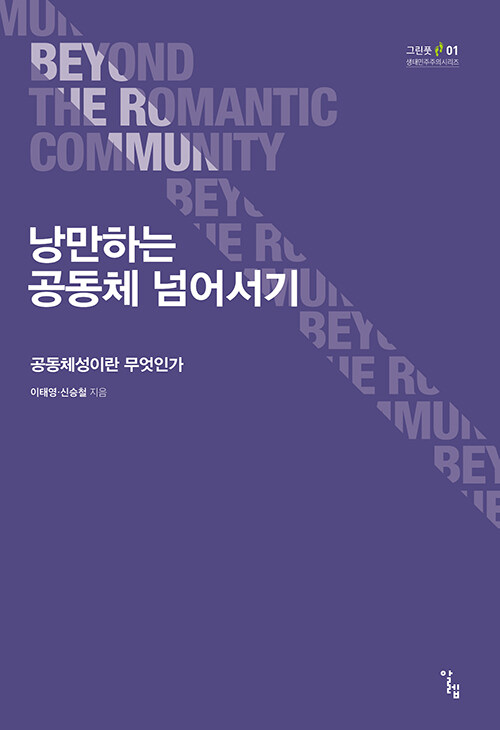
책소개 생태위기 시대에 우리의 민주주의는 어떻게 작동할까? 이 책은 공동체적인 대안에서 기후위기와 생태위기를 극복할 가능성을 모색한다. 공동체 활동가 이태영과 생태철학자 신승철이 그린풋(생태민주주의) 시리즈 중 “우리 시대의 공동체성”에 대한 근본적 물음과 성찰을 담아 ‘낭만하는 공동체 넘어서기’를 제안했다.
오늘날 우리 위기는 탄소기반경제와 그것을 지탱하는 산업자본주의에서 왔다. 그리고 그 위기를 극복하는 실천으로서 공동체적인 대안(플랫폼, 정동)이 떠오르고 있다. 이제 새로운 시민의 덕성과, 새로운 사회계약과, 공동자원을 관리하는 효율적인 시스템으로서 ‘공동체’가 적극적으로 검토되어야 한다.
공동체라는 개념에는 미래와 과거가 공존한다. 공동체는 새로운 미래를 상징하는 경로와 결과로 다뤄지는 한편, 가부장적이고 비근대적이며 개인의 자유가 없는 공간으로 여겨지기도 한다. 그래서 저자들은 공동체라는 개념을 전적으로 낭만하지도, 부정하지도 않은 채, 공동체에 대해서 질문하고 그 답을 찾는다. 이 책은 그러한 질문과 답변으로 이루어진 대화의 과정을 담는다.
Religion in Burundi is diverse, with Christianity being the predominant faith. Catholicism is the largest Christian denomination in the country, followed by Protestantism. Islam is the second largest religion, though its demographic share of the population has been subject to dispute.[2]
An estimate by the Encyclopedia of Africa in 2010, states that 67% of the Burundi's people are Christians, 23% follow traditional religions, and 10% are Muslims or adherents of other faiths.[7]
Censuses
The share of Christians increased from 78.8% to 85.3% of the total population between the 1990 and 2008 population and housing censuses. Similarly, the proportion of Muslims grew from 1.6% to 2.5%, and adherents of other religions also expanded from 0.6% to 6.1% of Burundians in the same period. Conversely, the share of those with an unknown religious affiliation has declined significantly from 18.7% to 6.1% by 2008.[8][9]
Both Christian and Muslim groups allege that the Muslim population has been undercounted and may constitute upward of 12–15% of the Burundian population.[2]
The earliest Christian missions arrived in 1879, but the missionaries were killed, and the king of Burundi, who ruled through 1908, had no interest in foreign theology or imported goods.[10]
Larger Christian missions arrived in Burundi in the early 20th century, during its German colonial rule era, and followed by its Belgian colonial rule era.[11] Catholic and Protestant missionaries arrived in the first two decades of the 20th century, while the 1920s saw the arrival of Baptists, the 1930s the arrival of Free Methodists and Anglican missionaries.[10] These missions were closely involved with the colonial project. In post-colonial independent Burundi, Christianity has had a deep engagement with political leaders of Burundi, a country with nearly 11 million citizens and one of the most densely populated nations in Africa (over 1000 people per square mile).[11]
The religious institutions within Burundi have both been called upon to help heal social divisions, help end civil chaos after political assassinations, and close wounds of mass violence, but they have also been criticized.[12] Some, such as Timothy Longman - a professor and director of the African Studies Center, state that the colonial officials and Christian missionaries assumed the people of the newly conquered lands to be "savage and anarchic", then worsened the ethnic divisions within the Burundi society by assuming that "the peoples of the world could be neatly divided into distinct racial categories and subcategories" in order to competitively convert them to Christianity.[13] The missionaries did not invent ethnic groups, states Longman, because they pre-existed. However, they did create racial significance when these didn't exist before, inadvertently creating ideological divisions and inequalities.[13]
Initial conversions to Catholicism in Burundi were almost exclusively among the Hutu people – the majority in Burundi but one who neither were the rulers nor were part of economic elite. In contrast, the Protestant missionaries gained early conversions in the elite but minority Tutsi people of Burundi.[14] The assumptions about the ethnic differences, states Longman, led to discriminatory practices, questionable distribution of property. The resulting conflicts and retaliatory genocide among the Hutu and Tutsi ethnic groups, in Burundi and Rwanda, with which Burundi shares history and culture, have attracted widespread dismay and attention.[15]
In the post-colonial contemporary era, Mushasha in the Gitega Province of Burundi serves as its archbishop's seat.[10] The traditional Catholic and Protestant community has been losing members to more emotional Evangelical Protestantism.[10]
Islam arrived in Burundi some 200 years before Christianity through Sunni Arab-Swahili traders active in the Lake Tanganyika region.[10] However, Islam has been a minority religion with some presence in the trading towns near the Lake.[10]
In 2022, Freedom House rated Burundi's religious freedom as 3 out of 4,[16] noting that relations between the government and the Catholic Church have worsened in recent years.
"National Profiles". Archived from the original on 10 October 2022. Retrieved 10 October 2022. The Muslim population is estimated to be as high as 10 percent.
The Constitution of Burundi provides for freedom of religion, and the Government generally respects this right in practice. Government policy contributes to the generally free practice of religion. In a 2007 US Government study, there were no reports of societal abuses or discrimination based on religious belief or practice.[1]
The country has an area of 10,747 square miles (27,830km2) and a population of 8,390,500. Although reliable statistics on the followers of various religious groups are not available, sources[who?] estimate the Christian population to be 67 percent, with Roman Catholics representing the largest group at 62 percent. Protestant and Anglican practitioners comprise the remaining 5 percent. The local representative of the Holy See estimates the Catholic population to be closer to 65 percent. An estimated 23 percent of the population adheres to traditional indigenous religious beliefs; some of the traditional indigenous groups promoted cures for HIV, AIDS and other ailments. The Muslim population is estimated to be as high as 10 percent, the majority of whom live in urban areas. Sunnis make up the majority of the Muslim population, and the remainder is Shi'a.
Foreign missionary groups are active in the country.
Status of religious freedom
Legal and policy framework
The Constitution, promulgated in March 2005, provides for freedom of religion, and the Government generally respected this right in practice. The Government sought to protect this right and did not tolerate its abuse, either by governmental or private actors. Discrimination on the basis of religious conviction is prohibited. A 1992 law covering nonprofit organizations, including religious groups, is the basis for the recognition and registration of religious bodies.
The Government requires religious groups to register with the Ministry of the Interior. Each association with a religious nature must file the following with the ministry: the denomination or affiliation of the religious institution, a copy of its statutes, the address of its headquarters in the country, an address abroad if the local religious institution is a subsidiary, and information about the association's governing body and legal representative. If an association with a religious nature fails to register with the Ministry, its representative is reminded of the requirement to do so. If the representative does not comply, the place of worship or association is instructed to close down. Although the representative of the religious institution or association can be jailed for 6 months to 5 years for failing to comply with these instructions, during the reporting period no representative received this penalty.
The Government requires that all religious groups maintain a headquarters in the country.
While there is no law that accords tax exemptions to religious groups, the Government often waives taxes on imported religious articles used by religious institutions and on the importation by religious institutions of goods destined for social development purposes. The Finance Ministry negotiates these exemptions on a case-by-case basis, and there is no indication of religious bias in the awarding of such exemptions.
The heads of major religious organizations are accorded diplomatic status. Foreign missionary groups openly promote their religious beliefs. The Government has welcomed their development assistance.
There were no reports of religious prisoners or detainees in the country.
Forced religious conversion
There were no reports of forced religious conversion, including of minor U.S. citizens who had been abducted or illegally removed from the United States, or of the refusal to allow such citizens to be returned to the United States.
Societal abuses and discrimination
There were no reports of societal abuses or discrimination based on religious belief or practice.
International Views
In 2022, Freedom House rated Burundi religious freedom as 3 out of 4,[2] noting that relations between the government and the Roman Catholic Church have worsened in recent years.
A 2021 report noted that the government recognizes and registers religious groups through a 2014 law governing the operational framework of religious groups, which states these organizations must register with the Ministry of Interior.[3]






.jpg)


 Gitega Church
 Bujumbura Mosque


