2025/12/20

How to Understand What You Read: 17 Easy Tips & Strategies

How to Understand What You Read: 17 Easy Tips & Strategies

PDF downloadDownload Article
Tips on how to read effectively for school, work, and leisure

Do you find that you forget what you read soon after you read it? Do you have trouble focusing when you need to read several pages? Improving your reading comprehension can help! Your reading comprehension is just your ability to read something, understand the information, and integrate it into the other information you already know. Improve your reading comprehension and you'll learn and retain more information to get more out of reading. Read on to learn what you can do today to better understand what you read.

Improving Reading Comprehension

  1. Skim the material first and do background research if necessary.
  2. Read actively, taking notes and marking up the text.
  3. Ask questions to better understand and relate to the material.
  4. Write a summary in your own words paraphrasing what you read.
  5. Revisit your notes and summary periodically to refresh your memory.
1

Eliminate distractions.

PDF downloadDownload Article
  1. Choose a quiet place to read where you can concentrate.
     To read closely, find a comfortable spot where you can sit and focus on the text. Make sure the area is well-lit and you have snacks, water, or anything else you might need nearby. Turn off notifications on your phone and do what you can to shut out anything else that might distract you.[1]
    • If you find it hard to concentrate in complete silence, some soft instrumental music in the background might help.
    • In a public place, such as a library or a café, you might want to try wearing headphones (with or without music) to isolate yourself.
2

Look through the pages you're going to read.

PDF downloadDownload Article
  1. Skim the headings to get a general idea of the topic.
     Flip through the material you need to read to get a sense of how it's organized and the information included. Pay attention to the way the material is divided and subdivided and how much ground you're going to cover. This also lets you know what the main idea or focus of the text is.[2]
    • As you skim, think about the topic or main idea covered and the information you already know about that topic. This can help you figure out if you need to do some background reading before you tackle this material.
    • It also helps to have a goal in mind as you get ready to read the material.[3]
    • For example, if you're reading something for a class, your goal might be to learn more about the topic of the next lecture.
3

Do background research if necessary.

PDF downloadDownload Article
  1. Build a basic understanding of the topic if you don't have one.
     It's much easier to understand what you read if you can fit it into context with other information that you already know. If you don't know anything at all about the topic, you'll have a hard time reading with any continuity because you'll have to stop and look things up all the time.
    • Getting a little background knowledge about the topic ahead of time is a good way to read more efficiently so that you'll get more out of everything that you read.[4]
    • Wikipedia pages can be good sources for a top-level summary that will give you a good basic understanding of a topic you're not super familiar with.
    • You might also read reviews or summaries of the material you're about to read (you can always save these for afterward as well).
4

Read the material closely and actively.

PDF downloadDownload Article
  1. Ask questions as you read to work actively through the material.
     While reading, ask open-ended questions to dig deeper into what the material is trying to say. Simply asking "why" after every sentence is often enough to get you thinking about the material on a deeper level.[5]
    • Asking questions turns reading from a relatively passive activity into an active pursuit. When your brain is engaged, you'll tend to understand better and recall more.
    • Asking questions also allows you to pinpoint precise parts of the text that are giving you trouble so you can fill in the blanks where necessary to unlock a greater understanding of the text.
5

Read the material aloud.

PDF downloadDownload Article
  1. Speaking can help you slow down and focus on the words.
     Research shows that when people read aloud, they tend to remember the material more consistently than they would if they read it silently. This memory-boosting effect also enhances your understanding of the text because you have a more accurate recall of it.[6]
    • Poetry and a lot of prose have a rhythm and inherent lyricism that makes it a much more profound experience when read aloud.
6

Use context clues when you don't know a word.

PDF downloadDownload Article
  1. Figure out a word's meaning by how it's used in a sentence.
     Typically, when you run into a word you haven't seen before, you can still get a general idea of what it means if you just take a look at the rest of the sentence. While this won't give you a perfect understanding, it should help you understand enough to get the basic idea of the text.[7]
    • Even if you use context clues to figure out what a word or phrase means by yourself, it's always helpful to take a moment to learn the true definition.
7

Build your vocabulary.

PDF downloadDownload Article
  1. Learn more words so you can read faster and more smoothly.
     The more words you know, the more material you can breeze through without having to stop to look up a word or figure it out from the context. If you don't have a large vocabulary, spend 5 to 10 minutes a day learning new words and you'll find that you start to understand what you read better.[8]
    • Keep a list with words and phrases you learn along with their definitions so you can refresh your memory every so often to expand your vocabulary, which will also help you better understand what you read.
8

Look up information you don't know.

PDF downloadDownload Article
  1. Expand your knowledge to enhance your understanding.
     If you don't understand the meaning of a specific word or reference, it can seriously impede your ability to understand the material. Make a note of anything you don't know so you can look it up as soon as you reach a good stopping place.[9]
    • When you return to the material, re-read the paragraph where the word or phrase appears, applying your newfound knowledge to reach a deeper understanding of the text.
    • It also helps to orient your reading by looking up general information about any places mentioned or time periods discussed. Then, you can put your reading in context.
9

Annotate as you read.

PDF downloadDownload Article
  1. Use highlights and underlining to mark important passages.
     If you have the ability to do so, being able to mark up the text will help you read more actively and really improve your reading comprehension. You'll have to think about which words or phrases you underline, and why, and how those parts relate to everything else in the material you've read.[10]
    • Writing comments in the margins is another good way to get a better understanding of what you're reading.
    • Include notes with your own thoughts or reactions as well to trigger an emotional reaction to the material, which will help you remember it better.
10

Create an outline of the text.

PDF downloadDownload Article
  1. Jot down important points to refer to later.
     Set up a separate document that you can use to create a basic outline of the material you read as you read it. This will help you see the underlying structure of the material and how the information is connected.[11]
    • In your outline, include any questions you have or things you want to look into further.
    • These will also help jog your memory as you're reviewing so you can tackle those for a greater understanding of the text.
11

Summarize each paragraph as you read.

PDF downloadDownload Article
  1. Write a single-sentence summary without looking back at the text.
     This is a good way to check your understanding of each paragraph before you move on with your reading. If you misunderstood or are unable to summarize a paragraph, go back and read it again slowly to try and figure it out.[12]
    • If you can write your summary directly on the page, it will also help you navigate the material later if you're reviewing and want to re-read something specific.
    • When you're done reading the material, you should be able to put all of your summaries together and get a cohesive overall summary of the material you've read.
    • Reader Poll: We asked 470 wikiHow readers which study guide format they find most effective, and 50% said a summary sheet[Take Poll]
12

Visualize the concepts you're reading.

PDF downloadDownload Article
  1. Imagine the scenario playing out in your mind.
     You might imagine you're a movie director and cast the movie of the material in your mind and watch it play out. Especially if you're reading about events that happened, picturing the scene will help you better understand what's going on.[13]
    • Visualizing also helps the material come to life in a way that it doesn't while it simply remains words on a page.
13

Relate the material to your own life.

PDF downloadDownload Article
  1. Make connections to your experience and other things you've read.
     When you make connections between the material you've read and your own life, you make that material a part of you in a way. It becomes much easier to understand and recall because it's attached to other memories. Any way you can relate the material to something you're already familiar with will enhance your overall understanding.[14]
    • It's helpful to put the material in context as well. You might look up other articles that reference what you've read or read online reviews to understand how it was received.
    • If there are other authors who write similar material or share a similar school of thought, connections between those authors can also help you discover connections between the material and the world around you.
14

Recall what you've read.

PDF downloadDownload Article
  1. Paraphrase the entire text in your own words.
     Once you've finished a section of the material, open a fresh document and attempt to write a short paraphrase of what you read. If you're unable to write anything cohesive, go back and read that section again. If this happens repeatedly, start breaking your material into smaller sections that you can recall more easily.[15]
    • The act of paraphrasing the material requires your mind to use the information you've just read to create something, which helps you understand it better.
15

Take frequent breaks while reading.

PDF downloadDownload Article
  1. Recall more by chunking the information.
     You'll gain a better overall understanding if you read short chunks of material and then take a break to process what you've read. [16]
    • For example, you might read for 45 minutes, then go outside and take a walk for 15 minutes to give your mind a rest and return to reading with a renewed focus.
16

Revisit your notes later.

PDF downloadDownload Article
  1. Use repetition to solidify the concepts in your mind.
     Pull out your notes a day later and see how much you can recall. What have you learned since you read that enhances your understanding of the text? Do this once a week or so, or whenever you read something else on a similar topic, to build a deeper understanding.[17]
    • When you continually revisit your notes, they become familiar to you—which means the topics discussed in those notes will become familiar to you as well.
17

Discuss the material with others.

PDF downloadDownload Article
  1. Talk about the material to enhance your understanding of it.
     If your reading was school- or work-related, you might talk it over with classmates or coworkers. Mention things that you didn't understand while reading and encourage others to do the same. Explaining something to someone else increases your own understanding as well.[18]
    • You can also share the material with people you know. Even better if they aren't familiar with the topic—you'll have to explain more, which can really boost your understanding.

Expert Q&A

  • Question
    How do I retain knowledge when taking an exam?
    Emily Listmann, MA
    Academic Tutor and Life Coach
    Expert Answer
    Try looking up different note-taking methods online to find one that works best for you while you are reading. For example, Cornell Notes and concept mapping are both popular note-taking methods.
  • Question
    How do I learn to better comprehend historical information?
    Emily Listmann, MA
    Academic Tutor and Life Coach
    Expert Answer
    The brain is not meant to remember isolated names, dates, and facts. Think of history in a larger, more connected sense by trying to find out more context for historical events and understand their larger significance instead of just a timeline of events.
Ask a Question

Video

Tips

Submit a Tip
All tip submissions are carefully reviewed before being published

About This Article

Emily Listmann, MA
Co-authored by:
Academic Tutor and Life Coach
This article was co-authored by Emily Listmann, MA and by wikiHow staff writer, Jennifer Mueller, JD. Emily Listmann is a Private Tutor and Life Coach in Santa Cruz, California. In 2018, she founded Mindful & Well, a natural healing and wellness coaching service. She has worked as a Social Studies Teacher, Curriculum Coordinator, and an SAT Prep Teacher. She received her MA in Education from the Stanford Graduate School of Education in 2014. Emily also received her Wellness Coach Certificate from Cornell University and completed the Mindfulness Training by Mindful Schools. This article has been viewed 765,710 times.
9 votes - 89%
Co-authors: 35
Updated: October 25, 2025
Views: 765,710
Thanks to all authors for creating a page that has been read 765,710 times.

Reader Success Stories

  • William M. 

    William M.

    Sep 18


How to Read Effectively: Boost Focus, Speed & Retention | Reading Genius

How to Read Effectively: Boost Focus, Speed & Retention | Reading Genius

How to Read with Focus, Speed, and Comprehension
Author: Ed Strachar
• Published on June 13, 2025


Introduction

Learning how to read is more than just recognizing words. It is about understanding, applying, and transforming information into usable knowledge.

Most people associate reading with schooling, but few are ever taught how to read effectively. The skill goes underdeveloped, leaving even intelligent readers unable to retain or apply what they consume.

Knowing how to read well is a foundational skill for anyone serious about lifelong learning.

Whether you’re tackling dense academic texts or absorbing high-level content quickly for your profession, your ability to read with focus and comprehension shapes your cognitive edge.

Understanding how to read opens doors to deeper knowledge, better memory, and smarter thinking.

In today’s fast-paced world, attention is fragmented, and distractions are constant. Without a method, most readers end up scanning words without engaging meaningfully.

That is why knowing how to read strategically, not just quickly, is an underrated intellectual advantage.

Most people assume reading faster means losing comprehension. In truth, how to read faster and better requires understanding why you are reading and how to navigate the material. Effective readers do not treat all texts the same.

They approach each with a structure tailored to their objective.

The first step in learning how to read with purpose is unlearning passive reading habits. This means letting go of the idea that reading is about getting to the end of a page.

It is about taking in information, analyzing it, and integrating it with what you already know.

When you learn how to read critically, you start noticing connections.

Patterns emerge. You stop highlighting entire pages and start asking better questions. Instead of passively underlining, you engage with the material and hold a conversation with the author.

How to read actively means slowing down, asking, “What does this mean? Why is this important? How does this connect to what I already know?” It is a discipline that separates elite thinkers from average ones.

The difference lies not in speed, but in depth.

Understanding how to read critically becomes especially useful in fields that rely on complex source material: academia, law, research, policy, and executive leadership.

These are areas where reading is not optional; it is foundational.


Understand the Four Levels of Reading

To truly master how to read, it helps to understand the four levels outlined by Mortimer Adler: elementary, inspectional, analytical, and syntopical reading.

Most people stay at the elementary level, basic decoding and comprehension. But professionals and academic minds benefit more by moving into analytical and syntopical modes.

Inspectional reading means skimming strategically, identifying structure and themes. Analytical reading demands you dissect arguments, weigh evidence, and uncover assumptions.

Syntopical reading goes a step further. It synthesizes multiple texts into a unified understanding. Learning how to read at this level changes not just what you learn, but how you think.
Build an Effective Reading Routine

How to read with discipline starts with structure.

An effective reading routine does not just rely on time spent; it optimizes the quality of engagement. One model includes pre-reading (surveying), setting a clear objective, focused reading, note-taking, and post-reading reflection.

Use methods like the SQ3R approach: Survey, Question, Read, Recite, and Review. It is not flashy, but it works.

This strategy forces engagement and retention at every step. Readers who adopt structured routines retain more and read less frequently, with better results.

Use Strategies to Improve Reading Speed and Retention

Speed is not the enemy of comprehension. In fact, how to read faster without sacrificing understanding is a skill that comes from practice and strategy.

The key lies in techniques like chunking (grouping words), reducing subvocalization (the voice in your head), and using a pacer (like a finger or pen).

Speed reading methods become powerful when used with intention.

It is not about rushing; it is about eliminating inefficiencies.

High performers know how to shift speeds depending on the material, accelerating through fluff and slowing down for complex ideas. Knowing when and how to read faster is a skill that adapts to the content.


Train Your Brain to Remember What You Read

Learning how to read is not just about intake; it is also about retention.

Retaining what you read is what turns information into transformation. Use spaced repetition, mental imagery, and summarization immediately after reading.

These are scientifically validated methods that help the brain encode and recall information.

Another method is the Feynman Technique. Explain what you just read to someone else using simple language. If you can teach it, you know it.

When paired with visual tools like concept maps and note structures like Cornell Notes, retention can improve dramatically.

Apply What You Read to Real Life

The best indicator of how to read is whether it changes how you think and act.

Reading without application is like memorizing ingredients without cooking a meal. Apply what you read by writing about it, teaching it, or acting on it. Integration is the final and most critical step in the reading process.

Synthesis happens when the information you read shows up in decisions, conversations, or creations.

It is how you connect what you read to your goals and challenges. If you are not applying what you read, you are consuming passively, not learning deeply.

Reading is a lifelong skill, but like any skill, it needs refining.

Some educators argue that comprehension suffers when reading becomes a mechanical habit rather than a thoughtful process.

This is why guides like 10 Tips on How to Understand What You Read emphasize questioning, visualizing, and summarizing as essential tools for meaningful engagement.

In academic settings, structured strategies are especially vital.

Institutions like Western Sydney University offer practical, research-based frameworks in their How to Read Effectively resource.

These emphasize time management, note organization, and context awareness, all reinforcing the idea that good reading is intentional and deliberate.

Introducing ReadingGenius®

For those who want to go beyond techniques and enter a state of reading transformation, ReadingGenius® offers a proven and holistic system.

It is not a speed reading gimmick. It is a comprehensive method designed to train your brain to think and absorb information in highly efficient ways.

Used by professionals, students, and elite thinkers, ReadingGenius® teaches you how to read with both speed and depth without compromising comprehension.

It focuses on mental clarity, emotional learning, and neurological engagement. While this blog offers strategies, ReadingGenius® delivers a framework for activating your untapped cognitive capacity.

Frequently Asked Questions (FAQ)

How can I learn how to read more effectively?
Build a structured routine that includes pre-reading questions, active engagement, and post-reading reflection. Use tools like SQ3R and mind maps to support comprehension.

How do I know if I am understanding what I read?
Try to summarize the text in your own words or teach it to someone else. Comprehension is measured by your ability to explain and apply the material.

Can speed reading help me retain more?
Yes, but only when paired with intentional strategies. Skimming alone will not help. Techniques like chunking and reducing subvocalization can boost speed while maintaining understanding.

What is the best way to remember what I read?
Use spaced repetition, explain what you learned out loud, and write short summaries. Memory thrives on review and application.

How do I stay focused while reading?
Create a distraction-free environment, read in intervals using the Pomodoro method, and set a purpose for each session. Focus improves with consistent practice and meaningful goals.

Conclusion

How to read well is not a gift; it is a trainable skill. It requires intention, discipline, and proven techniques. The most effective readers are not the fastest, but the most strategic. Whether you are a student, academic, or executive, improving how you read will elevate how you think.

You do not have to overhaul your habits overnight.

Start with one strategy, implement it daily, and track the results. And if you are ready to train beyond technique, explore systems like ReadingGenius® that integrate brain, body, and behavior into the learning experience.

Ready to transform how you read?

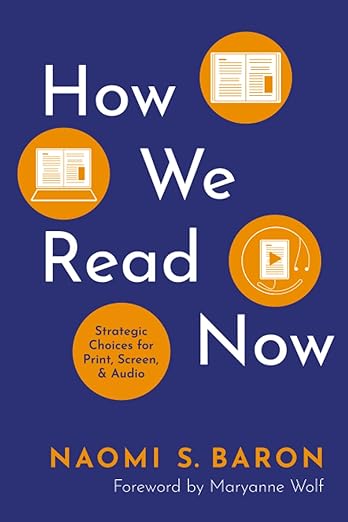
How We Read Now: Strategic Choices for Print, Screen, and Audio : Baron: Amazon.com.au: Books

How We Read Now: Strategic Choices for Print, Screen, and Audio : Baron: Amazon.com.au: Books

Kindle
$24.83
Available instantly

Hardcover
$44.57

Paperback
$46.95


How We Read Now: Strategic Choices for Print, Screen, and Audio Paperback – 30 December 2022
by Baron (Author)
4.6 4.6 out of 5 stars (35)


An engaging and authoritative guide to the impact of reading medium on learning, from a foremost expert in the fieldWe face constant choices about how we read. Educators must select classroom materials. College students weigh their textbook options. Parents make decisions for their children. The digital revolution has transformed reading, and with the recent turn to remote learning, onscreen reading may seem like the only viable option. Yet selecting digital is often based on cost or convenience, not on educational evidence. Now more than ever it is imperative to understand how reading medium actually impacts learning--and what strategies we need in order to read effectively in all formats. In How We Read Now, Naomi Baron draws on a wealth of knowledge and research to explain important differences in the way we concentrate, understand, and remember across multiple formats. Mobilizing work from international scholarship along with findings from her own studies of reading practices, Baron addresses key challenges--from student complaints that print is boring to the hazards of digital reading for critical thinking. Rather than arguing for one format over another, she explains how we read and learn in different settings, shedding new light on the current state of reading. The book then crucially connects research insights to concrete applications, offering practical approaches for maximizing learning with print, digital text, audio, and video. Since screens and audio are now entrenched--and invaluable-platforms for reading, we need to rethink ways of helping readers at all stages use them more wisely. How We Read Now shows us how to do that.
Read less

304 pages

Review
"Baron's work provides a weighted and critical description of printed and digital environments from an educational point of view, focusing on those factors of improvement that each of them entails. One of its main contributions is the introduction of audio and video analysis as complementary forms of reading that are becoming more and more important as the platforms for their use expand, and the services offered increase." -- José Antonio Cordón, University of Salamanca, Escola de Llibreria

"Beyond being eminently readable, How We Read Now is also inspiring in terms of design. Recommended. Graduate students, researchers, faculty, and professionals; general readers." -- P. Finley, University of Nevada, Las Vegas, CHOICE

"A well-researched, accessible treatise on all the ways we experience and absorb words... Educating tomorrowâs generations is of urgent importance to all of us, and for that reason, How We Read Now is must reading. Baron does not prescribe particular reading platforms, but rather enables us to better assess all the possibilities... Baron's light, conversational style makes for enjoyable reading - whether in print or on a screen. " -- Bàrbara Mujica, Washington Independent Review of Books

"How We Read Now is a wonderful guide to the complicated landscape where our minds meet the written word; it helps us understand how we read, how we learn, and how we navigate a changing world of text, information, stories, and connection, for ourselves and for our children." --Perri Klass, Professor of Journalism and Pediatrics, New York University, and author A Good Time to Be Born

"Naomi Baron has done a huge service to everyone involved in the study, teaching, and practice of reading-which means all of us. Written in a friendly and informal style, with well-placed signposts and summaries, her succinct synthesis of research findings provides a wealth of timely and relevant advice for policy-makers, teachers, students, parents, and children." --David Crystal, Honorary Professor of Linguistics, Bangor University, and author of Let's Talk

"Naomi Baron has done it again. She has enticed us to take a long, hard look at reading in this technological age. How We Read Now brings the advantages and disadvantages of each medium into the light, and guides us on what, when, or why to read in one medium or another. This eye-opening book is truly a 'must read' for educators, parents, and students." --Patricia Alexander, Distinguished University Professor, University of Maryland

"Dr. Baron clearly synthesizes the issues surrounding how we read from printed and screen texts. Everyone needs to read this book." --Larry D. Rosen, Professor Emeritus of Psychology, California State University, Dominguez Hills, and co-author of The Distracted Mind

"Naomi Baron expertly presents the latest research on the cognitive and behavioral facets of 'reading to learn' in multiple formats. She offers an accessible translation of points and strategies for policymakers and educators, including parents, to consider for readers at all levels. This book is essential reading in a time of transition to digital publishing." --Diane Mizrachi, UCLA Library, and Alicia Salaz, Carnegie Mellon University

===
From other countries


Chuck Werninger
5.0 out of 5 stars Timely Research Findings!
Reviewed in the United States on 4 June 2021
Format: HardcoverVerified Purchase
This book really helps educators understand what learners are reading and where they're learning...and not learning...and how that's changing in the last few years and especially since the pandemic began so it's very timely!
2 people found this helpful
Report


Gilvan Vilarim
5.0 out of 5 stars Bom!
Reviewed in Brazil on 7 April 2023
It provides a text for laypeople but with countless academic references from various studies. Try to balance the discussion between digital and printed reading, identifying the positive and negative sides of each one. It also includes the issue of audios, as in the case of audiobooks.
Translate review to English


C. D. Waage
4.0 out of 5 stars How We Learn to Read
Reviewed in the United States on 9 April 2021
Format: HardcoverVerified Purchase
I thought this was a book about how to improve your reading style. It's more of a book for teachers trying to teach students to learn to read. So if you want a teacher, probably has limited use to you.
2 people found this helpful
Report


===
Naomi Baron

Article
Talk
Read
Edit
View history

Tools
From Wikipedia, the free encyclopedia
Sorry to interrupt, but we're short on time to hit our goal.
This Saturday, we ask you to join the 2% of readers who give. If everyone reading this right now gave just $2.75, we'd hit our goal quickly. $2.75 is all we ask.
Give $2.75 Maybe later
 20 December: Wikipedia still can't be sold
We're sorry we've made several attempts to reach you lately, but it's Saturday, 20 December, and we still need some help. If everyone reading this gave $2.75 today, we'd hit our goal in a few hours. Most readers don't donate; only 2% do. Wikipedia is run by a nonprofit, not by a billionaire. So if Wikipedia has given you $2.75 worth of knowledge, please give. Any contribution helps, whether it's $2.75 or $25.
Give $2.75
Give a different amount
Maybe later 
I already donated
Close 
Naomi S. Baron (born September 27, 1946, New York, NY) is a linguist and professor emerita of linguistics at the Department of World Languages and Cultures at American University in Washington, D.C.[1]

Education and career
Baron earned a B.A. in 1968 in English and American Literature at Brandeis University, and, in 1973, a PhD in linguistics at Stanford University. Her dissertation is titled, "The Evolution of English Periphrastic Causatives: Contributions to a general theory of linguistic variation and change."[2] She taught at Brown University, the Rhode Island School of Design, Emory University, and Southwestern University before coming to American University, where she held a position from 1987 until her retirement.[when?]

Research interests
Her areas of research and interest include computer-mediated communication, writing and technology, language in social context, language acquisition and the history of English. She is also interested in language use in the computer age, instant messaging, text messaging, mobile phone practices, cross-cultural research on mobile phones, Human multitasking behavior, and Facebook online social interaction usage by American college students.[3] She has published a number of books on these topics.

Honors and awards
She was a Guggenheim Fellow,[4] Fulbright Fellow, and president of the Semiotic Society of America.[5]

Her book, Always On: Language in an Online and Mobile World, which was published in 2008, won the English-Speaking Union’s HRH The Duke of Edinburgh ESU English Language Book Award for 2008.[6][7]

Selected works
Books
Baron, Naomi S., Words onscreen. The fate of reading in a digital world, Oxford : Oxford University Press, 2015. ISBN 978-0-19-931576-5
Baron, Naomi S., Always on : language in an online and mobile world, Oxford; New York : Oxford University Press, 2008. ISBN 978-0-19-531305-5
Baron, Naomi S., Alphabet to E-mail: How Written English Evolved and Where It's Heading, London; New York : Routledge, 2000. ISBN 0-415-18685-4
Baron, Naomi S., Growing up with language : how children learn to talk, Reading, Mass. : Addison-Wesley Pub. Co., 1992. ISBN 0-201-55080-6
Baron, Naomi S., Pigeon-birds and rhyming words : the role of parents in language learning, Englewood Cliffs, N.J. : Prentice Hall, 1990. ISBN 0-13-662875-3
Baron, Naomi S., Computer languages : a guide for the perplexed, Garden City, N.Y.: Anchor Press/Doubleday, 1986. ISBN 0-385-23214-4
Baron, Naomi S., Speech, writing, and sign : a functional view of linguistic representation, Bloomington : Indiana University Press, 1980. ISBN 0-253-19373-7
Baron, Naomi S., Language acquisition and historical change, Amsterdam; New York : North Holland Pub. Co.; New York : distributors for the US and Canada, Elsevier North-Holland, 1977. ISBN 0-444-85077-5
References
 "Naomi Baron - Prof Emerita". American University. Retrieved 2021-12-30.
 "Ph.D. Alumni | Linguistics". linguistics.stanford.edu. Retrieved 2021-12-30.
 "Always On: Joint Winner of the 2008 Duke of Edinburgh ESU English Language Book Award", Oxford University Press news, 2008.
 John Simon Guggenheim Foundation List of All Fellows https://www.gf.org/fellows/all-fellows/naomi-s-baron/
 "Who We Are – Semiotic Society of America". 10 May 2021. Retrieved 2021-12-30.
 "HRH The Duke of Edinburgh ESU English Language Book Award 2008", ESU, November 12, 2008
 "Awards Ceremony at Buckingham Palace", ESU, November 12, 2008.
Further reading
Fahmy, Sameh, "E-mail and the mangling of the English language", USA Today, May 14, 2002, Gannett News Service
"Being 'Always On' Impacts Personal Relationships More Than It Impacts The Written Language", Science Daily, May 24, 2008
Maynard, Melissa, "Review: Always On: Language in an Online and Mobile World"[permanent dead link], Critical Inquiry in Language Studies, 2008.
External links
Official website at American University

changing reading habits.

(1) Facebook

AI Overview

The image displays the spines of four books, two of which are different editions or translations of works by the author Maryanne Wolf. The other two books are by Naomi Baron. 
Titles: Proust and the Squid, How We Read Now, and Reader, Come Home are visible.
Authors: Maryanne Wolf and Naomi Baron are the authors.
Language: The books appear to be Korean editions or translations of the original English works.

Topics: 
The books focus on the science of reading, literacy, and how digital media is changing reading habits.

Translation
Proust and the Squid: How We Read Now
Again, How Will We Read?
Naomi Baron, Author
Jeon Byeong-geun, Translator
Proust and the Squid
Again, To the Book
Reader, Come Home
Maryanne Wolf, Author

Literacy Gap
Kim Ji-won, Min Jeong-jong, Authors
Maryanne Wolf, Author

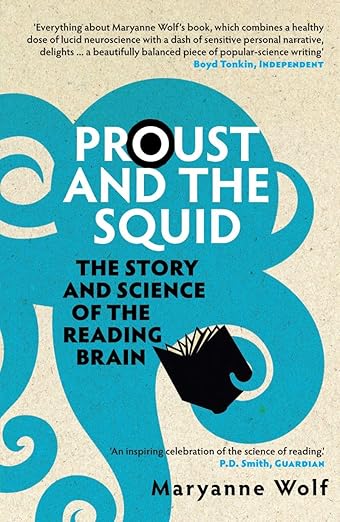
Proust and the Squid: The Story and Science of the Reading Brain: The Story and Science of the Reading Brain - WOLF, MARYANNE | 9781848310308 | Amazon.com.au | Books

Proust and the Squid: The Story and Science of the Reading Brain: The Story and Science of the Reading Brain - WOLF, MARYANNE | 9781848310308 | Amazon.com.au | Books

Paperback
$22.86


Proust and the Squid: The Story and Science of the Reading Brain: The Story and Science of the Reading Brain Paperback – Import, 1 December 2008
by MARYANNE WOLF (Author)
4.6 4.6 out of 5 stars (691)

Edition: 1st

See all formats and editions


A path breaking study of the brain and how the invention of reading has altered man's evolution.

How the brain learned to read is a startling reminder of the amazing achievements of humankind. We were never born to read, says Maryanne Wolf. No specific genes ever dictated readings development. Human beings invented reading only a few thousand years ago. And with this invention, we changed the very organisation of our brain, which in turn expanded the ways we were able to think, which altered the intellectual evolution of our species. In Proust and the Squid, Maryanne Wolf explores our brains near-miraculous ability to arrange and rearrange themselves in response to external circumstances. Wolf, a world expert on the reading brain, brings both a personal passion and a deft style to this incredible story. A pop science masterpiece on a subject that anyone who loves reading will be sure to find fascinating.
Read less


==
About the Author
Maryanne Wolf teaches at Tufts University and is Director of the Center for Reading and Language Research in Boston, USA. She teaches and lectures all over the world and is a renowned expert on the reading brain.
==
From Australia


Lisa Smith
5.0 out of 5 stars Excellent
Reviewed in Australia on 26 October 2020
Format: PaperbackVerified Purchase
Excellent! Well written! Based on solid evidence.
Helpful
Report


Amazon Customer
5.0 out of 5 stars Five Stars
Reviewed in Australia on 9 June 2017
Format: AudiobookVerified Purchase
:)
Helpful
Report
From other countries


neunzert
5.0 out of 5 stars Sehr spannendes Buch mit originellem, aber schwer verständlichem Titel
Reviewed in Germany on 16 June 2017
Verified Purchase
Das ist ein sehr spannendes Buch, leider gibt es nichts vergleichbares in deutsch. Es kam ja antiquarisch aus USA, war aber gut erhalten und ist wirklich lesenswert. Der Titel ist ein schöner Hinweis auf den Inhalt, aber sicher nicht leicht verständlich. Das Buch hält aber, was der Titel verspricht.
One person found this helpful
Report
Translate review to English


Dr. Lee D. Carlson
5.0 out of 5 stars An excellent introduction to the cognitive neuroscience of reading
Reviewed in the United States on 10 July 2008
Format: HardcoverVerified Purchase
In this fascinating work, which might be viewed as an introduction to the cognitive neuroscience of reading, the author gives the reader an excellent overview of the cultural origins of writing/reading, the brain mechanisms that are responsible for the ability to read, and the factors behind the inability to read. Written for a general audience, the book does contain some information of a more technical nature for those readers who might have a general background in neuroscience or cognitive neuroscience. Those readers who need more can find much more detailed information in the references. Everything about this book is interesting, especially to those who may be described as "obsessive" readers that spend a great majority of their life reading and are interested in knowing more about the cognitive mechanisms behind the reading act.


There are many interesting discussions and questions that are provoked by the reading of this book. Some of these include:
- Once one has achieved what the author has called "expert" reading status, what is the effect of biological age on this status? Does biological aging affect the "rate of processing" of textual information and if so to what degree? Along these same lines, is it more difficult for an older person to learn how to read as compared to young children?


- Erotic literature has the propensity for physical arousal, so does its reading evoke even more of the imaginative properties of the reading brain than does other types of literature or less? In addition, it would seem that the limbic system would play a greater role in erotic literature, since more emphasis is being placed on attention and imagination than comprehension.


- The technical description that author gives of the "first 500 milliseconds" of reading is fascinating and sheds light on the degree to which the reader must be attentive to the words in the text. But in relation to the need for this attention, while reading a book everyone no doubt has experienced the process of "drifting": you are turning the pages of the book and reading the text but your mind is engaged in other thoughts far removed from the content of the book. After some time and possibly many pages later you catch yourself and then skim the pages you thought you missed. Is the information in the book still assimilated when "drifting" or is completely ignored because the reader is not exercising deliberate concentration? Or is it being partially assimilated and to what degree? And if only partially, can the "skimming" fill in the lost details? If one believes the author's technical description then when "drifting" certain areas of the `parietal lobe', those that are responsible for "disengaging" attention from whatever else we are doing, are not being activated, but the `superior colliculi' that is responsible for eye movements, and the `thalamus' that coordinates information from the brain are.


- Is "speed reading" a viable or effective strategy and what exactly is behind it? Does speed reading require other neuronal mechanisms over and above what is discussed in the "first 500 milliseconds"? People who claim to be able to speed read usually also claim that they do so with complete comprehension. Is this true or are they missing some important information from the book? Unfortunately the author does not discuss speed reading in this book.


- Does it become easier to assimilate knowledge the more one reads? If one accepts the author's explanations this would be the case, for she holds that less time is required for a "fluent" brain to represent and retrieve the visual, phonological, and semantic information needed for reading. But in this regard is it possible to read "too much", i.e. to read at such an intensity/frequency that a kind of "asymptotic limit" is reached for the ability to retrieve information from `associative' memory as described by the author?


- Is the reading process as discussed by the author different to some degree when reading technical literature? Those who read mathematical texts can attest to the large degree of concentration needed as compared for example to reading a novel or a news story. The author asserts that the speed that we read a word is influenced greatly by the quality and quantity of the semantic or background knowledge that is activated by that word. But does this also hold for mathematical equations or other types of symbolic expressions that are essentially outside colloquial grammars? English grammar for example does not include mathematical expressions as part of its syntax or semantics so when such expressions are included in texts, as they are of course in mathematical texts written in English, the reader's "flow" must be interrupted so as to deal with these expressions. This slows down the reading rate considerably, and frequently a lot of backtracking must be done in order to fully comprehend the text. Ironically, visualization plays a strong role in the understanding of mathematical texts, but the authors of these texts frequently eschew the idea of incorporating diagrams or pictures in them.


- The author devotes a considerable part of the book to the historical invention of language and reading and compares the skepticism of Socrates towards writing/reading to her own skepticism on the use of online tools for the presentation of information. As far as the explanatory power of verbal narratives are concerned, Socrates certainly had a point if one is only concerned with dialogs of a philosophical or argumentative nature, as of course Socrates was deeply embedded in. But think of how difficult it would be exchange highly sophisticated mathematical information in a verbal dialog. Such an exchange almost necessitates the use of writing, as well as its preservation. And as far as online information and the way it is presented, the jury is still out on its efficacy due to the short timeline that the Internet has been available to everyone. In this regard the author, and all of those who love to read, must be careful not to morph into technoreactionaries when dealing with the new methods of presenting information. These new methods may be even more effective, even more fun, than the activity we have all done for thousands of years, this activity which at some point in the future may be christened as "classical reading."
27 people found this helpful
Report


Matilda
4.0 out of 5 stars A scientific approach to reading achievement and the problem of dyslexia
Reviewed in Spain on 13 August 2013
Format: PaperbackVerified Purchase
This book provides an overview of the neurological processes that take place during learning to read. It's quite fun, you learn with it and it invites you to think. A glossary is missed because sometimes it is very difficult to understand technical terms.
2 people found this helpful
Report
Translated from Spanish by Amazon
See original ·Report translation


-K-
5.0 out of 5 stars Loved the book! Highly recommended...
Reviewed in India on 8 August 2022
Verified Purchase
I would recommend this book to anyone who's interested in learning more about reading and the science behind it...really good book
Report


深川高山
5.0 out of 5 stars 読みやすいですよ。
Reviewed in Japan on 10 February 2010
Verified Purchase
邦訳版が読みづらかったので、原書を買ってみました。引用文以外は、読みやすい文章です。専門用語は、日本語でも意味がわかりませんから、気にせず読んでしまいましょう。引用文は文学的で、素人には少し荷が重いですね。
13 people found this helpful
Report
Translate review to English


Bryon L White
5.0 out of 5 stars Terrible Title But Great Book
Reviewed in Canada on 30 March 2025
Verified Purchase
The title of this book is horrible and doesn’t give readers any insight to the book’s contents. Proust put me to sleep, BUT this is a really interesting read about how writing evolved, how the brain reads and the connection to neurological development, and why some struggle. Unlike Proust or squids, it kept me turning pages.
Report


Ilkka Lavonius
5.0 out of 5 stars Five Stars
Reviewed in the United Kingdom on 15 June 2016
Format: PaperbackVerified Purchase
Advanced scientific results well explained, interesting graphics, personal point of views.
ILs
Report


Amazon Customer
5.0 out of 5 stars Proust and the Squid
Reviewed in Italy on 2 April 2015
Verified Purchase
The book arrived in time and the package was good. Excellent service. The book was also in excellent conditions. So now I only have to read it..
2 people found this helpful
Report

==