
Jesus Christ (as) did not die on the cross – a cardiologist's perspective
Author: Professor Dr. MMH Nuri, Rabwah/Pakistan
introduction
In recent years, the crucifixion of Jesus Christ (AS) has attracted considerable interest. The masterpiece by the Promised Messiah, Hadhrat Mirza Ghulam Ahmad (AS) , "Jesus in India," inspired this author to undertake an interdisciplinary investigation into the circumstances of the crucifixion and to present a historically and medically accurate analysis of why Jesus Christ (AS) fell into a state of unconsciousness, the circumstances that led to his recovery, and the evaluation of other clinical differential diagnoses from other physicians. There is a body of evidence in the literature concerning the course of the crucifixion. However,
The credibility of the discussion is primarily determined by the credibility of the source material. For this “theory,” the source material includes the extensive and detailed descriptions of the process of flogging and crucifixion in the Gospels of the New Testament [3] and various contemporary Christian and non-Christian authors. [14] The interpretations of modern authors, based on the findings of science and medicine, can offer additional insights into this topic.
Jesus Christ AS was arrested in Gethsemane after midnight and brought before the high priest, where he was found guilty of blasphemy. Shortly after daybreak, his eyes were blindfolded, he was spat upon, and his face was punched.
There are no reports of any blood loss, nor do significant blood losses occur in such attacks. Furthermore, it is reasonable to assume that Jesus Christ AS was in good physical condition.
Practices of flagellation
At the Praetorium, Jesus Christ (AS) was flogged, a precursor to almost every Roman execution. The instrument used was a short whip with several individual or bound leather thongs of varying sizes, in which small iron balls or, at intervals, sharp pieces of sheep bone were tied. [4,7,8]
The victim was stripped of his clothing and his hands were tied to an upright post. [8] He was then whipped on the back, with the side and parts of the chest being grasped in front. (See illustration above)
The iron balls of the whips caused deep bruising, and the sharp pieces of sheep bone caused deep cuts in the skin and subcutaneous tissue. [4,7,8] The extent of blood loss may certainly be a determining factor in how long the victim would survive on the cross. [9] In the case of Jesus Christ AS, the scourging was mild and the blood loss minimal. Also, the severity of the scourging is not described in the four Gospels [3] , and it is not known whether the number of lashes was limited to 39, in accordance with Jewish law. [4]
Surviving the Crucifixion
The duration of survival on the cross varied between two and five days, averaging three days. [8,9] Jesus Christ AS did not carry the cross from the place of scourging to the place of crucifixion (which was normally done for condemned men), which were a third of a mile (600-650 m) apart. [3,4,7,8,9,13]
On Golgotha, the site of the crucifixion, after noon on that Friday, Jesus Christ (AS) cried out in a loud voice, bowed his head, and fainted. [3:15] He remained on the cross for only about two hours, until the sixth hour on Friday, just before sunset, because the next day was the Sabbath, and according to Jewish custom, it is unlawful to leave someone on the cross on the Sabbath or the night before. The soldiers broke the legs of the two thieves, but not those of Jesus Christ (AS) , mistaking his faintness for death. [3] Instead, one of the soldiers pierced his chest with an infantry spear [3] , presumably through the pericardium, causing an immediate flow of blood and water. After a sandstorm and a violent earthquake, the people fled. [3:15]
Christ was presumed dead, and his body was handed over to Joseph of Arimathea. [3:15:8] Nicodemus, a well-read physician who knew the secrets of "therapents"—a term used in therapeutics—saw blood and water flowing from the wound, which is not seen in a dead person, and said in a low voice, "Friends, take heart, and let us proceed. Jesus is not dead. It only appears so because he lacks strength." [15] Nicodemus gently laid Jesus' body on the ground and anointed it with strong spices and healing ointments to protect it from further harm. These spices and ointments had great healing powers and were used in those days. Both Joseph and Nicodemus "blew their breath into him," [15] as if performing mouth-to-mouth resuscitation. Nicodemus was also convinced that “the wound in Jesus’ side should not be closed, as he considered the flow of blood and water helpful for breathing and beneficial for the renewal of life.” [15] This is common practice for patients with pericardial tamponade (bleeding or fluid accumulation in the pericardial sac), where, after aspiration with a broad-bore needle, the blood can be drained to prevent re-accumulation. On Pilate’s advice, Jesus Christ AS was taken to an inconspicuous, nearby house, which was built like a tomb or crypt. [3]
<figure style="box-sizing: border-box; margin: 0px 0px 3rem; display: block; position: relative; color: rgb(68, 68, 68); font-family: "Open Sans"; font-size: 16px; font-style: normal; font-variant-ligatures: normal; font-variant-caps: normal; font-weight: 400; letter-spacing: normal; orphans: 2; text-align: start; text-indent: 0px; text-transform: none; white-space: normal; widows: 2; word-spacing: 0px; -webkit-text-stroke-width: 0px; background-color: rgb(255, 255, 255); text-decoration-thickness: initial; text-decoration-style: initial; text-decoration-color: initial; “ class="wp-block-image size-full">
 </figure>
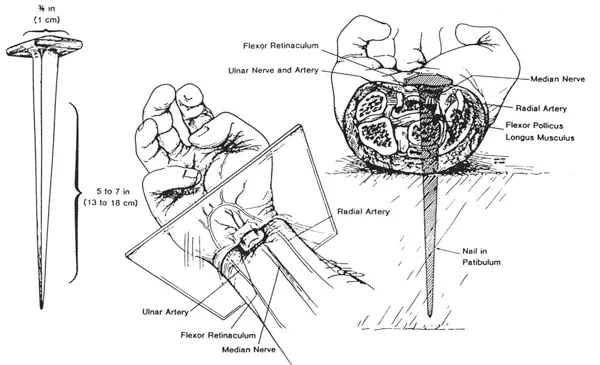
Figure 1: Nailing of the wrists
. Left: Size of the iron nail.
Center: Position of the nail in the wrist between the carpal bones and the radius.
Right: Cross-section of the wrist. Path of the nail in the plane is shown, with presumed transection of the median nerve and impalement of the flexor pollicis longus muscle, but without injury to arteries and without bone fractures. Blood loss is therefore minimal. [6]
Medical Aspects of the Crucifixion and Flagellation of Jesus Christ AS
The severity of the flogging depended on the temperament of the lictors (Roman soldiers) and was intended to humiliate and weaken the victim. [9] In the case of Jesus Christ AS, the flogging was rather mild due to Pilate's seemingly benevolent disposition. The iron balls caused bruising, and the pieces of sheep bone caused lacerations to the skin and subcutaneous tissue [7] , consequently, blood loss was minimal. The sharp pieces of sheep bone likely injured the pericardium, leading to the slow accumulation of blood in the pericardial sac. Had the blood accumulation progressed more rapidly, much greater damage would have been expected, as a faster accumulation would not be compatible with adequate cardiac function. The extent of the blood accumulation certainly determined the point at which Jesus Christ AS fell into a coma.
Crucifixion of Jesus AS
With arms outstretched, the wrists were nailed to the cross. It is known that the ligaments and bones of the wrist can support the weight of the body, but the palms cannot. [8,11,16,17] The nail in the wrist might have fit between the bony elements and not caused any fractures. However, the likelihood of a painful periosteal injury (injury to the periosteum, which is rich in nerves and consequently associated with strong pain) seems very high. [7,8,16] (See illustration below)
<figure style="box-sizing: border-box; margin: 0px 0px 3rem; display: block; position: relative; color: rgb(68, 68, 68); font-family: "Open Sans"; font-size: 16px; font-style: normal; font-variant-ligatures: normal; font-variant-caps: normal; font-weight: 400; letter-spacing: normal; orphans: 2; text-align: start; text-indent: 0px; text-transform: none; white-space: normal; widows: 2; word-spacing: 0px; -webkit-text-stroke-width: 0px; background-color: rgb(255, 255, 255); text-decoration-thickness: initial; text-decoration-style: initial; text-decoration-color: initial; “ class="wp-block-image size-full">
 </figure>
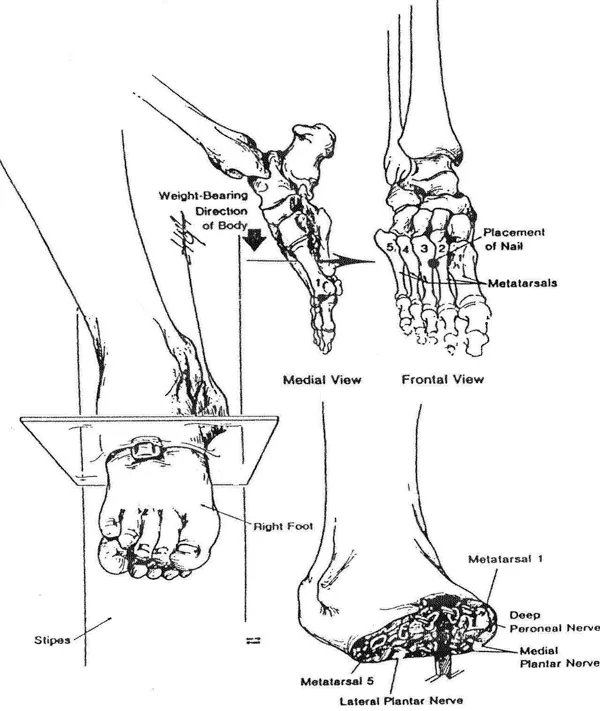
Figure 2: Nailing of the feet.
Left: Position of the feet stacked on top of each other and against the cross. Top right: Position of the nail in the second intermetatarsal space.
Bottom right: Cross-section of the foot at the level of the plane from the left image shows the path of the nail.
Most often, the feet were attached to the front of the cross by means of an iron nail through the first or second intermetatarsal space (the space between the first and second toes), immediately distal to the tarsometatarsal joint. [4,8,9,16,17] Thus, the crucifixion itself was a relatively bloodless procedure, since no major arteries pass through the affected anatomical sites of the piercing. [8,11,16] (See figure below)
<figure style="box-sizing: border-box; margin: 0px 0px 3rem; display: block; position: relative; color: rgb(68, 68, 68); font-family: "Open Sans"; font-size: 16px; font-style: normal; font-variant-ligatures: normal; font-variant-caps: normal; font-weight: 400; letter-spacing: normal; orphans: 2; text-align: start; text-indent: 0px; text-transform: none; white-space: normal; widows: 2; word-spacing: 0px; -webkit-text-stroke-width: 0px; background-color: rgb(255, 255, 255); text-decoration-thickness: initial; text-decoration-style: initial; text-decoration-color: initial; “ class="wp-block-image size-full">
 </figure>
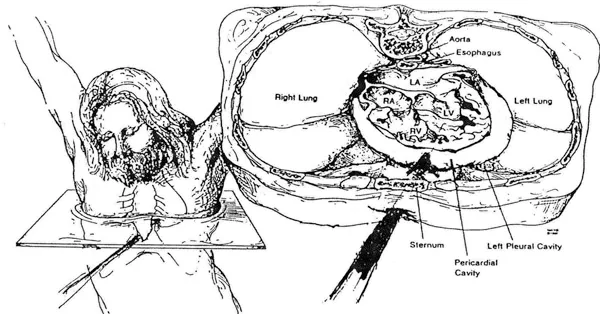
Figure 3: Spear wound on the chest
. Left: Possible direction of the spear.
Right: Cross-section of the thorax, at the level of the left image, showing perforated structures caused by the spear at the pericardial sac. LA means left atrium; LV: left ventricle; RA: right atrium; RV: right ventricle. (Adapted from Edwards et al.[6])
The actual cause of death varies from case to case. It depended primarily on the victim's initial state of health, including their mental condition, the duration of their time on the cross, the degree of dehydration, the excruciating pain, the degree of exhaustion, asphyxia (due to prolonged disruption of normal breathing), blood loss with hypovolemia (excessive blood loss), and crural fracture (the act of breaking someone's legs to alleviate the pain of hastening death on the cross). Jesus Christ AS was in good health and excellent mental condition. He remained on the cross for only a very short time, with minimal exhaustion, dehydration, and asphyxia. Blood loss was minimal during both the scourging and the crucifixion, virtually eliminating the possibility of shock due to significant blood loss. No bones were broken to hasten death. The spear wound to the chest can lead to a pleural effusion, but the blood of a dead person would clot due to the weak flow; at most, a few blood clots mixed with pleural fluid would be expelled. It is highly probable that the infantry spear saved the life of Jesus Christ AS when it pierced his pericardium, thus reviving his blood-filled heart "as blood and water flowed out." (See illustration on p. 56)
Only when the heart of a living person is beating is it possible for blood to flow out. Skepticism arose when attempts were made to find a precise medical explanation for why both blood and water flowed out. In ancient Greece, the order of words generally symbolized the significance of an event, rather than its chronological sequence. [18] Therefore, it seems quite plausible that John emphasized the significance of the flow of blood from the wound resulting from the penetration of the spear.
A widespread, but medically unacceptable, explanation is that Jesus Christ AS died of a ruptured heart. It has been suggested that the scourging and crucifixion may have caused a change in the coagulation system, which could have led to thrombotic changes in the aortic and mitral valves, which could then have led to embolisms in the coronary arteries followed by further complications such as heart attack, rupture, and cardiac death, [19,20] since the blood tends to clot, causing further clots to adhere to the structures on the left side of the heart. These clot masses could have broken away from the heart and entered the heart's blood supply, leading to this condition.
This is a very naive explanation that has rarely, if ever, been seen in medical practice. The altered blood clotting status (when blood clots within the body instead of flowing smoothly) is atypical and is not associated with scourging and crucifixion. If this does develop, it takes several hours and manifests primarily as increased bleeding from the wound. The patient usually dies within the following days due to blood loss. These detached blood clots primarily block the small arteries, for example, in the kidneys. The small arteries of the heart are rarely affected; even if they were blocked, a (major) heart attack is extremely unlikely, as the large coronary arteries branch out. After a heart attack, it takes five to seven days for the infarcted segment (the dead part of the heart) to potentially rupture. Therefore, this explanation has no cardiological acceptance. Another explanation often put forward is that of exhaustion due to the flogging, blood loss, and the precursor to shock. [7] The fact that Jesus Christ AS did not have to carry the cross is cited as evidence for this interpretation. However, it should not be forgotten how much Pilate, who never wanted to crucify Jesus AS , intervened on his behalf. In the case of Jesus Christ AS , the flogging was mild and is not mentioned in the four Gospels. Therefore, the above explanation is untenable. It has also been postulated that Jesus Christ AS may have died of acute heart failure and fatal cardiac arrhythmia (severe heart rhythm disturbances). [4,6-8,11,13,16] This explanation also seems very unlikely for a person like Jesus Christ AS without any corresponding pre-existing conditions. Jesus Christ AS , some report, suffered from a very rare disease called hemohidrosis (blood sweat). [21] This may have erupted in the highly emotional state he was in and could have led to hypovolemia (loss of blood volume), which ultimately resulted in his death. [3] It is rather far-fetched to assume that a healthy person would have such a rare disease that would cause him to lose a significant amount of blood in his sweat on a cold night in early April. [3] Likewise, it is extremely unlikely that a lofty prophet of God would succumb to mental stress.
conclusion
With knowledge of anatomy and ancient crucifixion practices, it is not particularly difficult to reconstruct the sufficient medical aspects of Jesus' crucifixion from a cardiologist's perspective. It is highly plausible that Jesus Christ suffered an injury to the pericardium (the sac surrounding the heart) during the scourging. The sharp pieces of sheep bone in the whip caused deep cuts in the pericardium. This resulted in blood accumulating in the pericardial sac. This blood accumulation continued during the crucifixion, causing pericardial tamponade with hemodynamic instability, a condition that severely impairs cardiac function because the heart is unable to circulate blood due to the blood surrounding it (in the pericardial sac), which in turn leads to low blood pressure and a weak pulse.
In this predicament, cardiac output decreased, impairing the brain's oxygen supply. It is highly likely that Jesus Christ , in this critical state of hemodynamic instability—resulting in low blood pressure and a high heart rate—cried out loudly, lowered his head, and lost consciousness. The spear's penetration of his chest toward his heart caused a tear in the outer layer of the pericardium. This led to decompression of the heart, "through which blood and water flowed out." The decompression of the heart led to an increase in cardiac output, which also improved the brain's oxygen supply. Furthermore, the arrival of Joseph of Arimathea and Nicodemus, an experienced physician, supports the theory that Jesus survived the ordeal of crucifixion. The application of strong spices and ointments was essential at this time to protect the wounds from infection and to alleviate pain. It is likely that Jesus Christ was also briefly given artificial respiration after being taken down from the cross, when they "blew their breath into him." Similarly, the spear wound was left open for drainage, as "Nicodemus believed it was better not to close the side wound of Jesus Christ . He considered the outflow of blood and water helpful in preserving/renewing life." This practice is common among cardiologists to prevent the reaccumulation of blood in the pericardial sac. Undoubtedly, the immense body of historical and medical evidence proves that Jesus Christ Christ did not die on the cross, but survived the crucifixion and subsequently received intensive medical treatment.
<figure style="box-sizing: border-box; margin: 0px 0px 3rem; display: block; position: relative; color: rgb(68, 68, 68); font-family: "Open Sans"; font-size: 16px; font-style: normal; font-variant-ligatures: normal; font-variant-caps: normal; font-weight: 400; letter-spacing: normal; orphans: 2; text-align: start; text-indent: 0px; text-transform: none; white-space: normal; widows: 2; word-spacing: 0px; -webkit-text-stroke-width: 0px; background-color: rgb(255, 255, 255); text-decoration-thickness: initial; text-decoration-style: initial; text-decoration-color: initial; “ class="wp-block-image size-full">
 </figure>
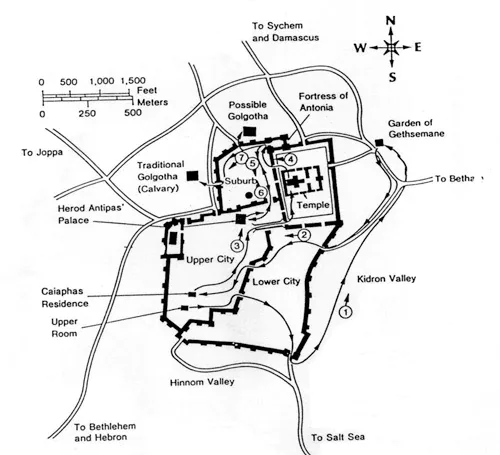
Map of Jerusalem at the time of Christ. Jesus left the Upper Room and went with disciples to the Garden of Gethsemane (1), where he was arrested and taken first to Annas and then to Caiaphas (2). After the first trial before the political Sanhedrin in Caiaphas's residence, Jesus was again brought before the religious Sanhedrin, probably in the Temple (3). Next, he was taken to Pontius Pilate (4), who sent him to Herod Antipas (5). Herod returned Jesus to Pilate (6), and Pilate finally handed Jesus over to be flogged in the Antonia fortress and crucified on Golgotha (7). (modified from Pfeiffer et al. 17)
………………………………………………..
About the author: Prof. Dr. MMH Nuri, MBBS, FCPS, MRCP, FACC, is the director and chief cardiologist of the Tahir Heart Institute (THI) in Rabwah, Pakistan. THI is a state-of-the-art, non-profit cardiac clinic located in one of the poorest regions of Punjab, Pakistan.
………………………………………………..
Sources:
1. Hazrat Mirza Ghulam Ahmad AS : Jesus in India, printed in Great Britain at the Alden Press, p. 20, Oxford 1978.
2. Riceiotti G: The Life of Christ, Zizzamia Al (trans), Milwaukee, Bruce Publishing Co, 1947, pp. 29-57, 78-153, 161-167 & 586-647.
3. Matthew ch:, Mark ch: Luke ch: John ch:, in Holy Bible Authorized (King James) Version. National Publishing Company USA, 1978
4. Bucklin R: The Legal and Medical Aspects of the Trial and Death of Christ, Sci Law 1970; 10: 14-26
5. McDowell J: The Resurrection Factor, San Bernardino, Calif, Here's Life Publishers, 1981, pp. 20-53, 75-103
6. Edwards WD, Gabel JG, Hosmer FE: On the Physical Death of Jesus Christ(as), JAMA 1986, 255: 1455-1463
7. Davis CT: The Crucifixion of Jesus: The Passion of Christ from a Medical Point of View, Ariz Med 1965; 22: 183-187
8. Barbet P: A Doctor at Calvary: The Passion of Our Lord Jesus Christ as Described by a surgeon, Earl of Wicklow (trans), Garden City, NY, Doubleday Image Books 1953, pp. 12-18,37-147,159-175,187-208
9. Tenny SM: On death by crucifixion, Am Heart J 1964; pp. 68: 286-287
10. Freidrich G: Theological Dictionary of the New Testament, Bremiley G (ed-trans) Grand Rapids, Mich, WB Eerdmans Publisher, 1971, Vol. 7, pp. 572, 573, 632
11. DePasquale NP, Burch GE: Death by crucifixion, Am Heart J 1963; P. 66: 434-435
12. Stroud W: Treatise on the Physical Cause of the Death of Christ and its Relation to the Principles and practice of Chemistry, ed 2, London, Hamilton & Adams 1871, pp. 28-156, 489-494
13. Johnson CD: Medical and cardiological aspects of the passion and crucifixion of Jesus, the Christ, Bol Assoc Med PR 1987; pp. 70: 97–102
14. Bloomquist ER: A doctor looks at crucifixion. Christian Herald, March 1964, pp. 35, 46-48
15. The Crucifixion by personal friend of Jesus in to an Essene Brother in Alexandria, Supplemental Harmonic Series vol II, 2nd ED, Chicago, Indo-American Book Co. 1907, pp. 62, 64, 65
16. Lumpkin R: The Physical suffering of Christ, J Med Assoc Ala 1978; 47:8 – 10,47
17. Pfeiffer CF, Vos HF, Rea J (eds): Wycliff Bible Encyclopedia, Chicago, Moody Press, 1975, pp. 149-152, 404-405, 713-723, 1173-1174, 1520-1523
18. Robertson AT: A Grammar of Greek New Testament in light of Historical Research, Nashville, Tenn, Broadman Press, 1931, pp. 417-427
19. Kim HS, Suzuki M, Lie JT, et al: Non-bacterial thrombotic endocadities (NBTE) and disseminated intervascular coagulation (DIC): Autopsy study of 36 patients, Arch Pathol Lab Med 1977; 101: pp. 65–68
20. Becker AE, Van Mantgem JP: Cardiac tamponade: A study of 50 hearts. Eur J Cardiol 1975; 3: pp. 349-358
21. Scott CT: A case of hematidrosis, Br Med J 1918, pp. 532-533
22. The Review of Religions: https://www.revuederreligionen.de/jesus-christus-as-starb-nicht-am-kreuz/
예수는 십자가에서 죽지 않았는가 ― M. M. H. Nuri의 의학적 가설에 대한 요약·평론
이 글의 원제는 <Jesus Christus (as) starb nicht am Kreuz – die Perspektive eines Kardiologen>, 즉 <예수 그리스도는 십자가에서 죽지 않았다 ― 한 심장병 전문의의 관점>이다. 저자인 파키스탄의 심장 전문의 M. M. H. Nuri는 복음서의 수난 기록을 현대 심장학과 해부학의 관점에서 재구성하여, 예수가 십자가에서 실제로 사망한 것이 아니라 심각한 순환기 쇼크와 심낭 손상으로 의식을 잃었으며 이후 회복했다는 가설을 제시한다. Jesus Christus (as) starb
이 글은 흥미로운 의학적 사고실험이지만, 결론을 입증한 연구라기보다는 특정한 전제―“예수는 십자가에서 죽지 않았다”―를 복음서의 세부 묘사와 의학적 가능성을 결합하여 설명하려는 가설적 논문으로 읽는 것이 적절하다.
1. 글의 핵심 주장
저자의 논리는 크게 세 단계로 진행된다.
먼저 그는 예수가 체포·심문·채찍질을 받기는 했지만, 십자가에 달리기 전까지 치명적인 출혈 상태는 아니었다고 본다. 복음서가 예수의 심한 출혈을 기록하지 않고 있으며, 채찍질 역시 로마 처형에서 가능한 여러 정도 가운데 비교적 가벼운 수준이었을 가능성이 있다고 주장한다. Jesus Christus (as) starb
두 번째로 저자는 십자가형 자체가 즉각적으로 죽음을 초래하는 처형법은 아니었다는 점을 강조한다. 실제로 십자가형 피해자가 수일간 생존할 수도 있었는데, 예수는 약 여섯 시간 정도밖에 십자가에 매달려 있지 않았다는 것이다. 복음서에서 두 강도의 다리를 부러뜨렸으나 예수의 다리는 부러뜨리지 않았다는 대목도 저자에게는 중요한 단서다. 군인이 창으로 예수의 옆구리를 찔렀을 때 “피와 물”이 흘러나왔다는 요한복음의 기록이 논문의 결정적 출발점이 된다. Jesus Christus (as) starb
세 번째가 저자의 독창적인 심장학적 설명이다. 그는 채찍질 과정에서 예수의 심낭(pericardium)이 손상되어 심낭 안에 피가 고였고, 그 결과 심장압전(cardiac tamponade)이 발생했다고 추정한다. 심장을 둘러싼 심낭에 피가 차면 심장이 충분히 팽창하지 못해 혈압이 떨어지고 뇌로 가는 산소가 감소하며 실신할 수 있다. 저자는 바로 이 상태를 예수가 십자가에서 “죽은 것처럼” 보이게 된 이유로 해석한다. Jesus Christus (as) starb
그리고 로마 병사의 창이 가슴을 찌르면서 오히려 심낭에 고인 액체와 피가 배출되어 압력이 줄어들었을 가능성을 제시한다. 따라서 요한복음의 “피와 물”은 사망의 증거가 아니라, 역설적으로 심낭 배액에 해당하는 치료 효과를 가져왔다는 것이다. 저자는 예수가 무덤으로 옮겨진 뒤 향료와 연고를 바르고 치료를 받아 살아남았다고 결론짓는다. Jesus Christus (as) starb
2. 십자가 못의 위치와 창상에 대한 의학적 설명
이 글에서 비교적 설득력 있게 보이는 부분은 십자가형의 해부학적 설명이다.
저자는 손바닥 자체에 못을 박으면 체중을 지탱하기 어렵기 때문에 못이 손목 부위의 뼈 사이를 통과했을 가능성이 높다고 설명한다. 문서 4쪽의 그림은 못이 손목뼈 사이를 지나면서 정중신경(median nerve) 주변을 통과할 수 있음을 보여준다. Jesus Christus (as) starb
6쪽의 그림에서는 발의 중족골 사이에 못을 박는 방법을 제시하며, 이러한 부위는 큰 동맥을 직접 절단하지 않기 때문에 출혈 자체가 반드시 치명적이지는 않았을 것이라고 주장한다. Jesus Christus (as) starb
7쪽의 그림은 창이 오른쪽 흉곽을 통해 흉강과 심낭 쪽으로 들어가는 경로를 묘사한다. Jesus Christus (as) starb
이런 해부학적 설명은 십자가형의 물리적 과정을 이해하는 데는 도움이 된다. 그러나 “그러한 경로가 가능하다”는 것과 “실제로 예수에게 바로 그런 일이 일어났다”는 것은 전혀 다른 명제다.
3. 가장 큰 문제 ― ‘가능성’이 ‘역사적 사실’로 변한다
이 글의 근본적인 약점은 바로 여기에 있다.
저자가 제시하는 심장압전 시나리오는 의학적으로 상상 가능한 하나의 경우일 수 있다. 그러나 예수가 실제로 심낭 손상을 입었다는 직접적인 자료는 존재하지 않는다.
복음서에는
- 심낭 손상
- 심장압전
- 혈압 저하
- 맥박
- 호흡 상태
- 창이 들어간 정확한 위치와 각도
등이 기록되어 있지 않다.
따라서 “심낭에 피가 고였다 → 예수가 실신했다 → 창이 심낭을 배액했다 → 다시 살아났다”라는 과정은 복음서의 두세 문장을 바탕으로 현대 의학적 시나리오를 역으로 구성한 것이다.
특히 저자는 “피와 물”이라는 표현을 매우 문자적으로 해부학적 관찰 기록처럼 사용한다. 그러나 요한복음은 현대 의무기록이 아니다. 그 표현에는 신학적·상징적 의미가 포함되었을 가능성도 함께 고려해야 한다. 저자의 방법은 이 문학적·신학적 성격을 거의 배제한다.
4. ‘피와 물’은 살아 있다는 증거인가
저자가 가장 중요하게 여기는 논증은 “죽은 사람에게서 이렇게 피가 흘러나오기 어렵다”는 것이다. 그는 상당한 혈액과 액체가 흘러나왔다는 복음서 기록을 살아 있는 심장의 증거로 해석한다. Jesus Christus (as) starb
하지만 이 논증은 생각만큼 강하지 않다.
사망 직후에도 흉강이나 심낭에 고여 있던 혈액이나 장액이 창상으로 흘러나올 수 있다. 또한 고대인이 본 “피와 물”이 정확히 어떤 액체였는지 확인할 방법도 없다. 흉수, 심낭액, 혈액의 분리, 혹은 문학적 묘사일 수 있다.
따라서 “피와 물이 흘렀다 → 심장이 뛰고 있었다 → 예수는 살아 있었다”라는 추론은 필연적인 결론이 아니다.
5. 역사적 관점에서 더 큰 난점
이 논문의 가장 중요한 한계는 의학보다 역사학에서 드러난다.
예수가 십자가 처형을 받았다는 사실과 그 처형으로 사망했다는 전승은 기독교 내부 자료뿐 아니라 초기 비기독교 자료와도 대체로 일치한다. 역사학계에서 논쟁이 되는 것은 예수가 처형되었는가보다 그 사건을 어떻게 해석할 것인가에 가깝다.
따라서 “예수가 실제로 죽지 않았다”는 주장을 역사적 설명으로 받아들이려면 단순한 의학적 가능성을 넘어 상당히 강한 독립적 증거가 필요하다.
그런데 이 글의 자료 목록을 보면 고대 원자료 연구보다는 십자가 처형의 의학적 해석을 다룬 20세기 의학 논문과 기독교 관련 저작, 그리고 “예수가 인도에 갔다”는 계통의 문헌에 크게 의존한다. Jesus Christus (as) starb
저자가 이미 생존설을 받아들인 상태에서 그에 맞는 의학적 메커니즘을 찾았다는 인상을 피하기 어렵다.
6. 아마디야 이슬람과 이 글의 배경
이 글을 이해하려면 저자의 종교적 배경도 중요하다. 저자는 파키스탄의 의사이며 참고문헌 첫 항목으로 미르자 굴람 아마드(Mirza Ghulam Ahmad)의 <Jesus in India>를 제시한다. Jesus Christus (as) starb
아마디야 전통에서는 예수가 십자가에서 죽지 않고 살아남아 동쪽으로 이동했으며 결국 자연사했다는 해석이 중요하다.
따라서 이 논문은 순수하게 임상 자료에서 출발하여 우연히 “예수 생존설”에 도달한 연구라기보다, 이미 존재하던 종교적 해석에 현대 심장학적 설명을 부여하려는 시도로 보는 편이 정확하다.
이 사실 자체가 논증을 틀렸다고 만들지는 않는다. 그러나 논문의 출발점과 자료 선택을 평가할 때 반드시 고려해야 한다.
7. 이 글의 가장 흥미로운 점
그럼에도 이 글에는 의미가 있다.
무엇보다 십자가 사건을 추상적인 신학적 상징이 아니라 “한 인간의 육체에 실제로 어떤 일이 일어났는가”라는 질문으로 돌려놓는다. 채찍, 못, 손목의 신경, 발의 뼈, 호흡, 혈압, 심낭과 흉강이라는 구체적인 신체의 차원을 보여준다.
그 결과 기독교 미술에서 너무 익숙해져 버린 십자가가 실제로는 극도로 잔혹한 국가 처형이었다는 사실을 다시 느끼게 한다.
그러나 바로 여기에서 역설이 생긴다. 의학은 복음서의 기록으로부터 “어떤 일이 가능했는가”를 말할 수 있지만, 2천 년 전 한 개인의 정확한 사망 원인을 확정할 수는 없다.
종합 평론
Nuri의 논문은 “예수의 십자가 죽음이 의학적으로 불가능하다”는 것을 증명한 글이 아니다. 정확히 표현하면 다음과 같다.
“복음서의 기록을 문자 그대로 받아들이고 몇 가지 추가적인 해부학적 가정을 한다면, 예수가 십자가에서 실제 사망하지 않았다는 시나리오도 구성할 수 있다.”
여기까지는 흥미로운 가설이다.
하지만 저자는 그 가능성을 역사적 현실로 너무 빠르게 전환한다. 특히 <심낭 손상 → 심장압전 → 의식상실 → 창에 의한 배액 → 소생>이라는 핵심 과정은 자료에 기록되어 있는 것이 아니라 저자가 만들어낸 의학적 재구성이다.
따라서 이 글의 가치는 “예수가 십자가에서 살아남았음을 입증했다”는 데 있지 않다. 오히려 “같은 복음서 문장을 신학자가 아니라 심장 전문의가 읽으면 얼마나 다른 이야기를 만들어낼 수 있는가”를 보여주는 데 있다.
그리고 더 흥미로운 문제는 여기서 시작된다. 예수가 십자가에서 죽지 않았다고 가정하면, 기독교의 핵심인 <죽음―부활>의 의미 자체가 완전히 달라진다. 부활은 죽은 자의 부활이 아니라 중태에서의 회복이 되기 때문이다.
그래서 이 문서는 단순한 의학 논문이라기보다, 결국 “십자가와 부활을 역사적 사건으로 어떻게 이해할 것인가”라는 기독교·이슬람 사이의 오래된 논쟁에 현대 심장학의 언어를 동원한 글이라고 평가하는 것이 가장 적절하다. Jesus Christus (as) starb
