영성, 몸-마음, 젠더, 생태, 평화 Scapbook

Spirituality, Mind-Body, Gender, Ecology, Ageing, Peace, Scrapbook (in English and Korean)

2022/06/10

대행 - Daehaeng 위키백과

대행 - 위키백과, 우리 모두의 백과사전

대행

위키백과, 우리 모두의 백과사전.

고대 중국의 관직에 대해서는 대홍려 문서를 참고하십시오.

이 문서의 내용은 출처가 분명하지 않습니다.
이 문서를 편집하여, 신뢰할 수 있는 출처를 표기해 주세요. 검증되지 않은 내용은 삭제될 수도 있습니다. 내용에 대한 의견은 토론 문서에서 나누어 주세요.
 (2012년 7월)
대행 스님

대행(1927년 2월 3일(음력 1월 2일) ~ 2012년 5월 22일)은 대한민국의 비구니 승려이다. 호는 묘공당.

생애[편집]

1927년 2월 3일 서울 이태원에서 태어나, 1950년 강원도 상원사에서 방한암 스님을 스승으로 출가했다. 대행은 1972년 경기도 안양에 한마음선원의 전신인 대한불교회관을 건립해 선원장으로 활동했다.

2012년 5월 22일 오전 0시 경기도 안양 한마음선원에서 입적했고, 전국비구니회장으로 경기도 안양 한마음선원 연화대에서 다비식이 봉행되었다.


==

Daehaeng

From Wikipedia, the free encyclopedia
Jump to navigationJump to search
Daehaeng
대행 大行
1-대행스님2.jpg
Daehaeng Kun Sunim in 1996
TitleDae Seon Sa
(Great Zen Master)
Personal
Born
Jum Soon No/ 노점순 /

February 3, 1927
Seoul, Korea
DiedMay 22, 2012 (age 85)
Anyang, Seoul, South Korea
ReligionBuddhist
NationalitySouth Korean
SchoolJogye Order of Korean Buddhism
Notable work(s)founder of Hanmaum Seon Centers
Posthumous nameMyo Gong Dang
(묘공당, 妙空堂)
Senior posting
TeacherHanam Jungwon (漢巖 重遠)
Websitewww.hanmaum.org/eng

Daehaeng Kun Sunim (대행, 大行; 1927–2012) was a Korean Buddhist nun and Seon (禪) master. She taught monks as well as nuns, and helped to increase the participation of young people in Korean Buddhism.[1][2] 

She made laypeople a particular focus of her efforts, and broke out of traditional models of spiritual practice, teaching so that anyone could practice, regardless of monastic status or gender. 

She was also a major force for the advancement of Bhikkunis (nuns), heavily supporting traditional nuns’ colleges as well as the modern Bhikkuni Council of Korea.[3][4] The temple she founded, Hanmaum Seon Center, grew to have 15 branches in Korea, with another 10 branches in other countries.[5]

Contents

  • 1Life
  • 2Teaching Style
    • 2.1Modern Versions of Traditional Buddhist Ceremonies
  • 3Hanmaum Seon Center
  • 4Works in English
  • 5Works in Korean
  • 6See also
  • 7References
  • 8External links

Life[edit]

Daehaeng Kun Sunim was born in Seoul, Korea, in 1927. Her family was originally quite wealthy, and owned large pieces of land stretching from what is now Itaewon down to the Han River. Her father was from an old Korean military family, and had continued to secretly support resistance to the Japanese Occupation of Korea. As a result, in 1932 or 1933, the Japanese secret police, the Kempeitai, came to arrest him. He was warned a few minutes before their arrival and escaped out the back of his home with his family. They fled south across the Han River, and lived in the mountains there in a dugout hut. Unable to safely contact friends or family, they lived in poverty, having to glean fields for leftover grains of rice or vegetables.

Daehaeng Kun Sunim often slept outdoors in order to avoid her increasingly angry father. Obsessed with the question of why people suffer, she awakened when she was around eight years old. She was formally ordained by Hanam Kun Sunim in around 1948, and received Dharma transmission from him at the same time. She spent many of the years that followed wandering the mountains of Korea, wearing ragged clothes and eating only what was at hand. Later, she explained that she hadn't been pursuing some type of asceticism; rather, she was just completely absorbed in entrusting everything to her fundamental Buddha essence and observing how that affected her life.

Around 1959, she settled in a hermitage below Sangwon Temple in the Chiak Mountains, and in the mid 1960s moved to the Wonju area. Later she moved to the Cheongnyangni area of Seoul, before eventually moving to Anyang, where she established the first Hanmaum Seon Center in 1972.(Daehaeng 1993, 19-141)[6]
At the time of her passing on May 22, 2012, she was the guiding teacher of over one hundred nuns, and the Dharma teacher of over fifty monks. The center she founded has a lay membership of over one hundred fifty thousand people, and has grown to twenty five branches around the world.[7][8][9]

Teaching Style[edit]

"Have faith in your inherent Buddha-nature, unconditionally entrust it with the things that come up in your life, and go forward. Observe what happens when you entrust problems and feelings to your inherent nature -- experiment with this, and try to apply what you learn. And then go forward without clinging to even that."

A Dharma talk by Daehaeng Kun Sunim at the Jinju, South Korea, Hanmaum Seon Center

The goal of Daehaeng Kun Sunim teachings was to help people to discover the great potential with themselves. In this way, they would be able to make their own way forward, and use the abilities inherent within them to help themselves and others. To this end, she taught people to rely upon the great wisdom and energy inherent within each of us, often called "Buddha-nature," through which she said each one of us is connected to every other being and thing.

In her own life and practice, Daehaeng Kun Sunim had experienced for herself that each and every person has this infinite potential with themselves, which she said could be called "Buddha-nature," "God," "inherent Buddha," "Father," and so on. Thus, she was determined to teach such that spiritual practice was something everyone could participate in, and which wasn't limited to certain groups such as monks or nuns.

It was important to her that people develop the strengths and tools to be able to practice and overcome whatever might confront them, without becoming dependent upon some outer teacher or guru. To this end, she taught people to rely directly upon this "inherent Buddha." (She also frequently used the Korean expressions for "foundation," "fundamental mind," "Juingong"(the one that is truly doing things," and "Hanmaum(one mind).) She did however say that an outer teacher may be necessary until people find their own, true inner teacher.

She exhorted people to work on letting go of thoughts such as "I," "mine," and "I did," as well as to be careful to interpret events positively. In addition, she warned about getting caught up in blaming others for the things one experiences. Instead, she said, understand that we've had a role in creating everything that we experience. So if we can handle them wisely, if we can entrust them to our foundation, even those will change and move in a more positive direction.

She didn't emphasize fixed periods of sitting meditation, nor did she encourage the systematic study of hwadus(kong-an). She wanted people to get used to listening inwardly and discovering what they needed to do at any particular time to brighten their own hearts, as opposed to getting caught up in other's fixed forms and traditions. To this extent, she taught people to take the issues of their own daily life as the material of their spiritual practice, and to practice entrusting that to one's inherent Buddha-nature.

About hwadus, she said that although they can still be effective, they don't work as well with modern people, and at any rate, each person has their own fundamatal hwadus that they were born with. "Why am I here?" "What am I supposed to be doing with my life?" and so on. She called these kinds of questions "naturally arising hwadus."

(See No River to Cross, 2007, Wake Up and Laugh, 2014)

Modern Versions of Traditional Buddhist Ceremonies[edit]

In the late 1970s, Daehaeng Kun Sunim began translating the traditional ceremonies used in Korean Buddhist temples.[7] These were used at the temples she founded, Hanmaum Seon Centers, beginning in the early 1980s, with the first collection of these ceremonies being widely published in 1987,[10] but it would not be until late 2011 when Korea's largest Buddhist order, the Jogye Order, would begin to introduce modern Korean translations of the traditional Chinese-character(hanmun) ceremonies.[11] Daehaeng Kun Sunim had been concerned that laypeople were missing the benefits and help that understanding the ceremonies could provide, so she began translating them from the traditional Sino-Korean characters into modern, phonetic Korean(Hangul). These included:

  • The Thousand Hands Sutra(千手經), which includes the Great Compassion Dharani(大悲咒)
  • The Heart Sutra(般若心經)
  • The Diamond Sutra(金剛經)

In addition, she translated the Flower Ornament Sutra(華嚴經). Her Korean version of the Thousand Hands Sutra and the Great Compassion Dharani has been published in English as A Thousand Hands of Compassion[12]

Hanmaum Seon Center[edit]

Hanmaum Seon Center("Hanmaum Seonwon"), Anyang, South Korea,

Hanmaum Seon Center(or Hanmaum Seonwon-한마음 선원) is large Buddhist temple complex near Seoul, South Korea. Founded in 1972, in Anyang City, it is part of the Jogye Order of Korean Buddhism. It is run by Daehaeng Kun Sunim's Bhikkuni disciples, and has fifteen Korean branches and ten overseas branches. In addition to its role as a center for teaching the Dharma, it is well known for its choir and youth groups. The youth group is the driving force behind many award-winning lanterns and floats that take part in the Buddha's Birthday parades.

Works in English[edit]

Primary Works

  • No River to Cross: Trusting the enlightenment that's always right here (2007, Wisdom Publications)
  • Wake Up and Laugh: The Dharma teachings of Zen Master Daehaeng (2014, Wisdom Publications)
  • A Thousand Hands of Compassion: The chant of Korean spirituality and enlightenment (2008, Korean/English, Hanmaum Publications)
  • My Heart is a Golden Buddha: Buddhist stories from Korea (2012, Hanmaum Publications)

Secondary Works

  • Educating Unborn Children: A Sŏn Master's Teachings on T'aegyo, by Chong Go (2006), in Religions of Korea in Practice, Buswell, Robert, (ed). 144-162.
  • Sŏn Master Daehaeng’s ‘Doing without Doing’, by Chong Go (2010), in Makers of Modern Korean Buddhism, Park, Jin Young, (ed). SUNY Press, 227-242.
  • Forum on the Thousand Hands Sutra: Frankfurt Bookfair 2009, (2009, English/German, Hanmaum International Culture Institute)

Works in Korean[edit]

Principle Works

  • 신행요전 Hanmaum Seonwon, 1987 (Ceremonies and Essentials)
  • 한마음요전 Hanmaum Seonwon, 1993, (The Principles of Hanmaum[One Mind])
  • 허공을 걷는 길, V. 1-15 Hanmaum Seonwon, 2005~, (Stepping Forward into Emptiness: The collected Dharma Talks of Daehaeng Sunim)

Major Secondary Works

  • 道 : 김정빈長篇實名小說 by Kim Jeong Bin, Kŭlsure, 1985, (The Way: A story of finding the Path, by Kim Jeong Bin)
  • 한마음 : 大行스님對談集, by Che-yŏl Yi, Kŭlsure, 1988 (One Mind: Conversations with Daehaeng Sunim)
  • 無 : 大行스님法語集 by Kim Jeong Bin, Kŭlsure, 1991 (Nothing: The Dharma Teachings of Daehaeng Sunim)
  • 한마음과 대행禪 edited by Hye Seon, Unjusa, 2013 (One Mind and Daehaeng's Seon)

See also[edit]

  • Korean Buddhism
  • Korean Seon

References[edit]

  1. ^ Chung, C.K. (May 22, 2012). '비구니계 큰스승' 한마음선원장 대행스님 입적 ['A Great Bhikksuni Teacher' Daehaeng Sunim, founder of Hanmaum Seon Centers passes away]. Yonhap News (in Korean). Retrieved May 5, 2014.
  2. ^ Oh, Hyeon Gyeong (May 26, 2012). 묘공당 대행스님 영결식 봉행 [The Funeral Ceremony of "Myo Gong Dang" Daehaeng Sunim]. Bulgyo Shinmun (in Korean). Retrieved May 5, 2014.
  3. ^ An, Jik Su (August 20, 2003). 전국 비구니회관 서울 수서에 개원 [National Headquarters for Council of Buddhist Nuns Opens in Seoul]. Bulgyo Shinmun (in Korean). Retrieved May 5, 2014.
  4. ^ Eom, Tae Gyu (November 11, 2010). 제22회 포교대상에 대행스님 [Daehaeng Sunim: Recipient of the 22nd Grand Award for Helping to Propagate Buddhism]. Bulgyo Shinmun (in Korean). Retrieved May 5, 2014.
  5. ^ "Nun who propagated Korean Buddhism abroad dies". Dong-a Ilbo. May 23, 2012. Retrieved May 5, 2014.
  6. ^ Daehaeng, Sunim (1993). 한마음요전 (The Principles of Hanmaum)
  7. ^ Jump up to:a b Si, Jun Bong (May 23, 2012). [부고]한마음선원 세운 대행 스님 [[Obituary] The Founder of Hanmaum Seon Centers, Daehaeng Sunim]. Jungang Daily (in Korean). Retrieved May 5, 2014.
  8. ^ Sunim, Chong Go (May 22, 2012). "The Passing of Daehaeng Kun Sunim". Wake Up and Laugh. Retrieved May 5, 2014.
  9. ^ Lim, Yunsu (May 27, 2012). 릴레이 상여꾼들이 멘 스님 운구 [Sunims Carry the Coffin]. Ohmynews (in Korean). Archived from the original on May 22, 2013. Retrieved May 5, 2014.
  10. ^ Hanmaum Seonwon(1987). 신행요전(Ceremonies and Essentials)
  11. ^ Bak, Seong Yeoul (October 11, 2011). 우리말 반야심경 널리 쓰여야 [It's Time for the Korean Version of the Heart Sutra to be Widely Used]. The Buddhism Journal (in Korean). Retrieved May 5, 2014.
  12. ^ Daehaeng (2008). A Thousand Hands of Compassion.

External links[edit]

  • Hanmaum Seon Center (Hanmaum Seonwon)
  • Wake Up and Laugh (blog featuring many articles about Daehaeng Kun Sunim's teachings.)
Posted by Sejin at June 10, 2022
Email ThisBlogThis!Share to XShare to FacebookShare to Pinterest
Labels: Korean Buddhism, spiritual practice, 공 空, 대행스님

사유수(思惟修) - Google 검색


검색결과


사유수(思惟修, 산스크리트어 dhyana) - Daum 블로그

https://blog.daum.net › ...
2017. 11. 4. — 혹은 선정(禪定)의 다른 말로서 마음을 한곳에 모아 움직이지 않게 하고 자세히 사유(思惟)하는 수행이란 뜻으로 해석하기도 한다. 즉, 사유수(思惟修)는 ...

사유수(思惟修) - 불교용어 사전

https://studybuddha.tistory.com › ...
2015. 9. 28. — 사유수(思惟修). = 선(禪). 선나(禪那)를 번역한 말. 마음을 한곳에 모아 움직이지 않게 하고 자세히 사유(思惟)하는 수행이란 뜻.

간절한 마음으로 사무치게 의심하라 - 불교신문

http://www.ibulgyo.com › news › articleView
2009. 1. 6. — 선이란 무엇인가? 선(禪)은 범어 댜나(dhya-na)의 음역인 선나(禪那)의 약칭이며, 사유수(思惟修), 정려(靜慮), 기악(棄惡), 공덕총림(功德叢林) ...

사유수(思惟修) - 세계불교법륜종 백운산 금선사

http://www.kumsunsa.com › board › board
사유수(思惟修). 작성자 : 관리자, 작성일 : 2554-08-05, 조회수 : 919. 선(禪)을 번역한 말로서 마음을 한곳에 모아 고요하게 하고 자세히 생각하는 수행이란 뜻.

사유수(思惟修) 관련 이미지

사유수(思惟修)에 대한 이미지 검색결과
모두 보기
피드백

모두 보기

좌선 - 위키백과, 우리 모두의 백과사전

https://ko.wikipedia.org › wiki › 좌선
... 선나(禪那)라고도 하며 사유수(思惟修) 또는 정려(靜慮)라고도 불린다. 따라서 좌선은 한어와 산스크리트어의 두 언어로 된 낱말로, 두 발을 꼬고 앉아(結跏趺坐) ...

선정(禪定)의 공덕 1 - 불광미디어

http://www.bulkwang.co.kr › news › articleView
... 그 의미는 '고요히 생각함(靜慮)' '생각으로 닦음(思惟修)'이다. ... 참선은 선(禪)에 참(參)하는, 즉 사유수(思惟修)의 여러 방법 중에 하나일 따름이지.

사단법인 한국불교교화복지선도회 행원불교민영교도소 설립 ...

https://en-gb.facebook.com › buda108 › posts
그래서 이것을 한역으로는 선나(禪那)라고 음역하거나 사유수(思惟修)라고 의역하거나 또는 정려(靜慮)라고 번역하였는데, 특히 불교에서는 思惟修라고 하거나 精慮 ...

탄허 선사의 사교 회통 사상 - 26페이지 - Google 도서 검색결과

https://books.google.com.au › books
문광 · 2021 · ‎Religion
탄허 도 선의 ' 정의 ' 에 대해 ' 생각 하여 닦는다 [思惟修] ' 혹은 고요히 ... (堅實心) 을 보는 공부 ” 라고 정의 하면서 범어 를 한역 (漢譯) 한 ' 사유수 (思惟修) ...

유가사지론 강의 상 - Google 도서 검색결과

https://books.google.com.au › books
남회근 · 2021 · ‎Religion
혹은 사유수 (思惟修) 로 말미암아 오묘한 일 [妙事] 이 따라서 옵니다 . 예 를 들 어 말 한다면 정 (定) 으로 인해 청정 의 경계 를 이루면 서방 극락 세계 나 동방 ...
Posted by Sejin at June 10, 2022
Email ThisBlogThis!Share to XShare to FacebookShare to Pinterest

Walk with Me - Documentary Thich Nhat Hanh

Walk with Me - Documentary Mania


Walk with Me

With unprecedented access, the film goes deep inside a Zen Buddhist community who have given up all their possessions and signed up to a life of chastity for one common purpose - to transform their suffering, and practice the art of mindfulness with the world-famous teacher Thich Nhat Hanh.
Filmed over three years, in their monastery in rural France and on the road in the USA, this visceral film is a meditation on a community grappling with existential questions and the everyday routine of monastic life. As the seasons come and go, the monastics' pursuit for a deeper connection to themselves and the world around them is amplified by insights from Thich Nhat Hanh's early journals, narrated by Benedict Cumberbatch.


Related Searches: Culture, Religions, Anthropology and Sociology, Ideas and Movements, Buddhism, Zen, Mindfulness, Thich Nhat Hanh
Posted by Sejin at June 10, 2022
Email ThisBlogThis!Share to XShare to FacebookShare to Pinterest
Labels: Thich Nhat Hanh

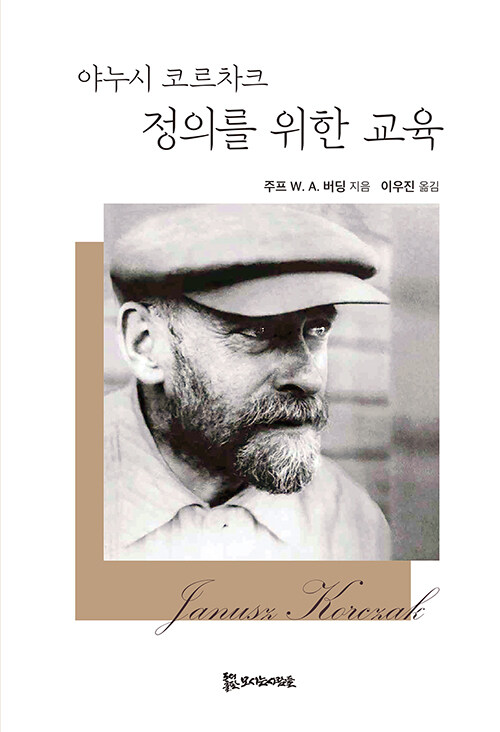
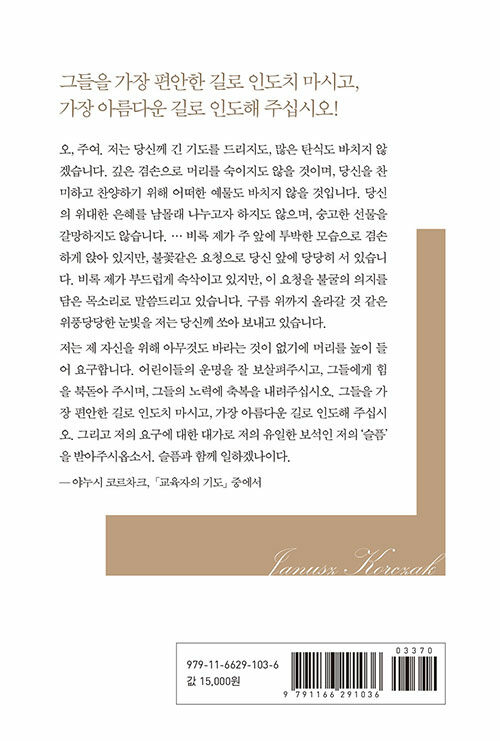
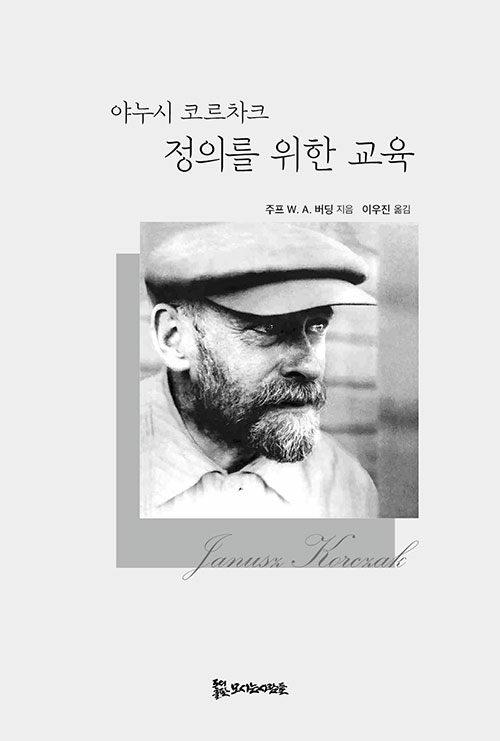
알라딘: 야누시 코르차크 : 정의를 위한 교육 Janusz Korczak: Educating for Justice

알라딘: 야누시 코르차크 : 정의를 위한 교육


야누시 코르차크 : 정의를 위한 교육
주프 W. A. 버딩 (지은이),이우진 (옮긴이)모시는사람들2022-05-25
원제 : Janusz Korczak: Educating for Justice


미리보기

정가
15,000원
판매가
208쪽


책소개
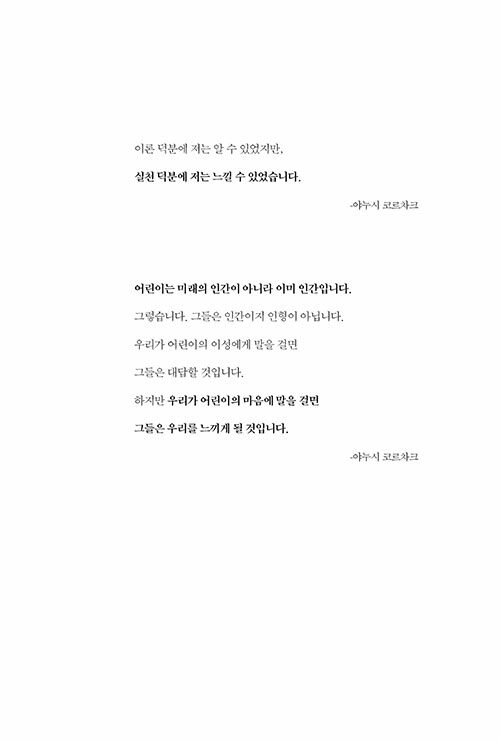
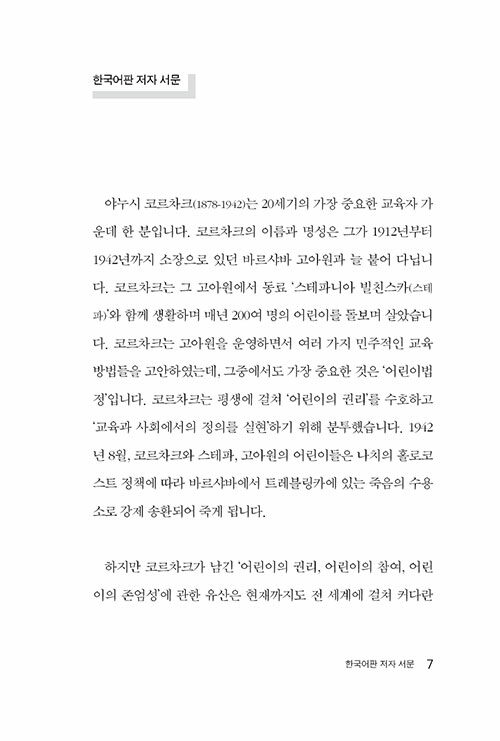
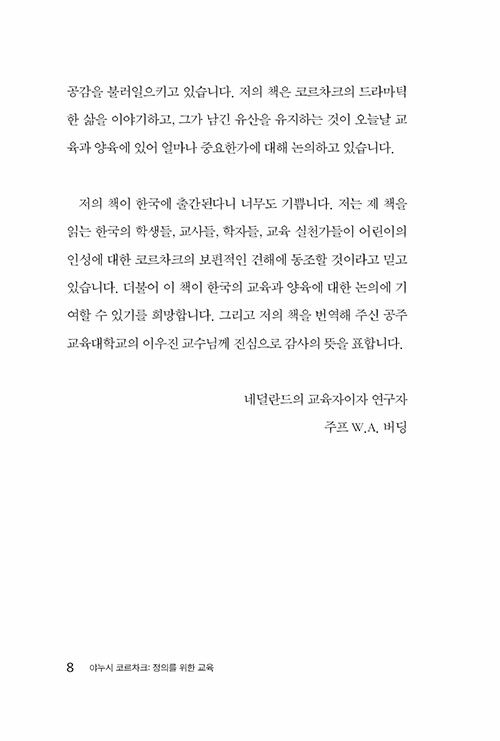
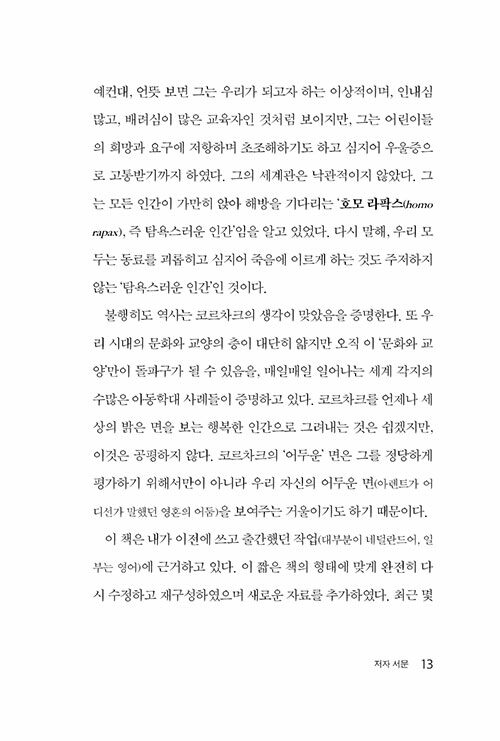
어린이를 위한 순교자로까지 추앙되는, 야누시 코르차크의 교육 철학과 생애를 그린 책이다. 코르차크는 이 사회에 어린이의 권리와 참여를 당연한 것으로 뿌리 내리게 하고, 어린이의 실수와 일탈을 질책하는 대신 용서하고 사랑하는 것이 정의임을 보편화하고, 무엇보다 어린이는 존중받아야 하는 한 사람의 완전한 인간임을 자각하게 한 선구자다.

저자는 어린이들과 기쁨과 슬픔, 그리고 죽음까지 함께한 코르차크의 생애를 따라가며, 그의 탁월하고 선구적인 교육적 태도와 프로그램들이 그의 삶 자체와 더불어 진행되었음을 이야기하고, 코르차크의 실험적이면서도 혁신적이며, 선구적인 교육 프로그램들을 ‘어린이에 대한 존중’과 ‘참여적 교육’ ‘정의의 실행’ 그리고 ‘공화주의적 방식으로 함께 살기’라는 네 범주로 간명하고 감동적으로 보여준다.

저자는 이 책에서 수십 년에 걸쳐 코르차크의 삶과 사상을 투철히 파고들며 연구해 왔으며, 수많은 코르차크 전문가들―연구자나 실천적 계승자―과 교류하고 협력하며 쌓아온 경험을 생생히 녹여냈다. 국내에 이미 많은 전기와 작품집이 번역-소개되었음에도 여전히 낯선 이름 야누시 코르차크. 이 책은 코르차크를 처음 접하는 이에게는 ‘입문서’로, 잘 알고 있는 이에게는 ‘새로운 시각’을 제공하는 교본으로, 전문가에게는 코르차크를 재발견하고 평가하는 논쟁적 토론서로서 값할 것이다.


목차


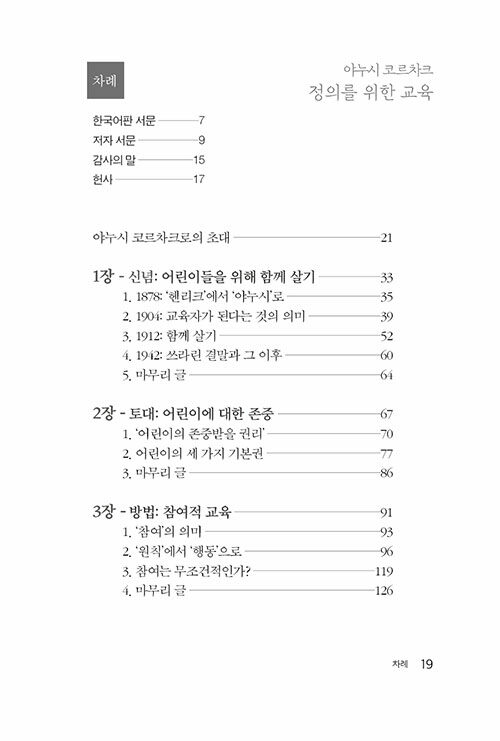
한국어판 서문 / 저자 서문 / 감사의 말 / 헌사

야누시 코르차크로의 초대

1장 - 신념: 어린이들을 위해 함께 살기
1. 1878: ‘헨리크’에서 ‘야누시’로
2. 1904: 교육자가 된다는 것의 의미
3. 1912: 함께 살기
4. 1942: 쓰라린 결말과 그 이후
5. 마무리 글

2장 - 토대: 어린이에 대한 존중
1. ‘어린이의 존중받을 권리’
2. 어린이의 세 가지 기본권
3. 마무리 글

3장 - 방법: 참여적 교육
1. ‘참여’의 의미
2. ‘원칙’에서 ‘행동’으로
3. 참여는 무조건적인가?
4. 마무리 글

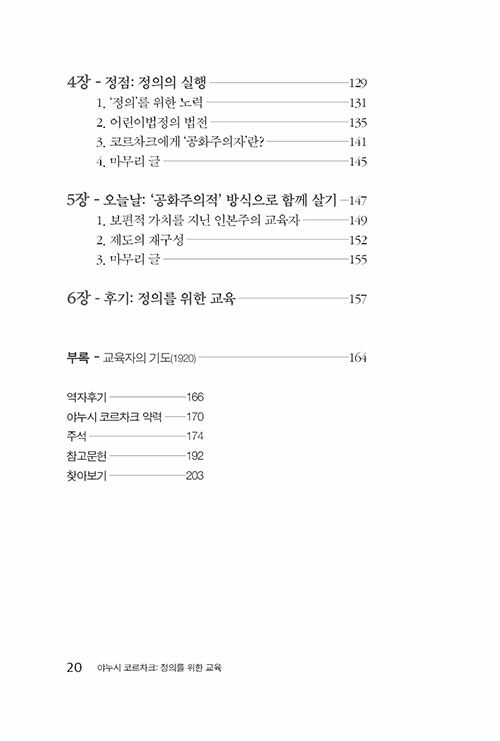
4장 - 정점: 정의의 실행
1. ‘정의’를 위한 노력
2. 어린이법정의 법전
3. 코르차크에게 ‘공화주의자’란?
4. 마무리 글

5장 - 오늘날: ‘공화주의적’ 방식으로 함께 살기
1. 보편적 가치를 지닌 인본주의 교육자
2. 제도의 재구성
3. 마무리 글

6장 - 후기: 정의를 위한 교육

부록 - 교육자의 기도(1920)
역자후기 / 야누시 코르차크 약력 / 주석 / 참고문헌 / 찾아보기
접기


책속에서


P. 45나는 이것이 현대 교육사에서 결정적인 전환점이라고 생각한다. 바로 이 순간 코르차크는 ‘교육은 교육자의 즐거움이나 편안함을 위한 것이 아니라 어떻게 정의로운 공동체를 구축하고 유지할 것인가에 관한 일’임을 인식하게 된 것이다. 이 일로 코르차크는 어린이를 양육하는 일이 (때로는) 힘든 작업임을 충분히 실감하였다. 왜냐하면 어린이를 포함하여 모든 사람은 각각의 동기와 관심사를 가지며 독자적으로 판단하고 선택하기 때문이었다. 그때 생기는 ‘저항’은 교육자에게 부인할 수 없는 매력으로 다가온다. 접기
P. 48코르차크의 접근법은 몇 가지 이유에서 대단히 흥미롭다. 첫째, 시간의 경과에 따라 순서대로 정확하게 기록하고 있다는 점이다. 둘째, 코르차크가 협상을 통해 어린이들이 비폭력적인 다른 행동을 하도록 이끌었다는 점이다. 이 에피소드는 또한 코르차크가 ‘현실적인 교육자’임을 잘 보여주고 있다. 그는 어린이들 사이에서는 언제나 몸싸움과 말다툼이 있을 것이며, 어린이들이 (때때로) 싸우는 것은 일반적인 사건이고, 싸움을 금지시키는 것은 비현실적인 일임을 인정하게 되었다. 그래서 코르차크는 “나는 싸움을 옹호하지 않는다. 하지만 교육자인 나는 싸움을 이해할 필요가 있다. 그래서 나는 이해한다. 결코 나는 싸움을 경멸하지 않는다. 나는 싸움을 받아들인다.”라고 썼다. 물론 코르차크가 말하지는 않았지만, 회의를 통하여 단 한 번밖에 싸우지 않게 된 결과에 대단히 만족스러워했을 것이다. 접기
P. 61코르차크와 스테파 그리고 200여 명의 어린이들이 트레블링카에서 독가스로 처형당했을 때, ‘하나의 전설’과 ‘하나의 순교자’가 탄생했다고 회자되고 있다. 이러한 시각은 제2차 세계대전 이후 코르차크의 이미지를 창조하는 데 중요한 역할을 하였다. 그는 도망갈 기회를 거부하였기 때문에 영웅이 된 것이었다. 어떤 사람들은 코르차크를 심지어 성인이라고 칭하기까지 하였다. 코르차크를 성인으로 받아들이게 된 첫 단계는 (놀랄 수도 있겠지만) 50년대 후반 독일에서 시작되었다. 점령기부터 말기까지 게토에 보관되고 있었던 코르차크의 일기장 사본이 회수되었다. 그 사본은 코르차크의 비서인 이고르 네벨리(Igor Newerly)가 벽돌로 벽을 만들어 숨긴 것이었다. 접기
P. 104코르차크의 교육제도를 논함에 있어 ‘어린이신문’인 『작은 평론(Mały Przegląd)』을 결코 빼놓을 수 없을 것이다. 어린이를 위한, 어린이에 의한 이 최초의 독립신문의 씨앗은 1915년에 이미 뿌려졌다. 당시 코르차크는 전쟁으로 인해 키예프(Kiev)에 있었고, 그곳에서 자신의 인생에 또 다른 중요한 여인인 마리나 팔스카(Maryna Falska)를 만나게 된다. 첫 신문은 1919년 바르샤바에서 ‘그녀’가 운영하는 고아원 ‘나슈 돔(Nasz Dom)’에서 발행되었다. (코르차크는 돔 시에로트 고아원에 이어 이 고아원에서도 원장을 맡고 있었다.) 신문은 한 면으로 구성되어 있었는데, 그것은 연필로 기사를 쓴 공책이었다. 코르차크 자신은 계속해서 어린이에 대한 글을 썼고, 그의 글은 다른 어린이잡지에 실렸다. 그러나 그것은 어린이를 위한 잡지는 될지언정 ‘어린이에 의한 잡지’는 아니었다. 접기
P. 142어린이법정의 업무와 더불어 그 업무를 둘러싸고 이를 모두 가능하게 하는 법전, 회의록, 보고서 등이 상징하는 가장 두드러진 측면은 의심할 여지없이 ‘공공성’이다. 개개인의 이해 충돌은 후미진 뒷방이 아니라 모두가 보고 들을 수 있는 열린 공간에서 다루어진다. 이를 코르차크가 교육자로서 성장하는 측면에서 해석해보면, 앞서 보았던 여름 캠프에서의 싸움과 같은 문제에 대처했던 것에 비하여 대단한 진전이라 할 수 있다. 여름 캠프에서 코르차크는 일종의 ‘중재자 역할’을 하여 대립하는 진영 사이의 갈등을 대화로 해결하고자 하였다. 반면 고아원에서는 이 ‘중재자 역할’을 어린이법정이 맡게 하여 ‘공개적인 방식’으로 업무를 처리함에 따라, 어린이들의 충돌과 갈등에 어떻게 대처해야 할 것인가 하는 문제에 완전히 새로운 해법을 제공하였다. 접기
더보기


추천글

이 책을 추천한 다른 분들 :
한국일보
- 한국일보 2022년 5월 27일자 '새책'


저자 및 역자소개
주프 W. A. 버딩 (Joop W. A. Berding) (지은이)
저자파일
신간알리미 신청

네덜란드 로테르담 응용과학대학의 교수 및 교육·청소년 연구소 소장을 역임하였다. 야누시 코르차크, 존 듀이, 한나 아렌트의 저작들에서 영감을 받아 여러 저서와 논문을 작성하며 강연하고 있다. 또한 그들의 교육철학적 통찰을 가정·학교·아동주간보호센터·청소년 노동 등과 같은 일상의 실천과 연결시키고 있다.

최근작 : <야누시 코르차크 : 정의를 위한 교육>

이우진 (옮긴이)
저자파일
신간알리미 신청

공주교육대학교와 한국학중앙연구원에서 교육학과 철학을 공부하고, 차세대 한국학자로 선발되어 University of Washington에서 연구하였다. 현재 공주교육대학교 교육학과 교수로 재직하면서 교육철학을 공부하며 가르치고 있다.


출판사 제공
책소개
야누시 코르차크는 1878(/1879)년 폴란드 바르샤바에서 유대계 폴란드인으로 태어났다. 그는 어린이 교육의 선구자·실험자·혁신가, 아동문학가(작가), 어린이를 위한 운동가, 어린이의 옹호자이며 어린이의 권리와 정의를 위한 급진적 혁명가, 어린이를 위한 철학자이자 이론가, 어린이 심리 전문가, 어린이를 위한 이야기꾼이며 시인, 음악가이자 극작가 등으로 자리매김 된다. 이 모든 이름이 허사(虛辭)가 아니라 그의 실제 삶으로부터 정의된 것들이다.

그는 소아과 의사로서 평탄한 삶을 시작한 직후 한 어린이 단체에서 실시한 어린이 여름캠프 인솔자로 참여하면서 이러한 ‘어린이를 위한 삶’의 길로 접어들었다. 이 여름 캠프에서 그는 “어린이를 교육하는 것은 그들이 원하는 것을 무조건 들어주는 것이 아니라, 그들과 대화하며 토론하고 중재하며 조정하는 것으로, 무엇보다 교육자와 어린이들이 끊임없이 계속해서 노력하는 일임을 깨닫게 되었다.(p.40)”

이는 그의 어린이 존중이, 어린이에 대한 방임이 아니라 어린이를 한 인간 존재라는 것을 각성하는 데서 비롯되는 것임을 보여준다. 그는 이때 어린이를 ‘어른의 눈’으로 ‘어른의 언어’로서 이해하고 일방적으로 교육하는 태도를 버리게 되었다. 그리고 “교육은 교육자의 즐거움이나 편안함을 위한 것이 아니라 어떻게 정의로운 공동체를 구축하고 유지할 것인가에 관한 일임을 인식”하고 “처음으로 어린이에게 (일방적으로) 말하지 않고 함께 대화를 하”게 되었다(p.45)고 고백한다. 그것을 통해 코르차크는 어린이들이 자신의 요구, 조건, 규정을 주장한다는 것, 그리고 그들에게 그렇게 할 권리가 있음을 확신하게 되었다.

이러한 통찰에 더하여 코르차크는 “자연과학자”와 같은 엄밀함을 유지하며, 그가 어린이들과 지내며 경험하는 모든 순간들을 기록하여 그것을 기반으로 어린이들과 끊임없이 대화하고, 그들을 존중하며, 그들과 함께 배우고, 함께 살아감으로써 그들이 그들 자신의 삶의 주체로 성장할 수 있도록 하였다. 이를 위하여 코르차크는 어린이들에게 무조건적인 ‘선의를 표방하는 교육’이 아니라 그들의 있는 그대로의 모습, 예를 들어 다툼이 끊이지 않는 실상을 외면하지 않는 “현실적인 교육자”의 모습을 견지하였다. 동방 조선에서 방정환이 주도하여 1923년 ‘세계 최초의 어린이 해방선언’이라고 할 어린이 권리 선언을 발표하기 훨씬 전부터 야누시 코르차크는 어린이 권리와 참여, 어린이를 위한 정의를 힘주어 강조하고 온몸으로 실천하고, 실현해 나갔던 것이다.

이러한 그의 교육철학의 기저 위에서 최초의 문학작품인 『거리의 어린이들』(1901)을 비롯한 여러 권의 동화와 소설, 『어린이를 사랑하는 법』, 『어린이의 존중받을 권리』를 비롯한 이론서, 어린이를 위한 잡지(『작은 평론』) 등을 발행하였고, 무엇보다 <돔 시에로트(고아들의 집)>를 비롯한 고아원에서 실제로 어린이들과 함께 살며, ‘어린이 법정’을 통한 공화주의적인 혁명적 교육 프로그램을, 많은 실패와 좌절에도 불구하고 결국은, 성공적으로 실행해 냈다.

방정환이 스스로의 건강을 돌보지 않고, 오직 어린이를 위한 길을 내달리다가 결국 죽음의 절벽으로 떨어져 버린 것처럼, 코르차크는 어린이와 함께하는 길을 포기하지 않기 위하여, 스스로 죽음의 수용소로 향하였다. 1942년 8월 5일(/6일), 야누시 코르차크는 그의 동료 교사들과 고아원의 190여 명의 어린이들과 함께 그가 머물던 게토 안에서 나치에 체포되었다. 그 이후 코르차크는 석방될 기회가 있었음에도 불구하고 어린이들과 운명을 함께하기 위하여 트레블링카에 있는 죽음의 수용소로 이송되어 죽음을 맞이한다. 그 장면은 전설과 실제가 어우러지며, 코르차크의 생애 전체와 그가 평생에 걸쳐 실험하고 실천해 온 어린이 교육의 정점으로, 그의 철학을 완성하는 장면으로 회자되고 있다. 이러한 그의 실천들은 어린이 권리 선언이나 아동 교육학에 관한 현대적 전범을 처음으로 마련한 것이며, 이러한 업적을 기려 그의 탄생 100주년이 되는 1979년을 ‘세계 아동들의 해’로 기념하였고, 아동권리협약을 제정 공포하였다.

의사로서, 과학적인 지식과 견해를 저버리지 않으면서도 코르차크는 모든 어린이를 신비로운 존재라고 알고, 믿고, 대우했다. 코르차크가 보기에 성인은 생각하는 사람인 반면, 어린이는 느끼는 사람이었다. 그때의 느낌은 어린이들이 온 몸과 마음으로 세계와 부딪쳐 얻어지는 것으로, 그 자체가 살아 있는 경험이며, 생명력의 발현이라고 보았다. 어른은 생각함으로써 예단하고, 예단함으로써 편견에 빠지는 존재인 반면에 어린이는 느끼는 대로 행동하고, 행동함으로써 경험하며, 경험하는 것으로 살아 있는 교육을 일구어 가는 존재라는 점에 착안하였다. 그렇게 코르차크는 어린이‘도’ 위하는 사람이고, 어린이‘에게도’ ‘정의’가 보장되어야 한다고 주장하였다. 이를 통해 코르차크는 “더 나은” 세상으로 나아가기 위해, 최선을 다해 “살아가고자” 했다. 접기


Janusz Korczak: Educating for Justice 
(SpringerBriefs in Education) 
1st ed. 2020 에디션
기준 Joop W. A. Berding (Author)
별 5개 중 4.0 2개의 평가
부: SpringerBriefs in Education(183권)

Kindle
US$11.97
읽기: 무료앱
Paperback
US$62.32
US$46.19부터 3 사용됨US$53.92부터 9 신규

This book presents the educational view and practice of the Polish-Jewish doctor, writer and pedagogue Janusz Korczak (Warsaw 1878–Treblinka 1942). In the authors' reconstruction five core elements stand out: respect for every child; participation; justice; dialogue as expression and communication; self-awareness and reflection on the part of the educator.

These elements do not constitute a well-rounded theory or philosophy, but are part of many stories of living together with children, in Korczak’s case orphans. Korczak, actively involving the children themselves, organized this life in such a way that justice ruled. He is the pedagogue of narrativity and of democratic upbringing. Korczak explored many, and today still challenging ways of participative education.The book shows that besides the now domineering positivist outlook on education, with its technocratic language and stress on output, standards, testing, etc., another language is possible, one that is more practice-based and that teachers will relate to immediately: love for children, a pedagogical ethos, and seeking ways to live together in a just way.


1st ed. 2020

편집자 리뷰

Review
“Berding has succeeded excellently in this with his clear introduction to the life and works of Korczak. One of the merits of the book is that it makes people curious about Korczak’s own work.” (Gerrit Breeuwsma, didactiefonline.nl, July, 2021)
Review


“Few educators deserve praise and recognition more than Janusz Korczak. Dr. Berding’s Educating for Justice offers fresh insights into how Korczak sought justice in living with children. This included an ethos of respect for the child (as well as the rights of the child), by means of active participation―which Korczak conveyed through his Children’s Court. Educating for Justice makes clear that pedagogy is more than an act of teaching, but one of advocacy and love for children everywhere.” (Daniel L. Berek, M.A., M.A.T., Teacher of students with disabilities and contributor to Janusz Korczak. A bibliography 1939-2012)“For Berding, Korczak’s justice education centers round creating a voice for the voiceless. Children, like many oppressed groups, are often silenced. When children are given voice, they are heard, respected, and their thoughts and ideas inform action. In this book, Berding explores the concrete structures, including the Children’s Court and Newspaper, that Korczak implemented to empower children, even under the most dire circumstances. This work is a richly detailed study into the life and thought of one of the most important educators of the 20th century, whose topicality cannot be underestimated.” (Kristin Poppo, Ph.D., Provost, Alfred State College)
“Dr. Joop Berding has been inspired by Dr. Janusz Korczak’s insights for over 35 years. His book is an invaluable resource for parents and educators who, deep inside, know that both parenting and educational systems need an overhaul. Dr. Berding’s book presents to them, in an easy to implement and well organized way, key values needed to do their job well while interacting with young people with respect, encouraging their participation and teaching them about justice.” (Mariola Strahlberg, MS, LAc is a founder and president of the Janusz Korczak Association of the USA)
“This new book by a famous researcher Joop Berding makes a valuable contribution to the study of Janusz Korczak, one of the greatest minds of the pedagogy of children’s rights in the 20th century, whose ideas have become critically important during the COVID-19 pandemic. Korczak’s practice demonstrates how in the most dire circumstances teachers should promote students’ full participation based on respect and justice. Learning about Korczak will make readers more knowledgeable about their inner strengths and more aware about ways to develop students’ resilience and creativity.” (Tatyana Tsyrlina-Spady, PhD, Adjunct Professor, School of Education, Seattle Pacific University, Seattle, WA)
“Why should we study what Janusz Korczak wrote many years ago? Korczak asks questions about children and their role in the world. He doesn’t give ready answers, beside this one – that a child is a human, just a smaller one. And that’s why it deserves respect, just treatment and active participation in the world. Korczak stands up for the rights, the dignity and the citizenship of children. Korczak’s pedagogical thought is still fresh, innovative and revolutionary. And above all – inspiring. Educating for Justice is a guide to pedagogics of respect and empathy.” (Dr Marek Michalak, Chairperson of the International Korczak Association)
“Joop Berding presents Korczak’s humanistic educational approach to the child – to the person. He opens the way for the reader to understand every aspect of this approach. Joop Berding’s writing shows his sensitivity and ability to touch on each point. Sketching Korczak as a person who fights for the rights of children and their right to take an active part in the educational process, places emphasis on the importance of the book for educators, parents and any adult who has an impact on the life of youngsters.” (Batia Gilad, Former Chairperson of the International Korczak Association, Chairperson of the Korczak Educational Center in Israel)
“Janusz Korczak. Educating for Justice gives us a true insight to the work of Janusz Korczak, doing justice to the person, physician, philosopher, author and pedagogue. We become acquainted with his life, philosophy, literary creation, and educational accomplishment, which are relevant to the humanist mission of education everywhere. It is thanks to such studies of Korczak’s life that we are now aware of his educational accomplishments, the principles of his educational teaching and his literary writings. This book tells the story of a unique educator whose relevance to education today stands as firm as ever.” (Dr. Avi Tsur, The Korczak Education Center, Israel)
“Janusz Korczak. Educating for Justice is a passionately written book devoted to Korczak’s contribution to the world of pedagogy and education. The book will appeal to people who may not know much about Korczak as well as those who studied and know him well. It is because of the systemic analysis of Korczak’s contribution to pedagogy and education in the context of socio-political structures that Berding captures and fully reinforces Korczak’s uniqueness. I recommend this book to all educators, philosophers of education and students as well as those concerned with creating a better world for children and adults.” (Malgorzata Kmita, Former Secretary General of the International Korczak Association, Former President of Mental Health Europe)

더 읽기


제품 세부 정보
출판사 ‏ : ‎ Springer; 제1st ed. 2020판 (30 10월 2020)
언어 ‏ : ‎ English
Paperback ‏ : ‎ 72 페이지

Posted by Sejin at June 10, 2022
Email ThisBlogThis!Share to XShare to FacebookShare to Pinterest
Newer Posts Older Posts Home
Subscribe to: Posts (Atom)

Directory Page

  • Home

Blog Archive

  • ▼  2026 (228)
    • ▼  June (13)
      • 오강남 종교란 무엇인가 요점과 평론
      • Here Where We Live Is Our Country: The Story of th...
      • Namgok Lee - 그가 공자의 '연찬 정신'을 이해하지 못했거나 간과했다
      • * 생명평화운동과 대승불교의 수행_1,2 도법스님 2010
      • 한국의 [생명평화운동>을 설명하고 분석 평가하는 책들
      • 길에서 꽃을 줍다 | 김하돈 | 알라딘
      • 14년만에 책으로 돌아온 수경스님, 참회와 기도로 위안을 주다 - 경향신문 2024
      • 기도 | 수경 | 알라딘
      • * 한국 불교의 생명⋅생태 사상과 그 실천 운동 이도흠 2012
      • 한국 생명평화사상의 뿌리를 찾아서 정지창 외 | 알라딘 2021
      • 그대와 평화에 닿았다 | 정재돈 | 알라딘
      • 지구별 생태사상가 | 황대권 외 | 알라딘 2020
      • 환경학과 평화학 | 토다 키요시 | 알라딘 2003
    • ►  May (31)
    • ►  April (30)
    • ►  March (37)
    • ►  February (69)
    • ►  January (48)
  • ►  2025 (760)
    • ►  December (75)
    • ►  November (17)
    • ►  October (46)
    • ►  September (118)
    • ►  August (94)
    • ►  July (139)
    • ►  June (61)
    • ►  May (30)
    • ►  April (17)
    • ►  March (83)
    • ►  February (68)
    • ►  January (12)
  • ►  2024 (1394)
    • ►  December (21)
    • ►  November (40)
    • ►  October (47)
    • ►  September (82)
    • ►  August (105)
    • ►  July (93)
    • ►  June (46)
    • ►  May (76)
    • ►  April (191)
    • ►  March (241)
    • ►  February (245)
    • ►  January (207)
  • ►  2023 (4088)
    • ►  December (154)
    • ►  November (141)
    • ►  October (313)
    • ►  September (371)
    • ►  August (552)
    • ►  July (584)
    • ►  June (523)
    • ►  May (480)
    • ►  April (341)
    • ►  March (180)
    • ►  February (212)
    • ►  January (237)
  • ►  2022 (3375)
    • ►  December (192)
    • ►  November (159)
    • ►  October (154)
    • ►  September (162)
    • ►  August (358)
    • ►  July (445)
    • ►  June (517)
    • ►  May (560)
    • ►  April (327)
    • ►  March (204)
    • ►  February (78)
    • ►  January (219)
  • ►  2021 (3270)
    • ►  December (154)
    • ►  November (223)
    • ►  October (374)
    • ►  September (316)
    • ►  August (252)
    • ►  July (286)
    • ►  June (272)
    • ►  May (302)
    • ►  April (338)
    • ►  March (316)
    • ►  February (212)
    • ►  January (225)
  • ►  2020 (2422)
    • ►  December (228)
    • ►  November (385)
    • ►  October (417)
    • ►  September (270)
    • ►  August (214)
    • ►  July (71)
    • ►  June (161)
    • ►  May (141)
    • ►  April (98)
    • ►  March (142)
    • ►  February (84)
    • ►  January (211)
  • ►  2019 (1234)
    • ►  December (85)
    • ►  November (8)
    • ►  October (98)
    • ►  September (228)
    • ►  August (50)
    • ►  July (76)
    • ►  June (52)
    • ►  May (55)
    • ►  April (111)
    • ►  March (64)
    • ►  February (152)
    • ►  January (255)
  • ►  2018 (587)
    • ►  December (157)
    • ►  November (28)
    • ►  October (22)
    • ►  September (82)
    • ►  August (59)
    • ►  July (13)
    • ►  June (40)
    • ►  May (53)
    • ►  April (48)
    • ►  March (66)
    • ►  February (18)
    • ►  January (1)
  • ►  2017 (188)
    • ►  December (14)
    • ►  November (19)
    • ►  October (4)
    • ►  September (55)
    • ►  August (11)
    • ►  July (38)
    • ►  June (1)
    • ►  April (16)
    • ►  March (11)
    • ►  February (7)
    • ►  January (12)
  • ►  2016 (987)
    • ►  December (53)
    • ►  November (111)
    • ►  October (267)
    • ►  September (70)
    • ►  August (11)
    • ►  July (41)
    • ►  June (92)
    • ►  May (153)
    • ►  April (123)
    • ►  March (66)
  • ►  2015 (6)
    • ►  August (2)
    • ►  July (3)
    • ►  February (1)
  • ►  2013 (1)
    • ►  October (1)

Search This Blog

Labels

  • Ibn Arabi (4)
  • ??? (1)
  • "American Veda" (8)
  • "Body keeps" (642)
  • "centering prayer" (62)
  • "contemplative life" (53)
  • "de Ropp" (2)
  • "Esoteric Christianity" (27)
  • "holy obedience" (30)
  • "inner chapters" (5)
  • "inner christianity" (4)
  • "Sejin Pak" (13)
  • "Shall We Live" (4)
  • "spiritual care" (33)
  • "spiritual practice" (298)
  • "study bible" (8)
  • "김시천 노자 강의 " (27)
  • "의식과 본질" (262)
  • "일본으로 건너간 연오랑" (5)
  • [Directory (2)
  • [spiritual journey (1)
  • [아직도 가야 할 길> 요약 (5)
  • ** (222)
  • *** (2)
  • 120 (2)
  • A.C. Graham (9)
  • Abhidharma (119)
  • Acupuncture (1)
  • adhidhamma (161)
  • Adi Da Samraj (12)
  • AFSC (100)
  • ageing (55)
  • Ajita (3)
  • Alastair McIntosh (1)
  • Aldous Huxley (102)
  • Amartya Sen (13)
  • Ambedkar (30)
  • American (1)
  • American Veda (8)
  • American+Veda (8)
  • Andrew B. Newberg (1)
  • anger (4)
  • Anil Seth (5)
  • Anne Bancroft (4)
  • Anne Marie Schimmel (16)
  • Anthony Manousos (3)
  • archetype (1)
  • Arthur Versluis (4)
  • Aurobindo (1)
  • Australia (5)
  • Australian soul (1)
  • Australian spirituality (1)
  • AVP (10)
  • Basham (4)
  • Beatrice Tinsley (10)
  • Before (4)
  • before triology (4)
  • Bessel A. van der Kolk (1)
  • Bessel Van Der Kolk (19)
  • Beyond Majority Rule (6)
  • beyul (13)
  • bhagavad gita (39)
  • Bible as literature (14)
  • Bill Devall (11)
  • biography (5)
  • body (2)
  • Body remembers (17)
  • Body Score (9)
  • bodymind (16)
  • Brain (1)
  • Brian Greene (5)
  • Brief History of Everything (8)
  • Buddha (3)
  • Buddhism (3)
  • C. S. Lewis (165)
  • calling (1)
  • Cambridge Companion to Quakerism (5)
  • Camino (1)
  • Care (1)
  • Carl Jung (170)
  • Carl Jung unconscious (65)
  • Cārvāka (2)
  • Change We Must (3)
  • Charlotte Kasl (11)
  • Chi (2)
  • Chikako Ozawa-de Silva (7)
  • Choan-Seng Song (6)
  • Chopra (3)
  • Chris Hedges (1)
  • Christian mysticism (3)
  • Christian pacifism (8)
  • Christian Zen (16)
  • Christianity Made in Japan (15)
  • Christopher Irsherwood (4)
  • Christopher Isherwood (9)
  • Claude Swanson (10)
  • compassion (44)
  • Confucianism (1)
  • contemplative (102)
  • Contemplative Practices (21)
  • cooperative (1)
  • Courage to Teach (1)
  • Course in Miracles (14)
  • Creel H G (11)
  • critics (4)
  • cult (5)
  • Dalai Lama (38)
  • Damasio (26)
  • Daniel Keown (1)
  • Dao (129)
  • Daoism (62)
  • dark matter (4)
  • David Bohm (73)
  • David Karchere (7)
  • David R. Hawkins (16)
  • death (9)
  • Deep Ecology (85)
  • Deepak Chopra (4)
  • deepening (50)
  • Dhammapada (85)
  • Diarmuid O'Murchu (8)
  • DISCIPLINE (3)
  • divine design (13)
  • divine ground (42)
  • Divine Light (1)
  • Doctor Zhivago (8)
  • Doctrine of the Mean (14)
  • Dogen (109)
  • Donald W. McCormick (15)
  • Donna J. Haraway (12)
  • Dorothee Solle (7)
  • Dr Wayne W Dyer (4)
  • dying (1)
  • ecology (2)
  • Ehrenreich (25)
  • Einstein (50)
  • Elton Trueblood (7)
  • emdr (24)
  • Emerson (159)
  • Émile Zola (1)
  • Emissaries (25)
  • Emissaries of Divine Light (2)
  • emotion (1)
  • emotionalism (1)
  • energy (1)
  • Energy medicine (2)
  • Engaged Buddhism (86)
  • Enneagram (11)
  • Enomiya-Lassalle (8)
  • Erwin Schrodinger (9)
  • Eternal Promise (1)
  • Ethics for the new millennium (12)
  • existential Jesus (5)
  • faith (50)
  • Feminism (1)
  • Fenelon (3)
  • fingarette (8)
  • Fiona Gardner (15)
  • Fit (2)
  • Forgiveness (1)
  • Francis S Collins (6)
  • Fusus Al-Hikam (1)
  • Gandhi (29)
  • gardening (1)
  • Garfield (12)
  • Garma Chang (13)
  • Gary Burge (6)
  • Gloriavale (3)
  • God (5)
  • Goddess (1)
  • Goddesses (2)
  • Great Courses (93)
  • Great World Religions (1)
  • Gretchen Rubin (5)
  • Grundtvig (61)
  • Grundtvig2 (3)
  • Gut (2)
  • gut microbiome (23)
  • Hakuin (3)
  • Hans-Georg Moeller (14)
  • happiness chemicals (1)
  • Hari Prasad Shastri (3)
  • Head & Heart Together (311)
  • Headspace (1)
  • healing (2)
  • Healing Touch (2)
  • Health (1)
  • Heinrich (9)
  • Henri Nouwen (22)
  • Heup-young Kim (2)
  • Hew Len (4)
  • Hindu (12)
  • Hinduism (69)
  • History of Christian Thought Tillich (14)
  • Ho’oponopono (4)
  • Hoʻoponopono (11)
  • holy indifference (42)
  • holy spirit (99)
  • Homosexuality (8)
  • how to know god (2)
  • Huayen (102)
  • Humor (5)
  • Huston Smith (86)
  • Huxley (1)
  • Hwa Yen (101)
  • Hwa Yen Buddhism (101)
  • Hwayen (102)
  • Hyun Ju Kim (1)
  • Ibn Al-Arabi (2)
  • Ibn Arabi (133)
  • Identity (1)
  • Ikeda (6)
  • ikigai (32)
  • Ilchi (61)
  • Ilia Delio (11)
  • India (17)
  • Indian (16)
  • Indian Cultural History (4)
  • Indian materialism (2)
  • Indian philosophy (81)
  • Indian philosopy (1)
  • indifference (99)
  • indigeneous (4)
  • Inner light (1)
  • Integral theory (11)
  • integrative (2)
  • Integrative Medicine (2)
  • Interbeing (53)
  • interspirituality (4)
  • Intimate Empire (1)
  • Intro 해설 (2)
  • Ishida Baigan (1)
  • Ishvara (1)
  • Islam (421)
  • Israel (1)
  • J Quaker (3)
  • Jamese Forest (8)
  • Japan Quaker (50)
  • Japanese Buddhism (3)
  • Japanese philosophy (72)
  • Jean Améry (7)
  • Jesus (1)
  • Jim Forest (8)
  • Johan Galtung (6)
  • John B Cobb Jr (24)
  • John Carroll (5)
  • John Howard Yoder (2)
  • John Lennon (24)
  • John Lie (1)
  • John O'Donohue (7)
  • John Woolman (19)
  • Joseph Goldstein (1)
  • Julie Anderson (6)
  • K. M. Sen (2)
  • Kabat-Zinn (93)
  • Kamiya Mieko (10)
  • Kang-nam Oh (50)
  • Karen Armstrong (37)
  • Karl Rahner (50)
  • Karma (17)
  • Kelly [Book] (1)
  • ken wilber (112)
  • Kenneth Boulding (50)
  • Ki (2)
  • Kohei Saito (8)
  • Komjathy (7)
  • Komjathy. Daoist Tradition (17)
  • Koran (5)
  • Korea (1)
  • Korea Quaker (126)
  • Korean Buddhism (11)
  • kukai (45)
  • Lakota (1)
  • Lame Deer (1)
  • leading (2)
  • Lecture Mystic Traditions (12)
  • Leonard Swidler (10)
  • Lessons In Truth (12)
  • Lessons In Truth Book (13)
  • Life force (10)
  • LIght (1)
  • Lisa Feldman Barrett (7)
  • lokāyata (4)
  • Losing Ourselves (2)
  • Lotus Sutra (28)
  • Louis Massignon (7)
  • Luke Timothy Johnson (24)
  • M. Scott (1)
  • Marcus J Borg (10)
  • Marie De Hennezel (7)
  • Marina Schwimmer (4)
  • Mark Mullins (18)
  • Mark W. Muesse (1)
  • Mary Baker (12)
  • Mary Baker Eddy (39)
  • Mary Magdalene (7)
  • materialism (2)
  • Matt Haig (3)
  • Matthieu Ricard (18)
  • Meaning (1)
  • Meaning of Life (15)
  • Medicine (2)
  • Meditation (1)
  • Meeting for Learning (26)
  • Meister Eckhart (60)
  • Mennonite (91)
  • Merton (1)
  • meta religion (3)
  • Michael Talbot (6)
  • Mieko Kamiya (4)
  • mindbody (11)
  • mindfulness (542)
  • mindfulness* (7)
  • Moana (3)
  • Mondragon (1)
  • Montgomery (5)
  • Moral action (1)
  • Mu Soeng (5)
  • Muhammad (1)
  • Mukunda Rao (11)
  • mystical (1)
  • mysticism (4)
  • Nagarjuna (4)
  • Naikan (31)
  • namarupa명색 (2)
  • name of the rose (6)
  • Namgok Lee (124)
  • Namgok Lee 이남곡 (102)
  • Nana Veary (3)
  • Native Indian (1)
  • Nei Gong (33)
  • Neil MacGregor (1)
  • New Thought (118)
  • Nietzsche (2)
  • Nishida Kitaro (1)
  • NK (68)
  • Noah (4)
  • Noble Strategy (51)
  • Non-Believer (1)
  • Non-Duality (1)
  • non-theism (1)
  • Non-violence (1)
  • nontheism (1)
  • nontheism nontheistic (57)
  • Nontheist Quakers (59)
  • nontheistic (1)
  • Nordic (1)
  • nuclear power (100)
  • Nyaya (1)
  • Oliver Sacks (31)
  • Os Cresson (17)
  • Osho (10)
  • Oxford Handbook of World Philosophy (10)
  • Panentheism (1)
  • Panikkar (5)
  • Pankaj Mishra (4)
  • Paramahansa Yogananda (5)
  • Parker Palmer (60)
  • Parkere Palmer selection (14)
  • Patanjali (14)
  • Peace (14)
  • peace studies (5)
  • People of the Lie (2)
  • perennial (118)
  • perennial phil (1)
  • Perennial Philosophy (1)
  • Perennial Philosophy Bk (33)
  • PerennialSufi (19)
  • Phenomenon of Man (10)
  • Phil Gulley (17)
  • Philip Goldberg (2)
  • Philip Sheldrake (6)
  • Philo Kalia (1)
  • Philo Kalia 심광섭 (32)
  • Pierre Claverie (5)
  • pilgram (198)
  • Pilgrimages in Japan (1)
  • plague virus pendemic (15)
  • Pleiadian (15)
  • pneuma (48)
  • Prabhavananda (8)
  • prayer (1)
  • pseudoscience (1)
  • psyche (149)
  • qi (1)
  • Qigong (138)
  • Quaker (33)
  • Quaker Australia (1)
  • Quaker indigenous (1)
  • Quaker missionary (1)
  • Quaker retreat (133)
  • Quaker retreat projects (36)
  • Quaker studies (5)
  • Quaker Sufi (35)
  • Quaker universalism (29)
  • Quakerism (65)
  • Quakersufi (2)
  • Quantum mysticism (12)
  • Qui Gong (33)
  • Quran (4)
  • Radhakrishnan (2)
  • Ramakrishna (4)
  • Real Zen for Real Life (13)
  • Rebellion (1)
  • reiki (32)
  • Reincarnation (52)
  • religion (4)
  • Religions of the Axial Age (2)
  • René Girard (1)
  • Rene Guenon (16)
  • Rex Ambler (1)
  • Riane Eisler (4)
  • Richard Rohr (39)
  • Richard Smoley (7)
  • Rick Hanson (1)
  • Rinpoche (55)
  • Road less travelled (7)
  • Robert E. Buswell (13)
  • Robert Powell (10)
  • Robert Wright (42)
  • Rodney Stark (2)
  • Roger Scruton (20)
  • Romain Rolland (6)
  • Rumi (159)
  • SA (2)
  • sabda (2)
  • Śabda Brahman (1)
  • Sacred Texts (9)
  • Sallie B. King (52)
  • Samkhya (6)
  • Samsara (4)
  • Sankara (10)
  • Satish Kumar (15)
  • scandal (3)
  • Schleiermacher (7)
  • Schweitzer (8)
  • science spirituality (125)
  • Scott Jeffrey (7)
  • Scott Peck (44)
  • sefirot (8)
  • SGI (41)
  • shade (1)
  • Shamanism (100)
  • Shankara (10)
  • Shanti Sadan (1)
  • Sheeran (7)
  • Shingon (51)
  • Shingon Buddhism (1)
  • Shinji Takahashi (8)
  • Shinto (12)
  • Shoko Yoneyama (4)
  • Shri Shankara (1)
  • shusaku endo (18)
  • Soil (5)
  • Song of God (9)
  • Spinoza (147)
  • spirit (1)
  • spirit possession (1)
  • spiritual gift (5)
  • spiritual practice (100)
  • Spirituality (213)
  • SQ 21 (2)
  • Starseeds (6)
  • Stefan Zweig (59)
  • Stephen Batchelor (48)
  • Stephen Cope (4)
  • Stephen Mitchell (1)
  • Steve Smith (5)
  • Steve Taylor (55)
  • Steven Katz. (1)
  • Subhash C. Kashyap (1)
  • Sue Hamilton (3)
  • Sufism (334)
  • Sufism and Taoism (4)
  • Sufism Intro (24)
  • Sumanasara (9)
  • Sun Myung Moon (45)
  • Swami Bhaskarananda (2)
  • Swami Mukundananda (1)
  • Swami Rama (9)
  • Swami Tadatmananda (6)
  • Swami Vivekananda (14)
  • Swedenborg (3)
  • Tae-Chang Kim (4)
  • Taechang Kim (36)
  • Tagore (32)
  • Tai Chi (2)
  • Taichi (1)
  • Tajalli (3)
  • Tao (3)
  • Tao Te Ching translation (12)
  • Taoism (148)
  • Taoism_Intro (15)
  • Teilhard de Chardin (32)
  • Tenzin Palmo (7)
  • Testament of Devotion (9)
  • Testment of Devotion (1)
  • Ṭhānissaro (13)
  • The "Philosophy of the Daodejing" (2)
  • The Body Keeps (2)
  • The Chosen TV drama (10)
  • The Courage to Teach (7)
  • The Meaning of Life (1)
  • The Razor's Edge (9)
  • The Road Less Traveled (2)
  • The Springs of Contemplation (1)
  • The Unity of Being (16)
  • The Way of Chuang Tzu (1)
  • The Yoga Sūtras of Patañjali (7)
  • Thich Nhat Hanh (210)
  • third Jesus (1)
  • Thomas Berry (20)
  • Thomas Kelly (1)
  • Thomas Mann (2)
  • Thomas Merton (160)
  • Thomas Moore (9)
  • Thomas R. Kelly (126)
  • Thomas Raymond Kelly (1)
  • Thomas Sowell (6)
  • Thoreau (100)
  • Tibet (1)
  • Timothy Morton (30)
  • Tolstoy (43)
  • Toshihiko Izutsu (113)
  • Toshihiko Izutsu Sufism And Taoism (50)
  • transcendentalism (63)
  • Transpersonal (61)
  • trauma (104)
  • Tuesdays with Morrie (6)
  • Tulshuk Lingpa (4)
  • U. G. Krishnamurti (19)
  • Uddalaka (3)
  • Umberto Eco (6)
  • unconscious (1)
  • unification (1)
  • unitarian (3)
  • unitive knowledge of God (64)
  • Unity (2)
  • Unity Church (2)
  • universalism (1)
  • upanishads (7)
  • Ursula K. Le Guin (1)
  • Val Plumwood (9)
  • Ved Mehta (14)
  • Vedanta (446)
  • Vibrational Medicine (2)
  • Vicki Mackenzie (1)
  • Vipassanā (36)
  • Vivekananda Biography (4)
  • Volunteer (23)
  • volunteer (240)
  • Waḥdat al-wujūd (19)
  • Wahiduddin (5)
  • Wakamatsu Eisuke (1)
  • Wayne Teasdale (4)
  • Welch Jr. (50)
  • Well (1)
  • Western Sufism (2)
  • When Nietzsche Wept (7)
  • Wherever You Go (1)
  • Wild God (2)
  • Will Durant (59)
  • Witness Lee (7)
  • Yalom (34)
  • Yamaga Sokō (1)
  • Yasuo Yuasa (20)
  • Yijing (1)
  • Yoga (93)
  • Yoga sutra (9)
  • Yoga Sutras of Patanjali (9)
  • Yuval Noah Harari (2)
  • zen (1)
  • Zen Buddhism (1)
  • Zhuangzi (5)
  • 가미야 미에코 (11)
  • 강민창 (2)
  • 강상중 (3)
  • 강유원 (1)
  • 개벽의 사상사 (1)
  • 격물궁리 (33)
  • 경의 敬義 (1)
  • 고인수 (3)
  • 공 空 (100)
  • 공 空 sunyata (12)
  • 공공철학 (78)
  • 공해 (42)
  • 관념론 (43)
  • 관음 (62)
  • 교토학파 (45)
  • 구카이 (15)
  • 국선도 (54)
  • 권근 (1)
  • 권나영 (1)
  • 귀신사생론 (1)
  • 그룬트비 (61)
  • 근친상간 incest (3)
  • 기공 호흡법 (5)
  • 기세춘 (14)
  • 기수련 (66)
  • 기철학 (10)
  • 기측체의 (1)
  • 기치료 (41)
  • 기학 (2)
  • 길희성 (9)
  • 김덕영 사회학 (3)
  • 김동춘 (12)
  • 김복기 (1)
  • 김상일 (33)
  • 김상준 (3)
  • 김성갑 (5)
  • 김성례 (11)
  • 김성수 (45)
  • 김승혜 (17)
  • 김시천 (35)
  • 김연숙 (3)
  • 김영민 (12)
  • 김용옥 (13)
  • 김용환 (44)
  • 김정현 (3)
  • 김조년 (62)
  • 김종건 (3)
  • 김지하 (100)
  • 김태영 (2)
  • 김태완 (3)
  • 김태창 (118)
  • 김태창 일기 (14)
  • 깊은 강 (7)
  • 깊은강 (2)
  • 깨달음 (148)
  • 나우웬 (5)
  • 남명 조식 (7)
  • 내관법 (10)
  • 노길명 (10)
  • 노자 (100)
  • 논어 (1)
  • 농업 (44)
  • 니시타니 케이지 (1)
  • 니체 (4)
  • 다다 마헤슈와라난다 (1)
  • 다산 (1)
  • 다카하시 신지 (30)
  • 단군 (2)
  • 단월드 (71)
  • 단학 (3)
  • 달라이 라마 (2)
  • 대장암 Bowel cancer (6)
  • 대종경 (1)
  • 대행스님 (6)
  • 데이비드 호킨스 (16)
  • 덴마크 (62)
  • 도덕경 (317)
  • 도마복음 (1)
  • 도법 (190)
  • 도법2 (5)
  • 도사카 준 (4)
  • 도승자 (2)
  • 도영인 (2)
  • 동경대전 (1)
  • 동양포럼 (46)
  • 동학 (2)
  • 들뢰즈 (4)
  • 러시아적 (3)
  • 로고스 (92)
  • 로카야타 (2)
  • 류경희 (9)
  • 리링 (8)
  • 마고 (1)
  • 마성 (8)
  • 마스노 슌묘 (6)
  • 마음공부 (124)
  • 마이스터 엑카르트 (13)
  • 만달라 (85)
  • 만달라 만다라 mandala (67)
  • 메이지의 그늘 (5)
  • 명리학 (1)
  • 명상 (787)
  • 모리시타 나오키 (4)
  • 모리오카 마사히로 (17)
  • 목민심서 (1)
  • 몸은 기억한다 (18)
  • 몸은 안다 (13)
  • 몽골생태영성순례 (5)
  • 무교 (1)
  • 무당 (133)
  • 무묘앙 (26)
  • 문선명 (66)
  • 문선명 사상 (1)
  • 문선명 통일교 (108)
  • 문수신앙 (5)
  • 문화영 (33)
  • 미생물 (103)
  • 밀의 종교 (1)
  • 밀의종교 (1)
  • 바가바드 기타 (44)
  • 박규태 (1)
  • 박길수 (1)
  • 박미라 (5)
  • 박보희 (11)
  • 박석 (36)
  • 박석 인문학 (1)
  • 박성수; 연오랑 (1)
  • 박성준 (23)
  • 박영재 (6)
  • 박재찬 (6)
  • 박정미 (69)
  • 박진여 (13)
  • 반성과 행복 (1)
  • 백낙청-박맹수-김용옥 (6)
  • 백승종 (18)
  • 버스웰 (2)
  • 벌레 이야기 (1)
  • 법구경 (33)
  • 법륜 (49)
  • 법화경 (21)
  • 베단타 (3)
  • 보은 (1)
  • 보현TV (3)
  • 부도지 (1)
  • 부모은중경(父母恩重經) (4)
  • 북한 (68)
  • 북한농업 (44)
  • 북한지리 (5)
  • 불광선인(佛光仙人) (1)
  • 불교 (2)
  • 불교와 기독교 (1)
  • 불필스님 (1)
  • 비통한 자들을 위한 정치학 (6)
  • 빌게이츠 (5)
  • 빙의 (1)
  • 사상계 (4)
  • 산수화(山水畵) (4)
  • 산자야 (5)
  • 삼국유사 (1)
  • 삼족오 (21)
  • 상카라 (10)
  • 상키야 (6)
  • 생명 (1)
  • 생명농업 (5)
  • 생명평화 (15)
  • 샤만 (1)
  • 샤먼 (1)
  • 샹카라 (10)
  • 서경덕 (19)
  • 서정록 (14)
  • 선과 그리스도교 (2)
  • 선도 (6)
  • 선도체험기 (2)
  • 선도회(禪道會) (3)
  • 선옥균 (2)
  • 선옥균 악옥균 (6)
  • 성덕도 (21)
  • 성령 (150)
  • 성리학 (1)
  • 성학십도 (1)
  • 세피로트 sefirot (15)
  • 소노 아야코 (4)
  • 소태산 (148)
  • 소학 (60)
  • 송규 (7)
  • 송기득 (1)
  • 송정산 (6)
  • 송천성 (6)
  • 수경 스님 (13)
  • 수련문화 (24)
  • 수선재 (20)
  • 수피즘 (118)
  • 수행 (101)
  • 숭산 (21)
  • 슈테판 츠바이크 (34)
  • 스콧 펙 (35)
  • 스티브 테일러 (8)
  • 스피노자 (3)
  • 신기통 (5)
  • 신내림 (25)
  • 신라불교 (1)
  • 신비 종교 (1)
  • 신비주의 종교 (1)
  • 신선사상 (1)
  • 신은희 (4)
  • 심광섭 (32)
  • 심광섭 신비주의 (4)
  • 심상 (40)
  • 심중식 (9)
  • 아나밥티스트 (42)
  • 아비달마 (50)
  • 아비담마 (100)
  • 아지타 (3)
  • 아직도 가야 할 길 (14)
  • 아카마쓰 아키히코 (1)
  • 야규 마코토 (66)
  • 야기 세이이치 (1)
  • 야마기시 (58)
  • 야마기시즘 (58)
  • 양명학 (47)
  • 양생도인법 (1)
  • 어윤형 (2)
  • 에너지 의학 (2)
  • 에노미야 라쌀 (8)
  • 엔도 슈사쿠 (37)
  • 역경 (11)
  • 연오랑 (1)
  • 영성 (1)
  • 영성 신학 (2)
  • 영혼의 탈식민지화 (16)
  • 예술신학 (1)
  • 오강남 (72)
  • 오구라 기조 (28)
  • 오대산 (5)
  • 오비츠 료이치 (4)
  • 오카다 다카시 (8)
  • 오카다 타카시 (11)
  • 와카마쓰 에이스케 (2)
  • 와카마츠 에이스케 (2)
  • 외경 畏敬 (2)
  • 요가 (1)
  • 우리는 누구인가 (13)
  • 웃다라카 (3)
  • 원불교 (239)
  • 원자력 (42)
  • 원전 (79)
  • 원주민 영성 (2)
  • 원톄쥔 (7)
  • 원효 (254)
  • 위안부 (124)
  • 유교페미니즘 (1)
  • 유동식 (72)
  • 유사역사학 (7)
  • 유사종교 (30)
  • 유상용 (15)
  • 유정길 (51)
  • 유지 크리슈나무르티 (22)
  • 윤정현 (13)
  • 윤홍식 (1)
  • 윤회 (67)
  • 율려 (1)
  • 은혜철학 (9)
  • 의식과 본질 (14)
  • 의식의 단계 (149)
  • 의식의 지도 (3)
  • 이기상 (28)
  • 이나모리 가즈오 (5)
  • 이나모리 카즈오 (6)
  • 이남곡 (127)
  • 이대섭 (2)
  • 이도흠 (20)
  • 이만열 (1)
  • 이명권 (5)
  • 이병철 (87)
  • 이부영 (21)
  • 이븐 아라비 (1)
  • 이슈바라 (1)
  • 이승헌 (102)
  • 이시다 바이간 (1)
  • 이시형 (8)
  • 이신(李信) (7)
  • 이은선 (43)
  • 이인우 (4)
  • 이정배 (65)
  • 이정우 (7)
  • 이종만 포럼 (6)
  • 이종철 (3)
  • 이종희 (11)
  • 이즈쓰 도시히코 (98)
  • 이즈쓰 토시히코 (1)
  • 이찬수 (111)
  • 이청준 (1)
  • 이케다 (20)
  • 이케다 다이사쿠 (25)
  • 이키가이 (32)
  • 이해인 (28)
  • 이행우 (17)
  • 이현주 (38)
  • 이황 (12)
  • 인도철학 (50)
  • 인류세 (57)
  • 인중무과론 (1)
  • 인중유과론 (1)
  • 일리아 델리오 (11)
  • 일본 이데올로기론 (4)
  • 일본 주자학 (1)
  • 일본 철학 (1)
  • 일본불교 (5)
  • 일본인식 (1)
  • 일본적 영성 (16)
  • 일본종교 (1)
  • 일본철학 (10)
  • 일지 (39)
  • 잃어버린 초월 (1)
  • 임건순 (10)
  • 임상 종교사 (20)
  • 임천고치(林泉高致) (7)
  • 입학도설 (1)
  • 자본론 (7)
  • 자천의학 (5)
  • 장 아메리 (7)
  • 장내미생물군 (23)
  • 장자 (364)
  • 장태원 (2)
  • 장회익 (1)
  • 재산 (1)
  • 적의 계보학 (14)
  • 전생 (21)
  • 전창선 (2)
  • 정경희 (3)
  • 정리 (6)
  • 정산종사 (1)
  • 정세윤 Sea-Yun Pius Joung (6)
  • 정약용 (3)
  • 정웅기 (5)
  • 정창용 (2)
  • 정채현 (1)
  • 정호진 (5)
  • 조선사상사 (11)
  • 조성택 (30)
  • 조성환 (121)
  • 조현 이남곡 인터뷰 (12)
  • 종교간 대화 (5)
  • 주역 역경 I Ching (122)
  • 주요섭 (18)
  • 죽음 (31)
  • 죽음 공부 (9)
  • 중용 (14)
  • 지구유학 (1)
  • 지두 크리슈나무르티 (1)
  • 지성수 (9)
  • 진언종 (51)
  • 창가학회 (45)
  • 천부경 (103)
  • 천지인 (1)
  • 천황가 (2)
  • 초기불교 (77)
  • 최민자 (29)
  • 최재목 (16)
  • 최준식 (68)
  • 최진석 (11)
  • 최한기 (82)
  • 최현민 (32)
  • 출가의 공덕 (4)
  • 츠시모토 소군 (5)
  • 친밀한 제국 (1)
  • 침구 (48)
  • 침구학 (14)
  • 카르마 (16)
  • 카마다 토지 (9)
  • 카미야 미에코 (10)
  • 칼 라너 (2)
  • 켄 윌버 (19)
  • 코란 (4)
  • 쿠바 (3)
  • 퀘이커 (197)
  • 큐바농업 (17)
  • 크리슈나무르티 (1)
  • 크릴 (8)
  • 타오 (1)
  • 탈원전 (8)
  • 태허설 (1)
  • 텅비움 (2)
  • 통불교 (11)
  • 통일교 (77)
  • 퇴계 (1)
  • 투리야 turiya (5)
  • 트라우마 (116)
  • 파동의학 (1)
  • 파커 파머 (6)
  • 팔정도 (31)
  • 폴 틸리히 (34)
  • 풍류신학 (10)
  • 플럼우드 (1)
  • 하늘을 그리는 사람들 (1)
  • 하늘철학 (1)
  • 하인리히 (5)
  • 한국 메노나이트 (42)
  • 한국 퀘이커 (105)
  • 한국선도 (4)
  • 한국철학 (1)
  • 한국퀘이커 (116)
  • 한스-게오르크 묄러 (1)
  • 한윤정 (99)
  • 한자경 (21)
  • 한형조 (1)
  • 함석헌학회 (1)
  • 허우성 (26)
  • 허호익 (40)
  • 혜강 (1)
  • 호모 쿠란스 (5)
  • 홍대선 (2)
  • 홍신자 (7)
  • 홍인식 (9)
  • 화엄 (102)
  • 화엄 華嚴 (102)
  • 화쟁 (10)
  • 화쟁2 (1)
  • 화쟁기호학 (1)
  • 환단고기 (37)
  • 훈육 (3)
  • アルボムッレ・スマナサーラ (15)
  • グルントヴィ (40)
  • バイブレーショナル・メディスン (1)
  • フーゴ・ラッサール (8)
  • 不倫 (8)
  • 井筒俊彦 (87)
  • 対本宗訓 (5)
  • 希修 (150)
  • 幻(환) (2)
  • 惠崗 (1)
  • 日本思想 (1)
  • 柳生真 (1)
  • 森岡 正博 (12)
  • 湯浅 泰雄 (1)
  • 神谷美恵子 (16)
  • 空海 (41)
  • 聖德道 (19)
  • 若松 英輔 (24)
  • 訓育 (3)
  • 論語 (4)
  • 論語. 이남곡 (1)
  • 高橋信次 (9)

About Me

My photo
Sejin
View my complete profile

Translate

Simple theme. Theme images by luoman. Powered by Blogger.