
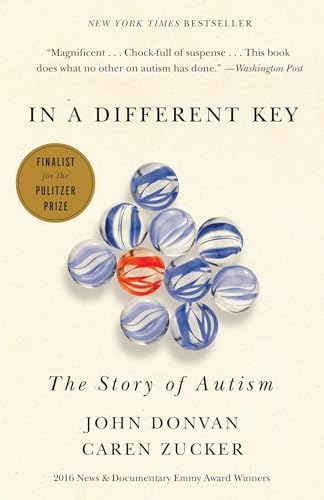
In a Different Key: The Story of Autism Paperback – 17 January 2017
by John Donvan (Author), Caren Zucker (Author)
4.7 4.7 out of 5 stars (703)
PULITZER PRIZE FINALIST -NEW YORK TIMES BESTSELLER - "Sweeping in scope but with intimate personal stories, this is a deeply moving book about the history, science, and human drama of autism."--Walter Isaacson, #1 New York Times bestselling author of The Code Breaker
"Remarkable . . . A riveting tale about how a seemingly rare childhood disorder became a salient fixture in our cultural landscape."--The Wall Street Journal (Ten Best Nonfiction Books of the Year)
The inspiration for the PBS documentary, In a Different Key
In 1938, Donald Triplett of Forest, Mississippi, became the first child diagnosed with autism. Beginning with his family's odyssey, In a Different Key tells the extraordinary story of this often misunderstood condition, from the civil rights battles waged by the families of those who have it to the fierce debates among scientists over how to define and treat it.
Unfolding over decades, In a Different Key is a beautifully rendered history of people determined to secure a place in the world for those with autism--by liberating children from dank institutions, campaigning for their right to go to school, challenging expert opinion on what it means to have autism, and persuading society to accept those who are different.
This is also a story of fierce controversies--from the question of whether there is truly an autism "epidemic," and whether vaccines played a part in it; to scandals involving "facilitated communication," one of many unsuccessful treatments; to stark disagreements about whether scientists should pursue a cure for autism; to compelling evidence that Hans Asperger, discoverer of the syndrome named after him, participated in the Nazi program that consigned disabled children to death.
By turns intimate and panoramic, In a Different Key takes us on a journey from an era when families were shamed and children were condemned to institutions to one in which a cadre of people with autism push not simply for inclusion, but for a new understanding of autism: as difference rather than disability.
==
Product description
Review
"Magnificent . . . Chock-full of suspense . . . This book does what no other on autism has done."--The Washington Post (Best Books of the Year)
"Donvan and Zucker sensitively and accurately portray the emergence of understanding of this thing we now call autism, a story that goes back hundreds of years. They make a compelling case for autistic traits--gift and disability alike--being part of the human condition. In the words of child psychiatry pioneer Leo Kanner, autism was 'always there, ' even before the diagnosis was invented."--John Elder Robison, New York Times bestselling author of Look Me in the Eye
"The prose is vivid, the tempo rapid and the perspective intimate, as if . . . filmed with a hand-held camera."--Jerome Groopman, The New York Times Book Review
"The book probes a difficult subject with intelligence and compassion. . . . The complete absence of hysteria will make it essential reading for many. . . . Its insights and quiet wisdom demand our attention, and gratitude."--Amy Bloom, Oprah Daily
"Fascinating . . . [In a Different Key] takes an accessible approach that sheds much light on this human condition . . . through the human stories of those raising autistic children, of those trying to treat, study and research it and those who are autistic."--Seattle Times
"A fascinating and comprehensive history . . . In a Different Key shares the often debilitating aspects of autism yet shows how those with autism can and do flourish with the right supports and environments, and how their lives, and the lives of their families, are filled with joys and triumphs and fun and irreverence, too."--Chicago Tribune
"In a Different Key is a story about autism as it has passed through largely American institutions, shaped not only by psychiatrists and psychologists but by parents, schools, politicians, and lawyers. It shows how, in turn, the condition acquired a powerful capacity both to change those institutions and to challenge our notions of what is pathological and what is normal."--Steven Shapin, The New Yorker
"A fascinating history of this confounding condition."--People
"Donvan and Zucker's generous yet sharp-eyed portraits of men, women, and children--most of them unknown until now--make it stunningly clear that we all have a stake in the story of autism. We come to understand that we are all wired differently, and that how we treat those who are different than most is a telling measure of who we truly are. This is the kind of history that not only informs but enlarges the spirit."--Susan Cain, #1 New York Times bestselling author of Bittersweet and Quiet
About the Author
John Donvan is a correspondent for ABC News, and host and moderator of the Intelligence Squared U.S. Debates, which are heard on public radio and by podcast. During his journalism career, in addition to anchoring such broadcasts as ABC's Nightline, John served as chief White House correspondent, and held multiyear postings in London, Moscow, Jerusalem, and Amman, Jordan. He is the winner of three Emmys and the Overseas Press Club Award. He became interested in autism's impact on families upon meeting his wife, the physician and medical school professor Ranit Mishori, who grew up in Israel with a brother profoundly affected by autism. John also performs as a live storyteller with the group Story District. He has two children and lives in Washington, DC.
Caren Zucker is a journalist and television producer who has reported on a broad range of subjects both domestically and internationally. As a producer for ABC's World News and Nightline, working alongside Peter Jennings, Charlie Gibson, and Diane Sawyer, she covered economic summits, presidential campaigns, social trends, and the Olympic Games. Emmy-nominated, she was honored for her part in ABC's coverage of 9/11 with two of television's most prestigious prizes, the Peabody and the Alfred L. DuPont awards. Her oldest son Mickey's autism diagnosis inspired a new direction in her reporting: to bring a better understanding of autism's realities. Zucker and her husband, NBC Sports senior producer John McGuinness, have three children and reside in New Jersey.

TopAbout this itemSimilarFrom the AuthorQuestionsReviews
In a Different Key: The Story of AutismProduct details
Publisher : Crown Publishing Group (NY)
Publication date : 17 January 2017
==
Customers say
Customers find the book well-researched and informative, providing a detailed look at the history of autism. They appreciate its novel-like readability, with one customer noting it doesn't read like a traditional history book. The book offers excellent background information, with one review highlighting its coverage of advocacy groups, and features real narratives that customers find engaging.
AI Generated from the text of customer reviews
Generated from the text of customer reviews
Select to learn more
Information quality(35)
Readability(35)
History of autism(18)
Story quality(16)
Writing quality(9)
==
From other countries
Paula Ayub
5.0 out of 5 stars The story about autism
Reviewed in Brazil on 30 January 2016
Format: KindleVerified Purchase
Reviewing the history of autism makes us reflect on what happened to wealth and what was left behind in the light of technology.
We can't help BUT LISTEN to our kids.
One person found this helpful
Report
Translated from Portuguese by Amazon
See original ·Report translation
BC
5.0 out of 5 stars The best book on the subject
Reviewed in France on 29 September 2016
Verified Purchase
The most comprehensive book on the subject that exists. Written by journalists, the science is absolutely complete. My only complaint is the passage on the Patriot Act, which seems a bit weak to me (there are sources as for everything else in the book but they are not easy to access). But it remains an indispensable book. Congratulations to the journalists. Really, well done.
Report
Translated from French by Amazon
See original ·Report translation
gatto
5.0 out of 5 stars In a different key
Reviewed in Italy on 27 February 2016
Verified Purchase
High educational quality scientific book. It is the extraordinary story of the autism affair, of parents fighting for the civil rights of their children, of medicine that tries to find a definition for this mysterious and multifaceted syndrome. It is the story of naivety, scientific controversy, profound social changes that have taken place over the decades. The discovery of a syndrome, that of autism, which has always existed, makes retrospective diagnoses fascinating, which go back decades in people's lives. The film “Rain Man” and Dustin Hoffman's spectacular performance have made known to millions of people the existence of this disease, and its extraordinary qualities. is the motto of the first parents' associations, and hence the title, “In a different key”, which offers a new, social reading of this diagnosis.
Report
Translated from Italian by Amazon
See original ·Report translation
Jim
5.0 out of 5 stars A good resource and a great read
Reviewed in the United Kingdom on 16 November 2016
Verified Purchase
Well researched, well written and all in all a bit of a page-turner. The work provides a human perspective to the study of Autism in a historical context. Some of the material is uncomfortable to deal with - particularly society's attitudes through time- but overall a good resources and a great read.
One person found this helpful
Report
David Badke
5.0 out of 5 stars Should be required reading
Reviewed in Canada on 1 November 2018
Verified Purchase
If you have any interest in autism, you should read this book. It is a carefully researched history of society's attitudes toward autism, from its earliest identification in the 1940s to around 2013. Through the stories of parents with autistic children, scientists and activists, and some of those with autism themselves, the authors reveal how attitudes changed over the years, from blaming mothers for their children's autism to a recognition of the organic causes of the disorder. The heroes - and villains - of the story are well profiled. This is not a medical or scientific study of autism, it is history, and as such provides excellent background to autism and its many puzzles. Highly recommended.
Report
Amazon Customer
5.0 out of 5 stars useful for parents and teachers
Reviewed in India on 27 July 2021
Verified Purchase
Good for education
Report
Barbara Dunlap
5.0 out of 5 stars In a Different Key: The Story of Autism A balanced view of a complex condition
Reviewed in the United States on 31 January 2016
Format: HardcoverVerified Purchase
"In a Different Key: The Story of Autism" by John Donvan and Caren Zucker chronicles the history of autism from its earliest roots to present day. Donvan and Zucker introduce us to professionals, parents and children with autism, all grappling with defining, redefining, and addressing this complex spectrum of behaviors that overtaken their lives and demanded their attention.
Lorna Wing, noted psychiatrist who first coined the phrase "autism spectrum" wrote, "Nature never draws a line without smudging it.". Indeed, autism is as variable as the people with it... from the completely withdrawn who cannot communicate or function with any amount of independence, to people like my son Ryan (not his real name), diagnosed with Asperger's Syndrome... a high functioning form of autism on the spectrum who is "quirky", but not unable to function in the adult world on his own.
When in the third grade, Ryan was identified as gifted and talented while at the same time being considered for placement in a contained classroom with other special education students because of his poor impulse control and his high anxiety level - particularly when
transitioning from one activity to another. Ryan is very verbal. He is an encyclopedia of knowledge about sharks and dinosaurs, and more recently wrestling and politics. He can speak for hours on these areas of interest, but, much like third grade, makes little or no contact while doing so. He has never learned how to fold into a hug, and has never learned to be gentle in his physicality.
Little did we know back in the day as we searched for a comfortable place for our son in the school system, that we were dealing with a
microcosm of Donvan and Zucker's book; How did this happen? Was it our fault? How do we handle those different from ourselves? When is a quirk a disability? How do we measure success in those differently-abled? And what becomes of those more affected who, unlike Ryan, will never be able to accomplish the tasks of daily living and live independently? What is out there for them? And yet, for those like Ryan, are we overreaching in trying to "cure" what is a simple case of being a little different... a variation of normal? Are we stifling neurodiversity and doing a disservice to those who should not be labeled? These are the issues presented in "In a Different Key".
Donvan and Zucker serve the autism community well in their book. As the mother of a son on the spectrum, I finished the book feeling that not only was Ryan well represented, but his entire family as well. A great historical read, broad in scope but intimate in its story telling, this book is also about love, respect and dignity. The story of Donald Triplett, the first person diagnosed with autism. who the authors found alive and well and living in Mississippi, is a wonderful counterpoint to the lengthy history of autism. As described in their book, Triplett is a "Happy
Man", dividing his time between travelling and playing golf at the age of eighty two. "In a DIfferent Key: The Story of Autism" embraces the human condition. It is relevant to us all.
13 people found this helpful
Report
Margaret Radway
5.0 out of 5 stars Brilliant Book
Reviewed in the United Kingdom on 1 March 2016
Verified Purchase
Brilliant book gives a clear history of how the word Autism came into being. How people with 'autism' were cared for and are still cared for. Treatments and support to parents. A good read.
2 people found this helpful
Report
Sam Hoffman
5.0 out of 5 stars A Must-Read For Anyone Interested In Autism
Reviewed in the United States on 24 November 2016
Verified Purchase
The world is a better place with this book in it. I am a better person for having read this book.
All of my friends (and myself) question why a 20-year-old with no personal connection to autism would be so interested in this book. Autism has always fascinated me; I don't know why. I do know that this book answered everything I could have ever wanted to know about autism.
If only school textbooks were written like this book. The authors do such a wonderful job of taking so much information and turning it into beautiful and relatable stories. Very rarely did I feel like I was reading a biographical, non-fiction book like the ones I'm used to reading as a result of educational assignments. I think this was strengthened by the fact that the authors have backgrounds in television. They know how to tell a great human narrative.
A few months ago, late on a Saturday night on my college campus, I ran into a group of kids handing out flyers. I was about halfway through this book at the time. I thought to myself, "oh my god who the heck is bothering people at 10pm on a Saturday night." I quickly retracted my negative thoughts when I was handed a flyer about neurodiversity. I struck up a conversation with the girl who handed me the flyer. She revealed that she was on the spectrum. We spoke for 20 minutes about a range of topics from ABA to Asperger's to Neurodiversity. It was enlightening and heartening to see such passion.
As I read the latter half of the book, I frequently thought back to that conversation. I can only imagine the impact this book might have on readers who have much closer connections with people on the spectrum than I do.
The authors do a wonderful job of remaining partial and non-bias in most situation where there's neither a right or wrong to certain sides. I think right now, a very interesting debate that they pose later on in the book is whether or not autism is something to be cured. I don't know if I have an opinion on it, but I do know that I am immensely fascinated in seeing how autism develops in the future. As I grow older, I hope that my financial and professional situations will provide opportunities for me to make a difference within this community.
Thank you for a compelling book, and a wonderful journey.
18 people found this helpful
Report
Mike
5.0 out of 5 stars I'm the father of a 42 year old son with ...
Reviewed in Canada on 22 February 2016
Verified Purchase
I'm the father of a 42 year old son with autism. I for one have been thirsting for an historical, well researched book on this subject. David, is lower functioning, yet, the ordeals that were shared, were said so eloquently, and hit the bullseye for me. This book was meant to be for every parent, and I truly thank the writer's for their hard work.
One person found this helpful
Report
==
rom other countries
Amazon Customer
5.0 out of 5 stars Five Stars
Reviewed in India on 25 December 2016
Verified Purchase
Must for every individual to understand autism.
Report
Cindy-Leigh
4.0 out of 5 stars Great read so far!
Reviewed in Canada on 14 December 2019
Format: PaperbackVerified Purchase
It's a great read so far even though I'm only on page 50. I can't put it down. It is easy to read and story like not text book like.
I am not overly impressed about the physical quality of the book. As soon as I opened it there was weakness in the lower spine and the pages are separating. If I'm not careful in future reads, the pages will eventually all fall out. Glued dried out or wasnt applied properly?
Customer image
Report
Jonathan Mitchell
4.0 out of 5 stars Good read about autism
Reviewed in the United States on 21 January 2016
Format: HardcoverVerified Purchase
Very good read about autism. Interesting stuff about "autism's first child" Donald Triplett from his youth to old age, covers a variety of topics from epidemic, vaccines and neurodiversity. One area not covered was science, such as findings on postmortem autopsies, MRI scans, and genetic studies, particularly new evidence for de novo mutations. Also, the authors had a mild case of "silbermanitis" in which some of the book is slow paced and goes into a bit of back story. Other than that excellent read. Recommended.
2 people found this helpful
Report
somya saxena
1.0 out of 5 stars Received damaged book
Reviewed in India on 30 October 2017
Verified Purchase
Folded pages and dark smudges over the book I was so excited for. Deeply disappointed..request for exchange.
Report
•
4.0 out of 5 stars If you have a lay contact with autism, read this!
Reviewed in the United Kingdom on 29 November 2015
Amazon Vine Customer Review of Free Product( What's this? )
The two authors both have someone with autism in their family. The book is well structured with main themes including short chapters on specific aspects of the theme.
The book is 544 long, plus an autism timeline to show how understanding of autism emerged, and further notes on every chapter along with an extensive bibliography. It is written in a very accessible language with no need for technical knowledge. Thus it is clearly aimed at the layman.
But it is very long and may defeat many readers, other than those with, say, an autistic child in the family.
The aim of the book is to provide an account of how we came to recognize autism as a diagnozable condition. It uses a wide variety of sources and some of the descriptions of what the child and parents went through are harrowing. There are impressive accounts of parents fighting for the rights of their child and subsequently, how the child lived on as an adult.
Although initially focuses on US cases, it broadens out to the role played internationally by experts such as in the UK. There is an interesting account of how autism as a single condition moved towards an autistic spectrum, and then the debates around inclusion of Asperger's within that profile.
There is a positive account of emerging research and of appropriate intervention. The writing style remains empathetic and humane throughout. The reviewer's only reservations are about the target audience for such a mammoth book, otherwise it would be a clear 5*.
One person found this helpful
Report
Gordon S.
5.0 out of 5 stars Well worth reading!
Reviewed in Canada on 14 May 2018
Verified Purchase
Amazing description of what to many is an affliction, and to some is a gift!!!
This will bring about some introspection, if you are so inclined!
One person found this helpful
Report
Amazon Customer
5.0 out of 5 stars My son is an autistic child. This book was ...
Reviewed in the United Kingdom on 10 February 2018
Format: HardcoverVerified Purchase
My son is an autistic child. This book was very helpful for me. I think it's "must read" for all autistic kid's parents. Delivery was quick.
Report
Steve Ceresnie
5.0 out of 5 stars children like Donald were called a string of derogatory labels
Reviewed in the United States on 14 April 2018
Verified Purchase
This is an extraordinary book. John Donvan is a television correspondent for ABC, and Caren Zucker is a journalist and producer. Together, they have dug deep into the history of autism – from an unknown psychiatric disorder to a diagnosis climbing from 4 to 5 cases per 10,000 people in 1966 to approximately 1 per 100 today. Donvan and Zucker tell the story of autism in 46 fast-paced chapters, presenting detailed accounts of the biographies of the characters: parents, children, psychologists, physicians, advocates and more --- each viewed as if seen through a hand held camera.
When a child in a family is not right, the whole family suffers.
Such was the case when Donald who was born in 1933 to affluent parents in Forest, Mississippi.
Donald was an odd child:
When he was seven, an examiner asked him a question for the Binet-Simon IQ test. If I were to buy four cents’ worth of candy and give the storekeeper ten cents, how much would I get back? I’ll draw a hexagon, Donald replied….He showed scant interest in the inhabitants of the outside world, and that included his parents. Of all his peculiarities, this was the most difficult for them to accept – that he never ran to his father when he came home from work, and that he almost never cried for his mother. Relatives were unable to engage him…Oblivious to those around him, he would turn violent the instant his activities were interrupted…it became clear he was protecting sameness.
Mary Triplett, Donald’s mother concluded that he was hopelessly insane, before the diagnosis of autism was invented. Her husband, Oliver, a lawyer, was known as Beamon to everyone, and was the former mayor’s son. Their doctor advised them that they had overstimulated Donald and he should be placed in an institution.
During the first half of the twentieth century, children like Donald were called a string of derogatory labels:
Cretin, ignoramus, simpleton, maniac, lunatic, dullard, dunce, demented, derange, schizoid, spastic, feebleminded, and psychotic.
Even in Dr. Benjamin Spock’s (1903 – 1998), “The Common Sense Book of Baby and Child Care,” first published in 1946, he recommended that parents immediately place a Mongolian baby in an institution.
For families like Donald’s, sending their child to an institution far from their home created shame, guilt, sorrow, confusion and loss:
They sent away their children in secret, and in time, the children themselves became secrets, never to be spoken of again.
Mr. and Mrs. Triplett brought Donald back home from the institution and took him to be evaluated by the eminent child psychiatrist Leo Kanner (pronounced “Kahner”; 1894 - 1981) at Johns Hopkins hospital in Maryland.
Donald was case number 1 in Kanner’s major work published in 1943, “Autistic Disturbances of Affective Contact.” Dr. Kanner studied eleven cases, 3 girls and 8 boys, he later called autism. ”It was Kanner who identified the two defining traits common to all of them: the extreme preference for aloneness and the extreme need for sameness.” Donald is now 82 years old.
The first time I evaluated an autistic child in the 1970s, I met two warm, loving, guilt-ridden parents telling me through their tears about their unresponsive, odd five year old child who didn’t talk and was obsessed with playing with door knobs and hinges. When this child entered my office, he walked past me as if I wasn’t there and went straight to the curtain and began sucking the on the cloth.
I was aware that blaming mothers for causing autism --- and other psychiatric disorders --- was the theory many clinicians studied to diagnose and treat autistic children.
Bruno Bettelheim (1903 – 1990), a prominent child psychologist, who had a Ph.D. in art history, was a famous clinician who promoted that theory. He wrote and lectured that “refrigerator mothers” raised their children in a climate of emotional frigidity causing autism. Bettelheim recommended a “parentectomy”, taking these autistic children away from their parents and putting them in a therapeutic milieu. Bettelheim founded the Orthogenic School at the University of Chicago as a residential treatment program.
I couldn’t square my subsequent many encounters with autistic kids and their parents with the refrigerator mother theory expressed in Bettelheim’s famous book, “The Empty Fortress.” My doubts about this blame the mother theory of autism were reinforced in a yearlong seminar taught by Fritz Redl, a contemporary of Bettelheim, and a brilliant teacher and writer. In this seminar of 8 students, 3 of the students had worked for Bettelheim, whose nickname they said was Bruno Brutalheim --- because of how he treated staff, children and parents.
In 1990 Bettelheim committed suicide, his method placing a plastic bag over his head. My thought was he recognized the monstrous damage he inflicted on children and their families with his cockamamie theory and treatment approach to autism. But who can know for sure.
Donvan and Zucker uncover the stories of courageous characters who fought against the blame theory of autism. Scientists, sometimes with an autistic child of their own, and parents of autistic kids worked tirelessly to get kids out of institutions, band together to make the education establishment teach autistic kids in public schools, find behavioral treatments that worked, and more.
The media did much to broadcast and humanize the life of autistic people For example, the brilliant movie “Rain Main” told the sensitive story about an autistic man starring Dustin Hoffman (1937 - ); Temple Grandin (1947 - ), the first celebrity autistic adult with a Ph.D. in biological sciences and a professor of animal sciences at Colorado State University wrote best-selling books about growing up with autism and lectures around the world. A movie about the life of Temple Grandin garnered rave reviews, starring Claire Danes (1979 - ). Oliver Sacks (1933 – 2015), the brilliant neurologist, wrote a book of essays called, “Anthropologist on Mars,” with the title referring to his chapter on Temple Grandin.
Along the way there were many missteps among autistic advocacy groups and scientific findings:
It was an early harbinger of the tragic tendency of autism advocacy groups, or individuals in them, all supposedly dedicated to the same cause, to turn against one another. It had been there at the beginning, and it would flare up, again and again, to the detriment of the greater cause, in every decade to follow.
In 1998, a British physician published a shocking paper in the well-respected Lancet journal claiming that the MMR (measles-mumps-rubella) vaccine may cause autism. The study was eventually discredited, the physician lost his license, but not without significant panic in the community about the safety of giving children vaccines. Many educated people stopped giving their children the MMR vaccines and “measles was becoming active again the United States, with reported infections reaching a twenty –year high in 2014.”
Whether we are witnessing a true increase in the autistic population, or whether the definition of autism on a spectrum makes the difference in numbers remains controversial.
Because we know so little about the complex etiology of autism, crank, expensive treatments masquerading as science promising quick cures lurk at the doors of progress, waiting to lure parents down the road of dangerous psychiatric misadventures.
Advocacy for autistic children and adults is essential and must be driven by scientists.
20 people found this helpful
Report
Amazon Customer
5.0 out of 5 stars Autism; Misconceptions and Reality
Reviewed in the United Kingdom on 3 March 2016
Verified Purchase
comprehensive and detailed study of the history of autism. Contains anecdotal, factual and scientific evidence of previous misconceptions and current breakthroughs in diagnosis and reasoning.
One person found this helpful
Report
FitOldDog
5.0 out of 5 stars I had no idea Autism and Aspergers experienced such a convoluted history. Fascinating!
Reviewed in the United States on 3 March 2024
Verified Purchase
Great reading, based on extensive research. The book addresses the evolution of public and medical perceptions of the conditions or phenotypes known popularly as autism and Aspergers. The writers included descriptions of the life of selected autistic and Aspergers individuals, to great effect. They also address the successes and conflicts of multiple autism advocacy groups, and the role of individuals with autism and Aspergers, their parents, and politicians, in such events. Sure taught me a lot. Highly recommended reading. Kevin Thomas Morgan
2 people found this helpful
Report
==
==
==
==
