
Paperback
$22.86
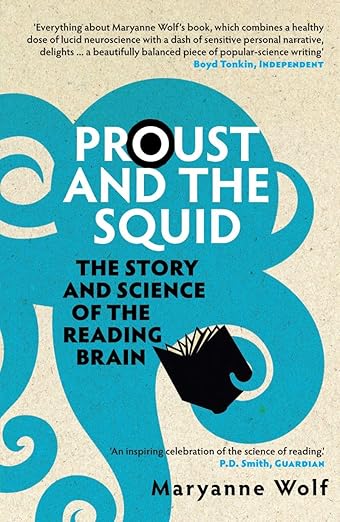
Proust and the Squid: The Story and Science of the Reading Brain: The Story and Science of the Reading Brain Paperback – Import, 1 December 2008
by MARYANNE WOLF (Author)
4.6 4.6 out of 5 stars (691)
Edition: 1st
See all formats and editions
A path breaking study of the brain and how the invention of reading has altered man's evolution.
How the brain learned to read is a startling reminder of the amazing achievements of humankind. We were never born to read, says Maryanne Wolf. No specific genes ever dictated readings development. Human beings invented reading only a few thousand years ago. And with this invention, we changed the very organisation of our brain, which in turn expanded the ways we were able to think, which altered the intellectual evolution of our species. In Proust and the Squid, Maryanne Wolf explores our brains near-miraculous ability to arrange and rearrange themselves in response to external circumstances. Wolf, a world expert on the reading brain, brings both a personal passion and a deft style to this incredible story. A pop science masterpiece on a subject that anyone who loves reading will be sure to find fascinating.
Read less
==
About the Author
Maryanne Wolf teaches at Tufts University and is Director of the Center for Reading and Language Research in Boston, USA. She teaches and lectures all over the world and is a renowned expert on the reading brain.
==
From Australia
Lisa Smith
5.0 out of 5 stars Excellent
Reviewed in Australia on 26 October 2020
Format: PaperbackVerified Purchase
Excellent! Well written! Based on solid evidence.
Helpful
Report
Amazon Customer
5.0 out of 5 stars Five Stars
Reviewed in Australia on 9 June 2017
Format: AudiobookVerified Purchase
:)
Helpful
Report
From other countries
neunzert
5.0 out of 5 stars Sehr spannendes Buch mit originellem, aber schwer verständlichem Titel
Reviewed in Germany on 16 June 2017
Verified Purchase
Das ist ein sehr spannendes Buch, leider gibt es nichts vergleichbares in deutsch. Es kam ja antiquarisch aus USA, war aber gut erhalten und ist wirklich lesenswert. Der Titel ist ein schöner Hinweis auf den Inhalt, aber sicher nicht leicht verständlich. Das Buch hält aber, was der Titel verspricht.
One person found this helpful
Report
Translate review to English
Dr. Lee D. Carlson
5.0 out of 5 stars An excellent introduction to the cognitive neuroscience of reading
Reviewed in the United States on 10 July 2008
Format: HardcoverVerified Purchase
In this fascinating work, which might be viewed as an introduction to the cognitive neuroscience of reading, the author gives the reader an excellent overview of the cultural origins of writing/reading, the brain mechanisms that are responsible for the ability to read, and the factors behind the inability to read. Written for a general audience, the book does contain some information of a more technical nature for those readers who might have a general background in neuroscience or cognitive neuroscience. Those readers who need more can find much more detailed information in the references. Everything about this book is interesting, especially to those who may be described as "obsessive" readers that spend a great majority of their life reading and are interested in knowing more about the cognitive mechanisms behind the reading act.
There are many interesting discussions and questions that are provoked by the reading of this book. Some of these include:
- Once one has achieved what the author has called "expert" reading status, what is the effect of biological age on this status? Does biological aging affect the "rate of processing" of textual information and if so to what degree? Along these same lines, is it more difficult for an older person to learn how to read as compared to young children?
- Erotic literature has the propensity for physical arousal, so does its reading evoke even more of the imaginative properties of the reading brain than does other types of literature or less? In addition, it would seem that the limbic system would play a greater role in erotic literature, since more emphasis is being placed on attention and imagination than comprehension.
- The technical description that author gives of the "first 500 milliseconds" of reading is fascinating and sheds light on the degree to which the reader must be attentive to the words in the text. But in relation to the need for this attention, while reading a book everyone no doubt has experienced the process of "drifting": you are turning the pages of the book and reading the text but your mind is engaged in other thoughts far removed from the content of the book. After some time and possibly many pages later you catch yourself and then skim the pages you thought you missed. Is the information in the book still assimilated when "drifting" or is completely ignored because the reader is not exercising deliberate concentration? Or is it being partially assimilated and to what degree? And if only partially, can the "skimming" fill in the lost details? If one believes the author's technical description then when "drifting" certain areas of the `parietal lobe', those that are responsible for "disengaging" attention from whatever else we are doing, are not being activated, but the `superior colliculi' that is responsible for eye movements, and the `thalamus' that coordinates information from the brain are.
- Is "speed reading" a viable or effective strategy and what exactly is behind it? Does speed reading require other neuronal mechanisms over and above what is discussed in the "first 500 milliseconds"? People who claim to be able to speed read usually also claim that they do so with complete comprehension. Is this true or are they missing some important information from the book? Unfortunately the author does not discuss speed reading in this book.
- Does it become easier to assimilate knowledge the more one reads? If one accepts the author's explanations this would be the case, for she holds that less time is required for a "fluent" brain to represent and retrieve the visual, phonological, and semantic information needed for reading. But in this regard is it possible to read "too much", i.e. to read at such an intensity/frequency that a kind of "asymptotic limit" is reached for the ability to retrieve information from `associative' memory as described by the author?
- Is the reading process as discussed by the author different to some degree when reading technical literature? Those who read mathematical texts can attest to the large degree of concentration needed as compared for example to reading a novel or a news story. The author asserts that the speed that we read a word is influenced greatly by the quality and quantity of the semantic or background knowledge that is activated by that word. But does this also hold for mathematical equations or other types of symbolic expressions that are essentially outside colloquial grammars? English grammar for example does not include mathematical expressions as part of its syntax or semantics so when such expressions are included in texts, as they are of course in mathematical texts written in English, the reader's "flow" must be interrupted so as to deal with these expressions. This slows down the reading rate considerably, and frequently a lot of backtracking must be done in order to fully comprehend the text. Ironically, visualization plays a strong role in the understanding of mathematical texts, but the authors of these texts frequently eschew the idea of incorporating diagrams or pictures in them.
- The author devotes a considerable part of the book to the historical invention of language and reading and compares the skepticism of Socrates towards writing/reading to her own skepticism on the use of online tools for the presentation of information. As far as the explanatory power of verbal narratives are concerned, Socrates certainly had a point if one is only concerned with dialogs of a philosophical or argumentative nature, as of course Socrates was deeply embedded in. But think of how difficult it would be exchange highly sophisticated mathematical information in a verbal dialog. Such an exchange almost necessitates the use of writing, as well as its preservation. And as far as online information and the way it is presented, the jury is still out on its efficacy due to the short timeline that the Internet has been available to everyone. In this regard the author, and all of those who love to read, must be careful not to morph into technoreactionaries when dealing with the new methods of presenting information. These new methods may be even more effective, even more fun, than the activity we have all done for thousands of years, this activity which at some point in the future may be christened as "classical reading."
27 people found this helpful
Report
Matilda
4.0 out of 5 stars A scientific approach to reading achievement and the problem of dyslexia
Reviewed in Spain on 13 August 2013
Format: PaperbackVerified Purchase
This book provides an overview of the neurological processes that take place during learning to read. It's quite fun, you learn with it and it invites you to think. A glossary is missed because sometimes it is very difficult to understand technical terms.
2 people found this helpful
Report
Translated from Spanish by Amazon
See original ·Report translation
-K-
5.0 out of 5 stars Loved the book! Highly recommended...
Reviewed in India on 8 August 2022
Verified Purchase
I would recommend this book to anyone who's interested in learning more about reading and the science behind it...really good book
Report
深川高山
5.0 out of 5 stars 読みやすいですよ。
Reviewed in Japan on 10 February 2010
Verified Purchase
邦訳版が読みづらかったので、原書を買ってみました。引用文以外は、読みやすい文章です。専門用語は、日本語でも意味がわかりませんから、気にせず読んでしまいましょう。引用文は文学的で、素人には少し荷が重いですね。
13 people found this helpful
Report
Translate review to English
Bryon L White
5.0 out of 5 stars Terrible Title But Great Book
Reviewed in Canada on 30 March 2025
Verified Purchase
The title of this book is horrible and doesn’t give readers any insight to the book’s contents. Proust put me to sleep, BUT this is a really interesting read about how writing evolved, how the brain reads and the connection to neurological development, and why some struggle. Unlike Proust or squids, it kept me turning pages.
Report
Ilkka Lavonius
5.0 out of 5 stars Five Stars
Reviewed in the United Kingdom on 15 June 2016
Format: PaperbackVerified Purchase
Advanced scientific results well explained, interesting graphics, personal point of views.
ILs
Report
Amazon Customer
5.0 out of 5 stars Proust and the Squid
Reviewed in Italy on 2 April 2015
Verified Purchase
The book arrived in time and the package was good. Excellent service. The book was also in excellent conditions. So now I only have to read it..
2 people found this helpful
Report
==
