
Kindle
$24.83
Available instantly
Hardcover
$44.57
Paperback
$46.95
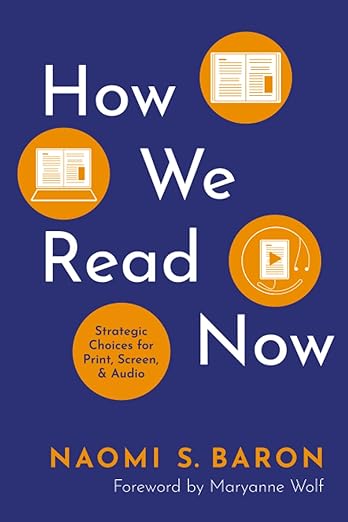


How We Read Now: Strategic Choices for Print, Screen, and Audio Paperback – 30 December 2022
by Baron (Author)
4.6 4.6 out of 5 stars (35)
An engaging and authoritative guide to the impact of reading medium on learning, from a foremost expert in the fieldWe face constant choices about how we read. Educators must select classroom materials. College students weigh their textbook options. Parents make decisions for their children. The digital revolution has transformed reading, and with the recent turn to remote learning, onscreen reading may seem like the only viable option. Yet selecting digital is often based on cost or convenience, not on educational evidence. Now more than ever it is imperative to understand how reading medium actually impacts learning--and what strategies we need in order to read effectively in all formats. In How We Read Now, Naomi Baron draws on a wealth of knowledge and research to explain important differences in the way we concentrate, understand, and remember across multiple formats. Mobilizing work from international scholarship along with findings from her own studies of reading practices, Baron addresses key challenges--from student complaints that print is boring to the hazards of digital reading for critical thinking. Rather than arguing for one format over another, she explains how we read and learn in different settings, shedding new light on the current state of reading. The book then crucially connects research insights to concrete applications, offering practical approaches for maximizing learning with print, digital text, audio, and video. Since screens and audio are now entrenched--and invaluable-platforms for reading, we need to rethink ways of helping readers at all stages use them more wisely. How We Read Now shows us how to do that.
Read less
304 pages
Review
"Baron's work provides a weighted and critical description of printed and digital environments from an educational point of view, focusing on those factors of improvement that each of them entails. One of its main contributions is the introduction of audio and video analysis as complementary forms of reading that are becoming more and more important as the platforms for their use expand, and the services offered increase." -- José Antonio Cordón, University of Salamanca, Escola de Llibreria
"Beyond being eminently readable, How We Read Now is also inspiring in terms of design. Recommended. Graduate students, researchers, faculty, and professionals; general readers." -- P. Finley, University of Nevada, Las Vegas, CHOICE
"A well-researched, accessible treatise on all the ways we experience and absorb words... Educating tomorrowâs generations is of urgent importance to all of us, and for that reason, How We Read Now is must reading. Baron does not prescribe particular reading platforms, but rather enables us to better assess all the possibilities... Baron's light, conversational style makes for enjoyable reading - whether in print or on a screen. " -- Bàrbara Mujica, Washington Independent Review of Books
"How We Read Now is a wonderful guide to the complicated landscape where our minds meet the written word; it helps us understand how we read, how we learn, and how we navigate a changing world of text, information, stories, and connection, for ourselves and for our children." --Perri Klass, Professor of Journalism and Pediatrics, New York University, and author A Good Time to Be Born
"Naomi Baron has done a huge service to everyone involved in the study, teaching, and practice of reading-which means all of us. Written in a friendly and informal style, with well-placed signposts and summaries, her succinct synthesis of research findings provides a wealth of timely and relevant advice for policy-makers, teachers, students, parents, and children." --David Crystal, Honorary Professor of Linguistics, Bangor University, and author of Let's Talk
"Naomi Baron has done it again. She has enticed us to take a long, hard look at reading in this technological age. How We Read Now brings the advantages and disadvantages of each medium into the light, and guides us on what, when, or why to read in one medium or another. This eye-opening book is truly a 'must read' for educators, parents, and students." --Patricia Alexander, Distinguished University Professor, University of Maryland
"Dr. Baron clearly synthesizes the issues surrounding how we read from printed and screen texts. Everyone needs to read this book." --Larry D. Rosen, Professor Emeritus of Psychology, California State University, Dominguez Hills, and co-author of The Distracted Mind
"Naomi Baron expertly presents the latest research on the cognitive and behavioral facets of 'reading to learn' in multiple formats. She offers an accessible translation of points and strategies for policymakers and educators, including parents, to consider for readers at all levels. This book is essential reading in a time of transition to digital publishing." --Diane Mizrachi, UCLA Library, and Alicia Salaz, Carnegie Mellon University
===
From other countries
Chuck Werninger
5.0 out of 5 stars Timely Research Findings!
Reviewed in the United States on 4 June 2021
Format: HardcoverVerified Purchase
This book really helps educators understand what learners are reading and where they're learning...and not learning...and how that's changing in the last few years and especially since the pandemic began so it's very timely!
2 people found this helpful
Report
Gilvan Vilarim
5.0 out of 5 stars Bom!
Reviewed in Brazil on 7 April 2023
It provides a text for laypeople but with countless academic references from various studies. Try to balance the discussion between digital and printed reading, identifying the positive and negative sides of each one. It also includes the issue of audios, as in the case of audiobooks.
Translate review to English
C. D. Waage
4.0 out of 5 stars How We Learn to Read
Reviewed in the United States on 9 April 2021
Format: HardcoverVerified Purchase
I thought this was a book about how to improve your reading style. It's more of a book for teachers trying to teach students to learn to read. So if you want a teacher, probably has limited use to you.
2 people found this helpful
Report
===
Naomi Baron
Article
Talk
Read
Edit
View history
Tools
From Wikipedia, the free encyclopedia
Sorry to interrupt, but we're short on time to hit our goal.
This Saturday, we ask you to join the 2% of readers who give. If everyone reading this right now gave just $2.75, we'd hit our goal quickly. $2.75 is all we ask.
Give $2.75 Maybe later
20 December: Wikipedia still can't be sold
We're sorry we've made several attempts to reach you lately, but it's Saturday, 20 December, and we still need some help. If everyone reading this gave $2.75 today, we'd hit our goal in a few hours. Most readers don't donate; only 2% do. Wikipedia is run by a nonprofit, not by a billionaire. So if Wikipedia has given you $2.75 worth of knowledge, please give. Any contribution helps, whether it's $2.75 or $25.
Give $2.75
Give a different amount
Maybe later
I already donated
Close
Naomi S. Baron (born September 27, 1946, New York, NY) is a linguist and professor emerita of linguistics at the Department of World Languages and Cultures at American University in Washington, D.C.[1]
Education and career
Baron earned a B.A. in 1968 in English and American Literature at Brandeis University, and, in 1973, a PhD in linguistics at Stanford University. Her dissertation is titled, "The Evolution of English Periphrastic Causatives: Contributions to a general theory of linguistic variation and change."[2] She taught at Brown University, the Rhode Island School of Design, Emory University, and Southwestern University before coming to American University, where she held a position from 1987 until her retirement.[when?]
Research interests
Her areas of research and interest include computer-mediated communication, writing and technology, language in social context, language acquisition and the history of English. She is also interested in language use in the computer age, instant messaging, text messaging, mobile phone practices, cross-cultural research on mobile phones, Human multitasking behavior, and Facebook online social interaction usage by American college students.[3] She has published a number of books on these topics.
Honors and awards
She was a Guggenheim Fellow,[4] Fulbright Fellow, and president of the Semiotic Society of America.[5]
Her book, Always On: Language in an Online and Mobile World, which was published in 2008, won the English-Speaking Union’s HRH The Duke of Edinburgh ESU English Language Book Award for 2008.[6][7]
Selected works
Books
Baron, Naomi S., Words onscreen. The fate of reading in a digital world, Oxford : Oxford University Press, 2015. ISBN 978-0-19-931576-5
Baron, Naomi S., Always on : language in an online and mobile world, Oxford; New York : Oxford University Press, 2008. ISBN 978-0-19-531305-5
Baron, Naomi S., Alphabet to E-mail: How Written English Evolved and Where It's Heading, London; New York : Routledge, 2000. ISBN 0-415-18685-4
Baron, Naomi S., Growing up with language : how children learn to talk, Reading, Mass. : Addison-Wesley Pub. Co., 1992. ISBN 0-201-55080-6
Baron, Naomi S., Pigeon-birds and rhyming words : the role of parents in language learning, Englewood Cliffs, N.J. : Prentice Hall, 1990. ISBN 0-13-662875-3
Baron, Naomi S., Computer languages : a guide for the perplexed, Garden City, N.Y.: Anchor Press/Doubleday, 1986. ISBN 0-385-23214-4
Baron, Naomi S., Speech, writing, and sign : a functional view of linguistic representation, Bloomington : Indiana University Press, 1980. ISBN 0-253-19373-7
Baron, Naomi S., Language acquisition and historical change, Amsterdam; New York : North Holland Pub. Co.; New York : distributors for the US and Canada, Elsevier North-Holland, 1977. ISBN 0-444-85077-5
References
"Naomi Baron - Prof Emerita". American University. Retrieved 2021-12-30.
"Ph.D. Alumni | Linguistics". linguistics.stanford.edu. Retrieved 2021-12-30.
"Always On: Joint Winner of the 2008 Duke of Edinburgh ESU English Language Book Award", Oxford University Press news, 2008.
John Simon Guggenheim Foundation List of All Fellows https://www.gf.org/fellows/all-fellows/naomi-s-baron/
"Who We Are – Semiotic Society of America". 10 May 2021. Retrieved 2021-12-30.
"HRH The Duke of Edinburgh ESU English Language Book Award 2008", ESU, November 12, 2008
"Awards Ceremony at Buckingham Palace", ESU, November 12, 2008.
Further reading
Fahmy, Sameh, "E-mail and the mangling of the English language", USA Today, May 14, 2002, Gannett News Service
"Being 'Always On' Impacts Personal Relationships More Than It Impacts The Written Language", Science Daily, May 24, 2008
Maynard, Melissa, "Review: Always On: Language in an Online and Mobile World"[permanent dead link], Critical Inquiry in Language Studies, 2008.
External links
Official website at American University
