Determined: A Science of Life Without Free Will - Wikipedia
From Wikipedia, the free encyclopedia
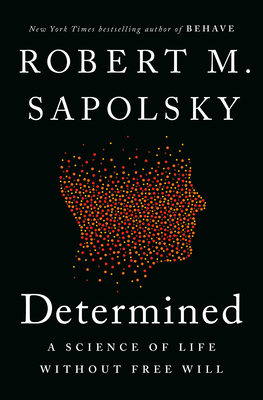
Determined: A Science of Life Without Free Will is a 2023 nonfiction book by American neuroendocrinology researcher Robert Sapolsky concerning the neurological evidence for or against free will. Sapolsky generally concludes that our choices are determined by our genetics, experience, and environment, and that the common use of the term "free will" is erroneous. The book also examines the "ethical consequences of justice and punishment" in a model of human behavior that dispenses with free will.
Reception
A review in The Los Angeles Times said of the book: "What he's written is stimulating to read, even for those who doubt his conclusions." A review in Science found it to have a "dismissive attitude toward how determinism might be compatible with free will" but was "well written" and "worth reading". Psychology Today's reviewer concluded it was "witty and engaging...a goldmine of fascinating information". A negative review by philosopher John Martin Fischer in Notre Dame Philosophical Reviews found that "despite all the commotion over it, [the book] does not offer anything new or illuminating about free will or moral responsibility." Andrew Crumey, writing in The Wall Street Journal, described Determined as "outstanding for its breadth of research, the liveliness of the writing, and the depth of humanity it conveys."
A critical review by Adam Piovarchy of the Institute for Ethics and Society says that the book does not achieve what it sets out to do and that "Sapolsky’s broader mistake seems to be assuming his questions are purely scientific: answered by looking just at what the science says." Philosopher Kieran Setiya in a negative review for The Atlantic criticises Sapolsky for not engaging with the philosophical literature on the question but praises his presentation of the science of decision-making.
Jessica Riskin in her review of Determined: A Science of Life Without Free Will for The New York Review of Books writes: "Science can't prove there's no free will because the question of free will is not a scientific question but a philosophical one. To misrepresent it as a scientific question is a prime example of scientism – of extending the claims of science beyond its bounds."
References
Sources
- Fagan, Abigail (October 17, 2023). "An Attack on Free Will – Why luck often trumps pluck". Psychology Today blog (book review). Psychology Today.
- Reese, Hope (October 18, 2023). "A Conversation With: Robert Sapolsky Doesn't Believe in Free Will. (But Feel Free to Disagree.)". The New York Times. Retrieved 19 Oct 2023.
- Maoz, Uri (October 12, 2023), "Freedom from free will – A scientist presents a case for a predetermined future", Science (book review), 382 (6667): 163, doi:10.1126/science.adk1277, PMID 37824635
- Purtill, Corinne (October 17, 2023). "Stanford scientist, after decades of study, concludes: We don't have free will". LA Review of Books. Los Angeles Times.
- "Determined: A Science of Life Without Free Will", Kirkus Reviews (book review), August 7, 2023
- Fischer, John Martin (November 21, 2023). "Review of Determined: A Science of Life Without Free Will". Notre Dame Philosophical Reviews. ISSN 1538-1617.
- Crumey, Andrew (December 2, 2023). "'Determined' and 'Free Agents' Review: No Choice in the Matter". The Wall Street Journal. Retrieved December 4, 2023.
- Piovarchy, Adam (December 1, 2023). "A Stanford professor says science shows free will doesn't exist. Here's why he's mistaken". The Conversation.
- Setiya, Kieran (November 3, 2023). "Do You Have Free Will?". The Atlantic. Archived from the original on 2023-11-16.
- Riskin, Jessica (February 13, 2025). "Turtles All the Way Up". The New York Review of Books. LXXII (2): 25. ISSN 0028-7504. Retrieved February 12, 2025.
Further reading
==
Determined: A Science of Life without Free Will
One of our great behavioral scientists, the bestselling author of Behave, plumbs the depths of the science and philosophy of decision-making to mount a devastating case against free will, an argument with profound consequences.
Robert Sapolsky's Behave, his now classic account of why humans do good and why they do bad, pointed toward an unsettling conclusion: we may not grasp the precise marriage of nature and nurture that creates the physics and chemistry at base of human behavior, but that doesn't mean it doesn't exist. Now, in Determined, Sapolsky takes his argument all the way, mounting a brilliant (and in his inimitable way, delightful) full-frontal assault on the pleasant fantasy that there's some separate self telling our biology what to do.
Determined offers a marvelous synthesis of what we know about how consciousness works--the tight weave between reason and emotion, and between stimulus and response, in the moment and over a life. One by one, Sapolsky tackles all the major arguments for free will and takes them out, cutting a path through the thickets of chaos and complexity science and quantum physics, as well as touching ground on some of the wilder shores of philosophy. He shows us that the history of medicine is in no small part the history of learning that fewer and fewer things are somebody's "fault"; for example, for centuries we thought seizures were a sign of demonic possession. Yet as he acknowledges, it's very hard, and at times impossible, to uncouple from our zeal to judge others, and to judge ourselves. Sapolsky applies the new understanding of life beyond free will to some of our most essential questions around punishment, morality, and living well together. By the end, Sapolsky argues that while living our daily lives recognizing that we have no free will is going to be monumentally difficult, doing so is not going to result in anarchy, pointlessness and existential malaise. Instead, it will make for a much more humane world.
528 pages, Hardcover
First published October 17, 2023
Original titleDetermined: A Science of Life Without Free Will
==
Displaying 1 - 10 of 1,116 reviews
Profile Image for Morgan Blackledge.
Morgan Blackledge
820 reviews
2,687 followers
Follow
November 6, 2023
In the 15th century, a person with epilepsy would have a high chance of being burned at stake for being a witch.
At that time, seizures were viewed as a sign of the devil, and as such, epileptics (people with epilepsy) were very commonly accused of witchcraft and murdered for it.
Particularly if they also happened to be female.
At present, very few people would ascribe an epileptic seizure to moral or religious impropriety.
We view epilepsy as a neurological condition and therefore well outside the individual’s freely enacted volition.
Punishing someone for having a seizure or calling them weak willed or evil or worse just would not make sense.
Of course, we don’t let individuals with untreated epilepsy drive (at least not until six months from their last seizure).
But that’s not a punishment.
That’s just common sense.
Right?
Someone with an untreated seizure condition is at a high likelihood of loosing control of their vehicle.
We need to keep the roads safe.
By this logic (most people would agree) preventing one (unlucky) individual (with epilepsy) from driving in order to safeguard the public is overwhelmingly reasonable.
In this regard, the criminal justice system serves as the mechanism of constraint whereby the public welfare is protected via regulation of certain individual freedoms.
Not as a means of moral condemnation or punishment.
But simply for the sake of everyone’s safety.
Sapolsky extrudes upon this logic (ad nauseam) in support of expunging moral judgements and punishment from our legal justice system and moral psychology/philosophy.
Sapolsky asserts there is no such thing as free will, in that everything anyone (including me and you) thinks, feels and does is mechanistically determined by multivariate, evolutionarily and environmentally conditioned biological, psychological and socio-cultural causal factors.
Sapolsky spends 200 or so pages supporting this argument with copious evidence from multiple disciplines including behavioral neuroscience, endocrinology and psychology.
By the end of the argument.
You’re essentially hog tied.
You simply have to capitulate to at least some, if not most, but probably all of the arguments.
Sapolsky spends the next 200 or so pages deconstructing the legal system, and moral psychology more broadly.
If free will doesn’t exist.
And the preponderance of evidence indicates that it doesn’t.
At least not like we commonly assume.
Then there really isn’t any room for moral condemnation or punishment in our legal justice system.
And we sort of need to rethink that whole thing.
So there you go.
Neuroscience just rendered the three legged stool of (1) free will, (2) moral culpability, and (3) punishment obsolete.
Akin to phlogiston, elan vital and the geocentric universe.
If all of that sounds grim or tedious.
It’s not.
Sapolsky is witty, charming and erudite to the MAX.
As I’ve said in other reviews.
He’s a puckish rascal of an intellectual nonpareil.
I find him IMPOSSIBLE not to love.
And although this book covers MUCH of the same ground as his others. I think it’s his best to date. Completely worth reading. Even if it feels a little repetitive.
In sum.
I loved it.
I ❤️ Sapolsky.
5/5 ⭐️
266 likes
57 comments
Like
Comment
Profile Image for Kailuo Wang.
Kailuo Wang
6 reviews
44 followers
Follow
March 24, 2025
The following is an updated version. The original one can be found below.
This book is a misguided attempt at moral reasoning based on scientific facts. Lacking a philosophical framework that can establish connections between morality and science, the author relied on his own rather lenient intuition without realizing it. One might say that he is another victim who falls on false philosophical questions.
Sapolsky conceptualizes 'free will' as a governing element inside a body, free from physical laws, thereby qualifying it as supernatural. This intuitive definition is not inherently wrong, albeit not that useful in some philosophical views (the definition places free will in the same realm as unicorns and Santa, i.e. useless non-existent things, I'll come back to this later). He devoted half of the book rigorously disputing against the existence of such a supernatural free will, of which there are many useful scientific insights. This is a view that is already readily embraced by all naturalists - for whom the whole universe is governed by physical law and "natural." And for antinaturalists, it's doubtful that any amount of empirical evidence will change their mind.
What is more problematic is when the book ventures to analyze the moral implications of the nonexistence of such supernatural free will. Had Sapolsky maintained his naturalist rigor, he would have discerned the absence of an established empirical grounding for morality as well, that is, it is not something natural that obeys physical laws (unless one subscribes moral naturalism). If one rejects the whole notion of free will due to the lack of empirical evidence substantiating its existence (for a specific definition of their choice), they would have no choice but to reject the whole notion of morality on the same ground. This would render any moral proclamations meaningless, of which the book contains an abundance. It is like when a child realizes that Santa doesn't exist and draw the conclusion that there is no need for him to behave.
If one wants to reason in morality with rigor, they must start with a solid philosophical foundation rather than just their own casual day-to-day moral thinking. One of the first philosophical questions the author should've asked himself might be how morality holds significance without empirical evidence substantiating its existence. Rather, his lack of awareness in this area is utterly disappointing, sometimes to the point of frustration.
Thus, the book treats the two main subjects, free will and morality with completely different attitudes - free will with one based on rigorous naturalist principles and morality with one based on lenient, casual intuitions. Upon such an uneven footing, the moral belief system it aims to build can’t help to be incoherent.
So where exactly did Sapolsky go wrong in his moral reasoning? It’s his confusion in identities. Let me explain this confusion by analyzing his statement that you do not deserve anything because you don’t have free will. To highlight the issue, let me rewrite “you don’t have free will” as “your decision apparatus isn’t free from deterministic physical laws”. I believe this is what Sapolsky means rather than “you don't have a neuron free from deterministic physical laws”. So the statement becomes “you don’t deserve anything because your decision apparatus isn’t free from deterministic physical laws.” The crucial ambiguity in this statement lies in whether 'you' and 'your decision apparatus' can be meaningfully distinguished from each other for the purposes of moral judgment. To put it another way, what is the identity of “you”? Is it just “your decision apparatus” or something else? The obvious choice for most naturalists is that there is no distinction, your identity is synonymous with the activities in your brain, i.e., your decision apparatus, parallel to how an advanced AI is indistinguishable from its software program. If this is the position Sapolsky takes, as he seems to for much of his book, then the statement should be “your decision apparatus doesn’t deserve anything because it isn’t free from deterministic physical laws,” which is apparently problematic - should we not first understand how a “decision apparatus” might have or lack deservingness before evaluating the relevance of deterministic physical laws? If someone makes such a statement about an AI program - “An AI program doesn’t deserve anything because it isn’t free from deterministic physical laws”, a natural reaction would be “why/how does an AI program deserve anything in the first place?” A naturalist such as Sapolsky has to find a justification or basis for deservingness without concerning the notion of “freedom from physical laws.” Such a justification for deservingness will render the original statement false. Conversely, if no justification is found, then there is no deservingness to begin with, which also nullifies the original statement. Therefore this is a dead end for Sapolsky's statement, which leaves him the only other choice - a meaningful distinction exists between "you" as an entity capable of being morally judged and "your decision apparatus."
Here is a thought experiment to scrutinize the identities our moral intuitions assign to notions of control. Consider a car accident caused by a malfunction in the onboard electrical system. It makes perfect sense to say that the driver was not at fault because he could not control the vehicle due to the defective system. But what if we’re discussing a self-driving car where the “car” and the “driver” are one and the same? It wouldn’t make sense to say that the car is without fault due to its lack of control over itself, as its actions are "determined" by deterministic physical laws. This suggests that the claim "you don’t deserve anything because your decision apparatus strictly obeys the physical laws" only holds up if we think of "you" and "your decision apparatus" as distinct entities and that "you" don't have control over "your decision apparatus." If we eliminate the distinction like we treat the self-driving car, the deterministic nature of physical laws becomes completely irrelevant in our moral assessment. Physical laws are exactly what the brain relies on to work. Your decision apparatus IS the configuration of all the atoms in your brain plus physical laws. If one accepts that "you" and "your decision apparatus" are the same thing, like Sapolsky did in the first half of the book, then physical laws simply cannot be deemed as something preventing the “you” from controlling "your decision apparatus". The unstated premise that "you" and "your decision apparatus" are separate underlies Sapolsky's (and any many others') conceptualization of free will as the influence "you" have over "your decision apparatus." The first half of the book rigorously argues against this assumption - there isn't a "you" other than your decision apparatus, there is no driver in the brain, "you" are the brain. But when Sapolsky makes moral statements he, under confusion over identity, brings the "you" back as an entity that can bear moral responsibilities and suggests that this "you" has none because it has no controls over "your decision apparatus".
What, then, could constitute this distinction if not a form of dualism—with "you" representing the immaterial aspect, and "your decision apparatus" the physical brain? By this interpretation of "free will," humans are not analogous to self-driving cars; rather, there remains a "driver" at the helm of the brain, an identity of the person that is beyond their brain, and it is this driver who assumes moral responsibility. Thus it’s clear that Sapolsky, who consistently refutes dualism in the first half of his book, dismissing the “you” beyond “your decision apparatus” as an illusory ghost, inadvertently leans back into it due to a lack of clear identities when discussing morality.
To end this review on a philosophically constructive note, the debate between free will and determinism can be handily resolved in philosophical paradigms in the line of pragmatism. Hereafter is my perspective, influenced by neopragmatism, especially that of Richard Rorty.
Concepts are not defined based on their truthfulness, i.e how accurately they represent reality, instead, they are defined based on practical usefulness for our goals. For example, the concept of “chair” is very useful for human beings that can sit, but imagine a world with plenty of chair shaped objects and yet no animals that can sit, the concept of “chair” would be useless and not exist in the first place. With the advancement of modern science, humans have been able to introduce more and more concepts such as cell, proton and black hole, that aim to represent elements in nature more accurately. But for neopragmatists, it's a mistake to take the accuracy of representation as the end. In fact scientists themselves, especially those who work in the micro dimensions, have learned to treat concepts as tools (their end is better prediction of measurements), unbothered by the lack of representations.
Similarly, the concept of “free will” existed long before modern science, it has been very useful for individuals and societies. We can try to clarify the definition of “free will” based on its origin and how it’s being used. We can and probably should define "free will" differently under different contexts as long as the contexts don't overlap - we do not need to give it a single definition that it represents something in nature - e.g. a neuron free from physical laws. Such a definition of free will is isolated and useless in many contexts where it disconnects from the other concepts based on “free will” but yet to be also redefined to represent something in nature.
Hence, the whole conundrum between naturalist determinism and free will is a false question due to a misguided redefinition of the concept of free will (due to representationalism). It’s time to move on.
P.S.
Thanks to Arthur Zey (see comments below) I realized the relationship between the concepts of volition and free will. The following are my thoughts on how this conundrum came to be.
When determining the moral responsibility borne by an individual's certain behavior, we take into consideration two factors: the number of alternative behavior possibilities available for them to choose from and the sophistication level of their volition process - the internal process of reasoning and choosing between those possibilities. Everything else being equal, the individual is more morally responsible if their volition process is at a higher level of sophistication. A child is less morally responsible than a grown-up thanks to this reasoning. On the other hand, given the same level of volition sophistication, the individual is less morally responsible if there are fewer alternative behavior possibilities. An impoverished starving man stealing food is judged less morally responsible than a wealthy man for the same behavior. An individual facing a single possible behavior choice is not morally responsible for that behavior. These two moral intuitions suffice for all our practical reasoning regarding moral responsibility. Note that they naturally do not concern whether volition itself has “free” alternatives or is deterministic, only the level of sophistication of it.
Then why is it intuitive that a deterministic universe and moral responsibility is at odds with each other?
I think it comes from three confusions.
The first confusion is conceptual. It is the confusion between the behavior possibilities post volition process with behavior possibilities before it. To better demonstrate what I mean, I’ll use a simplified scenario of a starving impoverished man deciding whether to steal the food. The man faces two choices - to steal or to starve to death. These are the behavior possibilities before his volition process. They are what matters when it comes to moral responsibility judgment. A deterministic world means a deterministic volition process, which in turn means there is only one possible outcome of it and one possible behavior the man ends up choosing. But this did not in any way change the fact the man had two choices to begin with before he decides. It does not reduce his choices to one. People who claim that determinism renders any decision process useless since there is no choice are confusing the choice possibilities before decision with the fixed possibility of one decision outcome. They reject determinism based on the absurdity of all decisions being useless, but the absurdity is really from the confusion, not determinism. This is apparent when we consider a robot agent. Imagine a robot programmed to make behavioral decisions on its own. No one has any problem that the program, hence the robot’s volition process, is deterministic. No one would suggest that it’s useless for this robot to make any decisions due to its deterministic nature.
The second confusion is historical. It originated when Christian philosophy introduced the term “free will” (liberum arbitrium) in the 4th century, which traditionally meant the lack of necessity in human will, resembles the idea of a non-deterministic volition process. This “free will,” I speculate, was introduced because the aforementioned moral intuitions are not satisfactory (to this Christian philosopher) due to their lack of causal relationship between volition and responsibility. The “lack of necessity in human will” sounds more causal and logical to explain why one has to be responsible for his behavior (it is not). Regardless of this speculative motivation, this historical notion of “free will” was actually introduced AFTER our moral intuitions. It’s not the other way around. If one gets this order confused, they will be tempted to believe that our moral intuitions are based on such a notion of “free will” and thus require it, causing a perceived contraction between determinism and our moral intuitions.
The third confusion is linguistic. The original meaning of “free will” gradually got lost for laypersons and became closely resembling the term volition. In day-to-day language, when people say “free will” they are referring to volition - the ability to reason and choose between alternative behaviors, free from coercion but not something free from physical laws. Volition is something that can be intuitively verified through introspection. So when people intuitively believe in the existence of “free will” they often conflate with volition. The opposite happens in the aforementioned intuitions on moral responsibilities - they think the degree of their "free will", mistaken for the original sophistication level of volition, is a source of moral responsibility. In a philosophical discourse though, the definition of “free will” is "clarified" back with the historical value, while the language of their intuitions remained unchanged. Now all of a sudden they have intuitions contradicting determinism.
Update Oct 28, 2023: added the last paragraph for further clarification.
Update Oct 30 2023: reworked to improve clarity, added a constructive part.
Update Oct 31 2023: added P.S.
Update Dec 2 2023: added a paragraph to pinpoint where Sapolsky went wrong.
Update Dec 12 2023: added a paragraph to clarify the identity issue
---ORIGINAL REVIEW BELOW---------
The main lesson is that no matter how brilliant you are, avoid writing a book on a subject that you haven't studied for years. Sapolsky defined free will as the existence of a neuron free from physical laws. Of course this is contradictory to the naturalist belief that the whole universe is governed by physical laws. But when people talk about free will, they mean different things, while the definition Sapolsky gave, upon some philosophical inspection, has no practical implications and thus is useless or meaningless to discuss. One simply cannot derive any practical guidance based on the non existence of the "free will" as defined by Sapolsky. To be more specific, when we talk about morality, we do not need to be concerned with whether naturalism is real, or whether something free from physical laws exists.
Sapolsky should have noticed that there is so much linguistic nuance and complexity in the notion of "free will" that it justifies more study into the existing philosophical discussion in this area, especially post WWII.
176 likes
52 comments
Like
Comment
Profile Image for Sara.
Sara
169 reviews
49 followers
Follow
August 2, 2023
This is a very technical book, yet Sapolsky made a considerable effort to break it down for the average reader. I have a bachelor's in Psychology and have read Dennett and some of the other authors Sapolsky mentioned, so many of the experiments mentioned were familiar to me already, and I have given a fair amount of thought to the free will debate in my personal life.
He's good at timing his jokes to keep you interested when things get dense. Once, he even tells you to just skip an entire paragraph and come back to it later if you need it, which was great (I had no idea what that paragraph meant, anyway).
I can't speak to the science of the book, as to its accuracy or the methodology of the experiments. As a casual reader, however, I don't think it matters a whole lot whether or not his argument is "correct." What matters is how we respond to it. I actually would have loved a few more chapters at the end on this part of the argument (what do we do if there's no free will?) because I felt like that was the strongest part of the book. It leaves you questioning whether any choices you make actually matter, but it also makes some important points about our criminal justice system that happen to be in line with my views: i.e., punishment should be about protecting people from likely future harm, not retribution against the perpetrator. In some cases, we punish too harshly, and in some not enough. Jail time may not be the best punishment for some crimes, either.
Overall, it's a good introduction to the subject if you've never thought about it before. It provides a positive view of Determinism, rather than a bleak diatribe about how nothing matters.
95 likes
3 comments
Like
Comment
Profile Image for Amber.
Amber
761 reviews
175 followers
Follow
January 1, 2024
This book failed to change my mind about anything. Which is disappointing. I was expecting a solid argument because I have a high opinion of Robert Sapolsky. But I spent the whole book shouting to myself, "We don't even seem to agree on what free will is!" You can't even build and argument if we can't agree on what we're talking about.
The main issue is this book's logic is far too extreme. Robert apparently thinks "free will" is "behavior that happens out of thin air." Which is something I feel no reasonable person would claim. I would hope the majority of us can understand that we're all pushed toward certain actions by our past, our genetics, and our environments. That doesn't mean there is no free will at all. You don't have to do something for no reason for it to be free will. You just need to have a choice between two actions. That's it. This entire argument feels like an obvious straw man. He's attacking ideas I've never heard anyone share, and even if there are people out there who do say these things, I think most of us can accept those arguments as bad.
And I agree with most of Robert's ideas around crime and punishment. Like I think we should absolutely take into account everything that lead someone to do what they did, and we should act based on what needs to happen to protect people from criminals. I'm also very anti punishment. I think we should try to prevent future crime in the most unintrusive way possible. The point should be to get the outcome we want, not to inflict suffering on criminals. I think these are relatively popular ideas and I don't disagree. That should have been the real focus of this book because that would have been a much better book, and there's plenty here to support that argument.
It's a shame this book is so poorly argued because there is an excellent point to be made here about how little free will we really have. But he mucks that up by arguing that we have NONE. And then he spends tons of time giving example after example after example of scientific principals that supposedly show we're not in control. I nearly DNFed this book because it was putting me in a coma. It's all stuff you've heard before if you're the type of person with any scientific curiosity.
The book kind of recovers from being mind numbing when it stops talking about chaos theory and quantum mechanics (interesting topics but he goes on for way too long) and moves on to talking about social science. But it still feels like a big mess of ideas that aren't really strung together coherently. I think he relies more on making the reader feel stupid for believing in free will than actually convincing you it doesn't exist. It's like reading a book that tries to convince you god is real. It was a bad idea from the start, and not surprisingly, it does a bad job.
I feel like this could have been reedited into a much better book. There is a good book here, it just needs to drop the whole "free will isn't real" thing, because it my opinion it never gets there, and focus on what drives us to make the choices we do.
49 likes
7 comments
Like
Comment
Tom
6 reviews
1 follower
Follow
Read
August 30, 2024
30 years ago, chaos theory was trying to tell us that a squirrel sneezing in the Midwest could cause a La Nina in the Pacific Northwest. Now this guy wants to tell us that whether we turn right or left has already been predetermined. I'm tired of this scientific extremism. The average person has less free will then he or she may think. Maybe he should explain that. Instead, this guy works in Academia, lives in California, and does research on baboons. I'm sorry, this guy doesn't have a clue. (or so it may seem) My best example on free will is his choice to write this book and take the public's money instead of presenting his research in scientific journals and face scientific and philosphical scrutiny. (BTW, his theories are not accepted in the the philosophical or scientific communities) Milking the public is a choice. Use your free will and go back to the baboons.
36 likes
25 comments
Like
Comment
Profile Image for Christie Bane.
Christie Bane
1,455 reviews
24 followers
Follow
October 28, 2023
This book is a real winner for me — not only pop science at its best, but also giving scientific credibility to something I have long believed: the idea that the great majority of our actions (the author would say all of our actions) are determined by A) who we are genetically and B) what our life experiences have been. The author’s conclusion is that there is no such thing as free will. Obviously this brings up some thorny issues, such as whether or not people who have achieved a lot in life deserve all their good fortune, and how punishment can be moral if people don’t truly have choices. (His answers: no and no, but the fact that punishment is not moral doesn’t mean we shouldn’t do it, because the rest of society still needs to be protected even if what the criminal does isn’t his fault.) I’m not enough of a scientist to critique the science in the book, but I will say that everything he says supports everything that I’ve always thought. I feel like almost everything I have is due to factors I didn’t have any control over, not to personal choices I’ve made, so I’m lucky rather than virtuous. Do with this book what you will, but I do think everyone should read it.
34 likes
1 comment
Like
Comment
Profile Image for Bharath.
Bharath
934 reviews
629 followers
Follow
April 29, 2024
I regard ‘Behave’ as an exceptional book, and I was hence keen to read ‘Determined’ (well, I actually listened to the audiobook).
Sapolsky gets my attention right at the start when he says we have no free will! His challenge – point me to a neuron which fires on its own irrespective of what happened before. He admits that many think this is too high a bar since it is near impossible to isolate our brains from the real world. Yet, he goes on to convincingly argue that there is no way to accommodate free will in our actions. What it means is - though we think we are pondering over options and exercising judgement, we would do the exact same thing each time. Our actions are a consequence of genes, upbringing, environment, culture, and experiences. Each of these by themselves introduce aggregate tendencies (eg: humans are more aggressive than bonobos and less than chimps, cultural differences etc) and in combination lead to individual action. The concept of grit (much discussed in management literature as well) has no scientific basis. This is difficult to intuitively prove or disprove – after all we will not get the exact same situation at the exact same time again (identical twins raised together do speak and act very similarly, but that by itself is not conclusive). Brain imaging shows that brain activity commences before we think we made a decision (his previous book ‘Behave’ also mentions this). There is a discussion on the quirks of quantum mechanics & chaos theory – but Sapolsky’s conclusion is that quantum phenomenon do not bubble up to the macro environment. That we cannot predict something, does not mean it is indeterminate. He also dismisses the possibility of our decision-making springing from anywhere except the brain, the PFC plays the critical role in our judgement and behaviour.
The second half of the book has detailed discussion on the implications for law enforcement and our life is itself, if we accept the absence of free will. Much of the punishment meted out to criminals is based on intent. This is used in combination with the actual result to decide punishment – eg: a person who shoots and kills gets more punishment than one who misses, if spontaneous, there is some benefit accorded. If there is no free will, there is no blame. That said, Sapolsky does not advocate criminals roaming around freely in our midst – isolation is necessary but for civil order and not as punishment.
Sapolsky admits that he has not fully worked out all the implications to life. This is because much of our thinking is around intent & morality. It is disconcerting to think that we can neither blame someone who harms us, nor be thankful to someone who helps us. Yet, he goes on to say that modern societies can live, and live well with this discovery. At one time, strong religious belief was regarded as a must for moral conduct. But today the less religious societies are doing very well. Theists are typically unkind to out of group members. We can also get over our tendency to seek retribution – here Sapolsky cites how punishment for serious crime is regarded as closure. Apparently, research shows that victims’ families participating in punishment does not bring closure, but only rekindles the pain. We still will need restrictive spaces, but not to enforce punishments.
While I am undecided on whether I accept all of Sapolsky’s views, this is an extremely thought-provoking book (much like how ‘Behave’ is). I strongly recommend you read/listen to it and form your own opinions. At the minimum, it reinforces how important it is to cultivate safe & progressive environments for people, especially children. It is too late to do it once the brain is set in its ways. The rapid advancement of scientific knowledge – genomics/gene editing, neuroscience and AI, hopefully will make our world a better place, even if we do not have free will. There are some sections which are dense, but overall the book is very readable.
I intend to also read “Free Agents” by Kevin Mitchell, which reaches a different conclusion.
29 likes
2 comments
Like
Comment
==
==
From Australia
Michael and Sarah Wood
5.0 out of 5 stars We understand ourselves better without the delusion of free will
Reviewed in Australia on 6 September 2024
Verified Purchase
This is a rigorous evidence-based demonstration that free will is a chimera. If you've ever felt critical of those that fail or disappoint - including yourself - you owe it to them to read this book. As more people read 'Determined', so global empathy will rise.
Helpful
Report
Aaron JB Walton
5.0 out of 5 stars Ex
Reviewed in Australia on 20 December 2024
Verified Purchase
Almost as good as his appearance on the middle way podcast
Helpful
Report
Dick Whittington
4.0 out of 5 stars Emininent professor of biology, neurological science & primatology debunks free will
Reviewed in Australia on 9 February 2024
he first thing to say is that Sapolsky's book is splendidly enjoyable. His ebullience is infectious. It's worth pursuing him in his podcasts to get the full savour of his book. There is a strange paradox here. In his enthusiastic promotion of determinism Sapolsky appears to be the living refutation of his thesis that he is a 'biological machine' without meaning or purpose. The paradox is apparent throughout. Sapolsky is hugely informative on the neurobiology he deploys in support of his thesis that science shows that determinism and free will are incompatible. But the science does not support his arguments that free will is an illusion or that determinism and free will are compatible. Complete disagreement with his thesis need not detract in any way from enjoyment of his wonderfully informative text.
Sapolsky’s title, 'Determined, Life without Free Will' is meant to convey two messages. The first is obvious. He argues that we have no free will because everything we do is determined by our biology and our interactions with the external world. As individuals and as a species ‘we are nothing more or less than the cumulative biological and environmental luck, over which we had no control, that has brought us to any moment.’[4] The network of causal events that brought each of us to the present moment goes back to the beginning of time. In Sapolsky’s vision free will can be dismissed as an imaginary entity. He calls it ‘fairy dust’. He describes himself as a 'hard incompatibilist'. His second message, advanced with far less assurance, is that we will be better off and that we will be better people, if we can learn to live in the world without believing in free will. He concedes that it won’t be easy. Towards the end of his extended argument that the absence of free will precludes responsibility, praise, blame or punishment for the best or worst that human kind can do, Sapolsky steps back for a moment and reflects, ‘Perhaps when done with the writing, I should read this book.’[384] To persuade himself again, perhaps.
Similarly disarming asides, mostly in footnotes, provide an accompanying obbligato to the argument in the text. In an early example Sapolsky insists that he is ‘really, really, really trying not to sound like a combative jerk in the book’.[8] He anticipates opposition. His Introduction suggests that only 5-10% of people will agree with his stance of hard incompatibilism. Most philosophers and legal scholars, 90% of them he says, are compatibilists who accept determinism but consider it unnecessary to scrap free will. The philosopher Daniel Dennett serves as Sapolsky’s exemplary combatant throughout. They are well matched. In their recent televised debate, Dennett and Sapolsky, both abundantly hirsute, resemble a pair of contending prophets from the Old Testament.
My own view is that the issue between Sapolsky and Dennett is never joined. They do not mean the same thing when they refer to ‘free will’. Sapolsky indeed makes no serious attempt to explain what he means by it. His exhaustive compendium of the biological, neurological and environmental sources of human action, valuable in itself, is meant to leave no space in the mix for anything that could be called free will. It is fairy dust, invisible in any version of science-based reality. The philosopher Daniel Dennett, on the other hand, argues that ‘free will’ is a product of our social and linguistic evolution and an essential element in the determinist mix that governs the conduct of our lives. The philosophical elements of Sapolsky's book are heavily reliant on Gregg Caruso's case for incompatibility in 'Just Deserts: Debating Free Will' (2021), in which Caruso and Dennett go head to head.[42,435 and index]
The Graduate and the Garbage Collector
Sapolsky tells a story at the beginning of the book to illustrate his argument with the compatibilists. He asks his readers to imagine a university graduation ceremony. Parents, siblings, relatives and friends are there to celebrate the graduates’ success as they clutch their parchment scrolls and wait their turn with the photographer. Their bright futures beckon. Now Sapolsky asks you to look beyond the cluster of approbation surrounding the graduates to a wall at the back of the auditorium where there are garbage bins and a man is filling the bins with debris from the afternoon celebrations. Pick a random graduate says Sapolsky and ‘do some magic so that this garbage collector started life with the graduate’s genes’, the same uterine environment as a fetus and every other cultural, familial and educational benefit that nurtured the graduate’s progress. And now, with the same magic wand, inflict the graduate with the garbage collector’s miserable childhood and impoverished physical and cultural environment. ‘Trade every factor over which they had no control and you will switch who will be in the graduation robe and who will be hauling garbage cans. This is what I mean by determinism’.[17]
In Sapolsky’s world without free will, where outcomes are unavoidable, the graduate and the garbage collector are equally undeserving of their positions in the social pecking order. The difference between them is nothing but luck. So far as the graduates are concerned, the successful future that awaits them should be undercut by the deflating consciousness that their success now and in prospect is mere chance and completely undeserved. Their pleasurable consciousness of their success should be tempered by humility. Sapolsky’s brief evocation of the garbage collector at the back of the auditorium can be extended to provide a corresponding negative tale of deprivation that will culminate in disaster. After finishing his shift at the graduation ceremony, the garbage collector goes to a bar to drink. Towards the end of the night when he is very drunk, a random remark by a companion enrages him. He smashes his glass on the zinc counter and jabs the sharp end into his companion’s neck several times, severing the carotid artery, so that he dies. The garbage conductor is charged with murder; in some American jurisdictions he will be a candidate for the death penalty.
Sapolsky is familiar with such cases; he is not infrequently called as an expert witness on the question of criminal fault in trials for murder. He will be asked to give his opinion on the question whether the garbage collector intended to cause death or serious injury. In a court of law the answer to that question will determine whether the garbage collector is guilty of murder. As an expert witness Sapolsky must play the lawyer’s game and do the best he can with the question of intention. In his world of reality-based science outside the courtroom however, there can be no rational ground for a finding of criminal responsibility or the punishment that will follow that finding. The garbage collector’s barroom attack, whatever his ‘intention’, was the ineluctable product of biological and environmental events that stretch into an immemorial past. There are no gaps for free will in the causal net that determined his fatal attack. Moral condemnation for killing his companion like praise for the graduates’ achievements is accordingly unjustified. In an interview he recalls with rueful resignation that the expert evidence he has given in nine cases similar to the case of the imaginary garbage collector has only once induced a jury to acquit of murder.
The current state of American criminal law, with its cruel and wasteful encouragement of vengeance, is the moral driver for much of Sapolsky’s polemic. In the second half of his book, where he argues the ethical case for a world without free will, the courts would have a preventive rather than punitive role; dangerous individuals would be quarantined until they could be safely released. As an alternative to American penal practice he discusses the case of Anders Breivik, the Norwegian neo-Nazi terrorist who murdered 77 people in 2011 and now resides in spartan comfort in a secure three room complex with a small gymnasium, television, computer access for his university studies and three budgerigars. Breivik was sentenced to 21 years imprisonment, the maximum possible in Norwegian law. He will be released in 2033 unless he continues to be dangerous, a finding that would allow one or more extensions of his sentence. Breivik’s custodial containment is consistent with Sapolsky’s proposal for ‘quarantine’ to contain danger, rather than punishment for wrongdoing.
The excesses of American criminal law, ‘barbaric’ by comparison with Norwegian practice, play a central but distracting role in Sapolsky’s polemic. There are ample grounds for reform of American criminal law, punishment and penology without wholesale abandonment of the concept of criminal responsibility. It is, moreover, an argument unlikely to win support for reform, if one accepts Sapolsky’s concession that the great majority of lawyers and philosophers reject his hard incompatibilism. The case of Anders Breivik on which he places such reliance cuts the other way. Though Sapolsky tries to deflect the point by calling it ‘funishment’, Breivik is currently serving a penal sentence for an atrocious crime. His attempt to avoid criminal responsibility on the ground of insanity failed. He was convicted of mass murder and the penalty of 21 years for mass murder, served in moderate comfort with opportunities for recreation, represents the maximum punishment for his crime. The years he will spend in prison, though strict in their privation, are not meant to humiliate or reduce his humanity and the prospect of eventual release is an inducement to change. Penal reform can proceed without embracing hard incompatibilism.
Determinism and the Architecture of Choice
Sapolsky’s constant recourse to the law of homicide and violent killers in making his case against free will is misleading in its focus. Most of our laws have no application to individuals who may be biologically incapable of containing their violent impulses. Consideration of the ordinary lives of ordinary people provides a more realistic appreciation of the nature of free will in a determinist universe.
Let’s return to Sapolsky’s thought experiment and ask what his graduate will do, after the ceremony. The graduate - call him Paul - applies for a junior lectureship at Sandstone College Inc. He does well in his interview and the corporation offers him an $80,000pa contract as a lecturer. He takes a chance and asks for something more. He wants a reduced teaching load with one day off, when he can take his share of childminding. After negotiation the corporation agrees with his request and renews its offer without reduction of his initial salary. There is a standard probation period with an option for renewal of his contract. With the assurance of employment Paul and his wife decide to buy a house and move out of rental accommodation. They compile a check list of desiderata and spend some weeks house-hunting. After several unsuccessful bids at auctions they find a house that matches their checklist and finances. Most other people in their street will have followed a similar trajectory in making their choices to settle there.
These events occur in a world composed predominantly in what the philosopher John Searle called ‘institutional facts’. The contracts, the corporation, the $80,000 salary, the option to renew and the contract for the house and ownership title that Paul acquired are all real things. Institutional facts like these form part of an extensive architecture of choice enabling people to lead a conventionally happy life in an ordered society. If it were possible to descend to the level of biology and electronics we would find these institutional facts – the contracts, corporations, options, property titles, salary entitlements - as configurations of electronic particles instantiated in computer codes and in the neuronal pathways of the individuals who negotiate their way through these legal structures. Institutional facts are different from what Searle calls ‘brute’ facts. Institutional facts only exist because our society collectively agrees that they exist and accepts their status and significance in a connected network of regulation of human society. In Searle’s classic example, a dollar note only counts as negotiable currency because of our collective recognition of the monetary status of that palpable object, the dollar ‘note’ - polymer in Australia, paper or cotton fibre in other nations. In similar fashion, the 'corporation' with which Paul makes his contract is a ‘fictional person’, distinct from the human beings who fill its executive positions from time to time. It only exists because of our collective recognition that an organisation of people can count as a ‘legal person’. So also, with the contracts and other elements in Paul’s plan to pursue his academic career and family life. They constitute the institutional framework within which he will exercise his freedom of choice as he negotiates with personnel managers, agents and owners, drawing on whatever resources of rationality and self-assurance he can command. This is all compatible with determinism: there’s no ‘fairy dust’ here. Each choice he makes is determined by preceding events in his neurobiology and the world.
The architecture of choice that enables Paul to negotiate his contracts has evolved over centuries. It is embedded in his brain and in our brains together with the entirety of the past that has brought him to the negotiating table. The compatibilist accepts that Paul’s choices are completely determined by preceding events at the point where he signs each of his contracts.. If he is ordinarily fortunate and if he and his wife were sensible in setting their goals and recognising their constraints on expenditure and so on, they should find that they have done about as well as they could expect in achieving what they wanted. It is no objection to the compatibilist that their wants were determined by the entirety of their preceding lives and the lives of their ancestors. Unless something has gone wrong, and it usually doesn’t, these are exercises of free will that are embedded in their transactions. This is the modest essence of the compatibilist case for a freedom of will worth having.
The choices Paul made in the preceding sketch were all enabled by the civil law. But the same pattern of ordered opportunities for choice prevails in our more informal social engagements where the law is usually an indiscernible presence in the architecture of choice. There is no bright line between law and life. Outside formal contracts and the like, the potential applications of law are often uncertain and disputable. As, for example in the uncertain penumbra of laws that have a potential bearing on the ways in which individuals choose to express their sexuality.
And the garbage collector? Compared with Paul, it is less likely that he will achieve what most people would consider a good life. He might not be able to buy a house but settles instead for rental accommodation. Statistically, he is more likely to be charged with a serious criminal offence than Paul and more likely to be imprisoned. Paul’s children are more likely than his to receive schooling that will equip them to achieve the same modest level of social and economic success as Paul and his wife. The garbage collector’s access to the architecture of choice is more restricted and more biassed towards potentially criminal choices. But advocates for free will, whatever their stripe, do not claim the freedom to do whatever you want without constraint. The case against unjustifiable inequality is compelling, but there is no reason to suppose that it will be advanced by the elimination of free will.
Sapolsky’s Malaise
In an interview promoting 'Determinism' Sapolsky was asked if he would take a pill that would convert him to believe in free will. He said he would take it without hesitation. Believing the myth might relieve his lifelong depression. He thought that people who believe in some varieties of free will are generally more fun to be around. ‘Maybe some of their peace would rub off on me’.(8) His answer to the interviewer’s question will serve to introduce the strange set of paradoxes at the end of his book, when he presents a peculiarly American vision of a modern dystopia. I will quote liberally to give its flavour.
Sapolsky’s hard incompatibilism has brought him to the realisation that ‘there’s no place for meaning or purpose’ in our lives. Research has revealed that we are simply ‘biological machines’,[391-2] That’s a ‘bummer’, as he remarks in a footnote.(389) Whatever your achievements in your life, they are undeserved, your self-discipline is merely a consequence of the way ‘your cortex was constructed when you were a fetus’.(392).
If that realisation makes you feel deflated, you should take comfort says Sapolsky, ‘you are one of the lucky ones. You are privileged enough to have success in your life that was not of your own doing, and to cloak yourself with myths of freely willed choices. Heck, it probably means that you have both found love and have clean running water. That your town wasn’t once a prosperous place where people manufactured things but is now filled with shuttered factories and no jobs, that you didn’t grow up in the sort of neighbourhood where it was nearly impossible to “Just Say No” to drugs because there were so few healthy things to say yes too, that your mother wasn’t working three jobs and barely making the rent when she was pregnant with you, that the pounding on the door is not from US Customs and Immigration…’
If you are one of these lucky ones, one of those ‘benighted’ individuals who still believe in ‘myths of free willed choices’ and believe that they ‘deserve their superyacht’ then good luck to you: the ‘ultimate implications of this book don’t concern you’.
So – if the book is not addressed to this happy band of free will believers - whose concerns are being addressed by Sapolsky? They are the concerns of the ‘unwashed majority who need to be convinced that it’s not their fault’ that they fall somewhere below average as individual human beings who will never get to own a superyacht. Unhappily, as Sapolsky remarks in several interviews, this unwashed majority is unlikely to be educated to a level of literacy sufficient to read 'Determinism' and benefit from his reassuring message that their below average performances in life are really not their fault.
Sapolsky's confession that he would take the free will pill if it was offered was meant, I suppose, as a
rueful joke. He is consistently disarming. It might also be taken to suggest that he is not entirely sure that the way ahead into the brave new world of neurobiology requires our acceptance that we are all just 'biological machines'.
12 people found this helpful
Helpful
Report
Bruce Dixon
5.0 out of 5 stars Just a drop
Reviewed in Australia on 27 September 2024
Format: KindleVerified Purchase
Customer image
Helpful
Report
Gayle
5.0 out of 5 stars Challenges my perception of humanity
Reviewed in Australia on 8 November 2023
Verified Purchase
I haven't read his other work but I've seen his lectures online. Great communicator.
One person found this helpful
Helpful
Report
Sean Manning
4.0 out of 5 stars It's an essential book.
Reviewed in Australia on 25 July 2024
Format: KindleVerified Purchase
Sapolsky asks lots of questions, but provides few answers as to what to do, which is fine, once you accept that our actions are more determined than conscious choice.
Helpful
Report
Mark M
1.0 out of 5 stars Text is small and faded. Unreadable.
Reviewed in Australia on 13 February 2025
Format: PaperbackVerified Purchase
I'm sure the content would have been enjoyable IF it was ACTUALLY READABLE. Do not purchase this edition, seek it elsewhere. Sadly this is typical of Amazon books. Returned.
Helpful
Report
Wozza
4.0 out of 5 stars The guy is a genius
Reviewed in Australia on 4 November 2023
Format: KindleVerified Purchase
A complex matter explained exceptionally well in his own inimitable style. A pleasure to read. A fantastic follow up to Behave.
3 people found this helpful
Helpful
Report
From other countries
Celso Passos Jr
5.0 out of 5 stars DETERMINISMO É UM FATO
Reviewed in Brazil on 14 September 2025
Verified Purchase
Trata-se, grosso modo, de uma tese de doutorado provando minuciosamente que o livre-arbítrio é uma ilusão. Se vc tiver serenidade, persistência e mente aberta vai se tornar uma pessoa muito melhor após essa leitura. É inevitável!
Report
Translate review to English
Fabiola R.
5.0 out of 5 stars Sapolsky es un genio
Reviewed in Mexico on 2 February 2024
Format: HardcoverVerified Purchase
Todo lo que hace Sapolsky es fabuloso
One person found this helpful
Report
Translate review to English
==
From other countries
D. S. AMARILIO
5.0 out of 5 stars If true, it's scary...
Reviewed in Germany on 5 November 2025
Verified Purchase
Shocking ideas that make you wonder...
Report
Sandra Peregrin Pedrique
5.0 out of 5 stars brillant Sapolsky explaining behavioral determinism
Reviewed in France on 16 October 2025
Format: KindleVerified Purchase
The most insightful explanation of human behaviour of al times. Brillant Sapolsky explaining why the « believe in yourself » is not always true.
Report
久永公紀『切り札中の切り札としての権利』・『意思決定のトリック』・『宮沢賢治の問題群』
5.0 out of 5 stars Yes. Yes. Let me add some points.
Reviewed in Japan on 26 July 2024
Verified Purchase
Yes. We do not have any free will in the sense that we can consciously control our decisions.
To me, it is obvious that a decision is made based on (comparing with) relevant feelings of individual options, whether it is good or not so good, and we cannot consciously control the feelings at the time of the decision.
Now, by recognizing the fact that free will is an illusion, our view/attitude to the world would change in such a way to regard death penalty as the extreme abuse.
On the other hand, we human-beings (society) cannot exist without the illusion of free will since we need the illusion to abide by rules.
Consequently what we AT LEAST should do would be:
to remind ourselves the fact that there is no free will whenever someone is accused for her/his act or existence, and to avoid pushing someone to death.
とてもいい本だったので、日本語訳が出て広く読まれることを期待してます。
Kiminori Hisanaga (Tokyo, Japan)
3 people found this helpful
Report
J. Drew
5.0 out of 5 stars Amazing book on free will - do we have it
Reviewed in the United Kingdom on 19 May 2025
Format: KindleVerified Purchase
- This is such an amazing book that could change your thinking. It’s one of the best books on behaviour that I have ever read – certainly since I read Sapolsky’s previous book ‘Behave’.
- Sapolsky argues that free will is an illusion and our behaviours are primarily influenced by biological functions that are influenced by the environment and culture that surrounds us rather than the illusion that we have free will and conscious thought to make rational choices and reasoning over our behaviours. I work with children with profound autism who show patterns of behaviour clearly beyond their control (e.g. watching the same YouTube clips repeatedly, lining up toys, or constantly opening and closing draws or doors) and my own experiences of watching people lose skills and awareness through dementia. You start to think, how much control do I and others also have. Basically, we are nothing more or less than the cumulative biological and environmental luck, over which we had no control, that has brought us to any moment.
- The book is divided into two parts, the first how we develop behaviour, and the second part argues that if we don't have free will, how can things change, but change they do.
- WHAT IS BEHAVIOUR: “Behaviour is influenced in the seconds to minutes before where neurons are activated by a thought, a memory, an emotion, or sensory stimuli. And in the hours to days before that behaviour occurred, the hormones in your circulation shape those thoughts, memories and emotions and altered how sensitive your brain was to particular environmental stimuli. And in the preceding months to years, experience and environmental changed how those neurons function, causing some to sprout new connections and become more excitable and causing the opposite in others. Then we can hurtle back decades in identifying antecedent causes that explain why behaviour occurred. It requires recognising how forces shaped our adolescents brain regions change and are constructed, shaped by socialisation and environment. And further back childhood experiences shaped the construction of your brain as well as the same thing applied when you were a foetus in utero. Basically, you are the actions of events occurring a millisecond ago to what happened billions of years ago via your biology and how it is impacted by the culture, society and environmental events going on around you.” I would add the trillions of microbes in your gut and elsewhere, also has an effect.
- INENT: If you explain to people the case of Phineas Gage whose personality changed following a steel rod going through his brain and what happened to him and how his personality changed following this accident. “Can we find the neuron that started this process in the man's brain that had an action potential for no reason, where no neurons spoke to it just before. Then can you show that the neurons action was not influenced by whether the man was tired, hungry, stressed or in pain at the time”. The question asked is, does this man have free will over his actions.
- We can’t understand a film by watching the last 3 minutes or book by reading the last 5 pages – we need to know what happened before to explain what happens at the end. This is the same with behaviour. We need to know and understand everything that comes before the act or a certain behaviour - from the moment a neuron fires to the way hormones and genes develop from foetal development to previous generations, and the society that influences changes at every level of the behaviour.
- HORMONES: Hormones can influence our behaviour – e.g. the amount of testosterone in your body predicts, whether you will be more aggressive if a certain situation occurs to make that aggression happen. Or oxytocin, which promotes mother-infant bonding. The related hormone, vasopressin makes males more paternal in the rare species where males help to parent. When you give these hormones into the part of the brain in males of polygamous rodent species, they become monogamous. No free will there!
- There are over 75 hormones that can influence our behaviour and our decision-making that play out in different levels throughout the day
- There is more bacteria in your gut than cells in your own body and this is influencing how we absorbs food in different ways but also impact on behaviour.
- Cell signally, hormone influences and genetic liability and brain function and its plasticity are all not only shaped by what we eat, how much sleep we’ve had, and how ourselves and genes work within us, but also shaped by the environment and the different ages we are, which influence how we behave. And the important thing to note is that we have no control over the environment that we're born in to, but different environments shape different personalities. So, for example, if you have a low caring mother and you grow up in a deprived neighbourhood, you will have different outcomes than those who are born to a loving home, parents, and a warmer climate, and even the month that we were born in, which could impact on our learning and how people behave towards us when in life, from birth, childhood, being a teenager (the pre-frontal cortex has yet to fully develop) and as adults and into old age. .
-IN UETRO: Another crucial factor is all the different factors that occur when we are in utero; from what the mother eats, their stress levels, and their hormones, etc. that foetus absorbs.
- A baby born in Mississippi rather than Norway, that simply by being born in Mississippi, will have a shorter life expectancy that is five times the infant mortality, 41 times the chance of dying younger and 39 times the chance of being murdered and have reduced literacy. A child trajectory is being set when already nine months old. We are nothing more than the sum of the biology over which we had no control and its interactions with environment over which we had no control.
- “Starting right at foetal life when you are born, you have already shared nine very intimate months with your mother. And depending on your foetal environment, that can cause significantly increased odds of all sorts of neurodevelopmental neuropsychiatric disorders early in life. And throughout all of life. Being malnourished as a foetus and you've got a 19-fold increased likelihood of being obese and having hypertension when you're 60 years old, exposure to certain stress hormones from your mother while your foetus and as adult, you are more likely to have an anxiety disorder or depression. Our outcomes in life are already beginning to do things to you over which you have no control. While you were still a foetus”.
- Beginning in foetal life, experience does not change your DNA, genetics or the sequence of your genome. What experience does epigenetically is change the regulation of it, how readily genes are turned on or off.
- We have 20,000 genes which will switch on and switch off and that are influenced and controlled by the environment that we live in. The best way to look at this is that we think about plants or the seed for a tree that is also dependent upon the environment that it grows in. This will show how well it will become the tree, plant, or flower. Some plants can grow in any situation and other plants need lots of air, light, and the right love of care and needs to support them. Think dandelions and orchids, dandelions can grow in almost any environment, but orchids need lots of care to bloom into something wonderful.
- “Humans have roughly 20,000 genes in our genome; these, approximately 80% are active in the brain- 16,000”.
- If the per-frontal cortex (PFC) is damaged, you can change your behaviour so that you struggle to make, show and mange emotion you become more irrational and no longer have a gut instinct to make choices.
- SUMMARY SO FAR. Every behaviour that you act out is influenced by cell signalling, how your neurones fire and signal to one another which is influenced by hormones (over 75) influence behaviour, which is also influenced by your genetic coding, which is influenced by your parents, and their parents and previous generations, which are all determined by culture, sleep and the food that we put into us and this is shaped by the environment and culture you are born in.
- An example of decision-making is where judges will decide whether somebody is going to prison or not, is influenced by how long it was since they had their last meal, and this has been replicated several times in regards to judges that hunger can influence how you will decide someone’s future at parole. The judges show that how much blood sugar levels can influence behaviour in regards to people being paroled at 65% when the judge has just had a meal to 0% when there's been a time that has passed from them having their meal.
- Dopamine impacts on motor coordination as seen in people with Parkinson's, who were given the dopamine substitute of L-dopa medication, will then start to have better motor control, but some also tend to be prone to suddenly start gambling and behaving in different ways to how they were prior to having dopamine treatment to manage their Parkinson's.
- When the pre-frontal cortex (PFC) part of the brain has been damaged, then you will see increases in changes such as increased violence or reduced empathy or inhibitions in regards to diseases like dementia or road traffic accidents where somebody's personality changes because of damage to the brain.
- Roughly 50% of the prison populations who commit a violet antisocial criminality have had some form of traumatic brain injury (TBI), verses 8% of the general population who commit a similar crime. A TBI also increases the likelihood of prison populations being repeated offenders.
- Children brought up in economic poverty with lower income will often have greater stress on both the family, the parent and the child, which can greatly impact on brain function and behaviour. Another interesting fact is that the more spoken language you hear, the more words you're going to have in which will make you brighter and have more vocabulary.
- In Norway, they spend a lot more money to support prisoners, but they educate them and they treat them well, and these criminals have far less tendency to go on and commit further criminal at as opposed to America where it's just incarceration for punishment.
- Slime mould, which is a collection of molecules can form and branch out together and will spread over the large areas to find food of the richest sources that they want, and then we find from all of this, the quickest, shortest route by signalling in molecules, working individually and together as a group to find the food they seek through the shortest route. The same thing can be said to be true of atoms or neurons, firing in a brain working together to create intelligence, but which one is intelligent when it's nothing more than just simple neurons firing and working together and sticking together. Learning how neurons fire and work is like how ants behave to find food and build homes for the queen ant. They spread out until the form the shortest and most effective route for finding material to build nest and eat – and discard all the other routes. By working collectively even though no one is planning, into finding the shortest route from the food source to the nest. It's all of this occurs through simple ideas which occur time and time again but lead to great complexity. They start by scaffolding a route and then finding the quickest route and this is the same process that is quite simple in how neurons and molecules behave within the human being to create behaviour. From simple movements we end up with great complexity.
- Some diseases such as Huntington’s occur, where one specific mutation in the 20,000 odd genes that we have in our genetic make-up, creates an abnormality that impacts on 100’s of different proteins within the body, creating a devastating effect, where behaviour changes and a whole range of other complications occur. Massive manifestations occur, even though it's just one gene affected in causing that condition.
- No neuron fires independently to show free will and these will fire under the influence of hormones and cell-signalling, influence by the food we eat and the environment, going all the way back to foetal development and even further back in time over billions of years.
- When we make decisions, the brain triggers neurons, molecules and receptors to fire and set up algorithms for making choices. An example is if a boy slept and fell into some ice, what would you do - would you jump in and save them, would you run away, or try and get help? But you could easily think about decisions such as doing a tango or walking on one leg, but the idea is that our brain has set algorithms to decide on the choices that we make rather than our own actions, and obviously those algorithms get rid of all the silly decisions that we could make and choose one of the three that would be probably more optimal in saving the boy.
- WILL WE ALL RUN AMOK IF WE HAVE NO FREE WILL: The first part of the book that explains why free will is a delusion. The second part looks it at the idea that if we know this information, what can we do with it and how can it benefit us. One of the first things that people often think if there is no free will is that you can tend to give up on how we should behave, so perhaps we need that illusion to make us better human being if we just believe that we're all separate cells, atoms, and molecules that all behave in some associated manner.
- The book looks at how religious beliefs are so different and varied in countries but where there are more secular beliefs such as a in Scandinavian countries, these countries have much better rates of child mortality and reduced infant death and other social norms, whereas countries like America, which is very religious have increases in child mortality rates and increases in reoffenders in prison populations.
- It's important to know that genes aren't fixed, but they are determined and developed by the environment that they are within. We share 70% of our DNA with sponges, and they don't even have neuron connections.
- So much of what we do is scaffolded by our past, in the brain wiring, in what the amygdala does and with all the influences that impact on the brain such as hormones and the receptors in the brain. There are some fascinating studies on rats that if they are deprived of maternal mothers when they're young as opposed to other rats that do have loving caring parents, then they were almost certainly have wiring problems and be more anxious and avoidant than the control rats.
- EPILEPSY: Epilepsy occurs when we get brain activity becomes too excitable or not excitable enough regarding the nervous system, then it can trigger an epileptic episode. We used to think that it was due to evil spirits or being controlled by demonic forces. One neurologist has stated that epilepsy is “4000 years of ignorance, superstition, and stigma, followed by 100 years of knowledge, superstition, and stigma”. In the past, we used to hang people for having epilepsy and considered that they had a contagious disease which could be spread and infected by demons, but now, if somebody has a crash and it's the first time an epileptic seizure has occurred, we will understand that as being beyond anybody's control. We must do the same thinking about behaviour.
- Schizophrenia affects 1-2% of the population: normal speech becomes muttering to yourself and less coherent. This is often a sign of schizophrenia. It doesn't matter what your gender is or where you live. We used to think these people were witches and use to believe schizophrenic people might show higher rates of violence, but they are more likely to be the victim of a violent attack. There was a period in the early 20th century, particularly around the time of Freud, that thought all schizophrenia and autism was a result of how parents brought up their children. Whereas sickle cell disease, Huntington's disease and others are impacted by a single cell, there are likely to be, in schizophrenia and autism, many genes that are influencing behaviour. In siblings where one child has schizophrenia, that there is likely another sibling has a 50% chance getting schizophrenia as opposed to 1 - 2% in the general society. Schizophrenia is genetic but it is also influenced by the environment particularly factors that occur when you are younger, such as stress. Stressful environment and other factors can all trigger schizophrenia in regard to the genetic predisposition to being affected by this condition.
- We live in a universe that just came together and made sense, even though we don't know why, and the same thing needs to be thought about people and how they behave.
- Even though many people do believe that they have free well and even if it's just an illusion, perhaps it does help many people to believe the illusion. An example of this might be a doctor who has a person in front of them with 3rd degree burns, and then they ask if the rest of my family are all right following these burns - what do you say, if the rest of the family have wiped out in a house fire.
- PUBLIC EXECUTIONS: Under religious times we used to have crowds watching public displays of people being burnt at the stakes or being cut, drawn, and disembowelled through to public executions even in the C20 in America.
- Society has changed its viewpoint on race, religion gender, disability, public executions but it's still has some way to go around obese people, whose weight is influenced by hormones such as ghrelin and peptide, surrounded by an environment that promotes junk food, which dictate when you will eat and not eat, and these are influenced by your past and your present state. In the Dutch hunger famine during the Second World War, mums not only gave birth to children who would have health problems because their bodies readjusted to the famine, but also occurred in subsequent generations that followed.
- The country that you live in can affect your behaviour and life expectancy. In Japan, average life expectancy is 85 years, in Central African Republic, it is around 50+, These simple quirks may not be fair, but perhaps we should look at this in the same way that we look at sexual orientation or health matters, or whether you are susceptible to a certain disease and shorter life longevity; it is all dependent on how you are wired and how everything works inside of you and the environment, place and time you were born into.
- This is a brilliant, thoughtful book even if you don’t agree.
3 people found this helpful
Report
Mirko Casella
5.0 out of 5 stars Lettura illuminante
Reviewed in Italy on 19 October 2025
Verified Purchase
Lettura eccezionale: tra filosofia, neurobiologia e psicologia. Scorre bene in inglese e l'autore rende la lettura, seppure molto tecnica a tratti, scorrevole e ricca di elementi ironici. Diventerà un grande classico della questione del libero arbitrio.
Report
Translate review to English
123321
5.0 out of 5 stars A must-read for those who want to get closer to truth, wherever it leads
Reviewed in the United States on 8 January 2024
Format: HardcoverVerified Purchase
One of the most radical, thought-provoking, moving, poignant, and viscerally haunting books about the human condition I've ever read.
I don't know if Sapolsky is correct that humans have no free will whatsoever--it's his philosophical interpretation of scientific facts and he admits philosophy is not his strong suit--but he makes a damn strong and formidable case not only for no free will but for the abolition of the criminal justice system, discarding the very notions of blame and praise, etc. and what might replace that.
I think this book will make anyone a more compassionate and less judgemental person just having had to wrestle with Sapolsky's arguments and all the scientific facts gathered (and he says most of the studies he cites are from the past 5 years, and he cites a lot).
For some, it will probably induce an existential crisis and challenge core beliefs that many people take for granted. Sapolsky himself approaches this with humor trying not to be too depressing and heavy, but also seriousness, he admits where he thinks he could be wrong and he struggles to wrestle with all he's learned and come to believe about the nature of the universe and our place in it in his many years as a scientist and professor (and before), and the book gets very emotional near the end with Sapolsky talking about his family members killed in the Holocaust, struggling with his own feelings of hate, experiences working with defense attorneys and their clients, etc.
The book is chock-full of science but at its core it's a professor, seeing himself as nothing more or less than another cog in a vast machine, but with a heart that cries out for humans to be more understanding of one another and society to be more just, even if that seems impossible. He himself is aware of the paradox in that and ponders it. And he's both cynical and very hopeful and optimistic. We used to burn witches, now we don't. We used to think people with schizophrenia and epilepsy were possessed by demons, now we don't. Each time subtracting responsibility and focusing on addressing root causes of behavior made society kinder. It's very political, and I suspect for a long time it's going to be hard to think about politics again without thinking about this book.
That all said, my only major critique is that I feel like looking at the objective facts of "all we are and do is heavily influenced by all that came before and we are built of components that work like machines" and concluding "there's no room for humans to have any control or agency whatsoever" is a philosophical jump that's unwarranted. Sapolsky makes a good and sincere case for why he thinks it is warranted, but I think he's not taking seriously enough what the role of consciousness might be. It seems to me if we have any agency or control consciousness would absolutely be key to that. Ironically, I feel like reading this book gave me more agency, in that knowing all the science and arguments within about constraints on human behavior enables me to make better choices (not to judge someone, to be more patient with them, to be more understanding, for example).
I'm "agnostic" on this topic (and about to read Kevin Mitchell's book arguing the opposite), but it seems to me that humans may still have some small level of control. Like, maybe "free will" is more akin to us being on a raft hastily made by people who had no idea it was supposed to last a lifetime... And we may only have one arm, but we also have a little paddle to change our trajectory ever so slightly and pew pew gun to shoot any monsters that may pop out and menace us along the way. Food for thought!
But this book is a clear 5-stars. Any disagreement shouldn't take away from that. Worth reading and owning.
115 people found this helpful
Report
joseba e. berrocal cebrian
5.0 out of 5 stars Revisando los fundamentos
Reviewed in Spain on 24 May 2025
Verified Purchase
Robert Sapolsky es, probablemente, lo más parecido a un Platón o un Aristóteles que tenemos entre nosotros. Cualquier cosa que escriba merece ser leída, rumiada y debatida.
Report
Translate review to English
June Rei
5.0 out of 5 stars Much more than I expected
Reviewed in Canada on 26 February 2024
Verified Purchase
I picked this on a recommendation after a visit with my therapist as a potential answer to some of the existential questions I’m struggling with.
This book was eye opening for me and made my head spin with the sheer volume of technical explanations but it’s written in an accessible and entertaining manner.
As is the case for me, each answer leads only to another question but I feel better informed and perhaps a touch wiser after reading this book but It has not come without pain.
My curiosity has lead me this far; a number of new insights and doors have been opened in my life.
3 people found this helpful
Report
Sandeep Bhasin
5.0 out of 5 stars Don’t miss this one !
Reviewed in India on 13 April 2024
Verified Purchase
"Determined" by Sapolsky is an insightful masterpiece that delves deep into the complexities of human behavior and the intricate workings of the brain. Sapolsky's meticulous research and engaging writing style make this book a captivating read from start to finish. From genetics to environment, he explores the myriad factors shaping our actions and decisions, leaving readers with a profound understanding of what it truly means to be determined. I wholeheartedly agree with your five-star rating—it's indeed one of the finest reads of recent times.
One person found this helpful
Report
ralunicol
5.0 out of 5 stars toujour aussi provocateur
Reviewed in France on 27 April 2025
Format: KindleVerified Purchase
du régal , pur stimulus intellectuel ,le Professeur Sapolsky aussi drôle ,bavard et exceptionnel comme dans toutes ses livres!! Toujours un plaisir de le lire!
One person found this helpful
Report
Translate review to English
==
Lino
5.0 out of 5 stars Da leggere per capire al meglio il Determinismo
Reviewed in Italy on 15 April 2025
Verified Purchase
Bellissimo ed illuminante. Trovo migliore la versione in lingua originale, perché i concetti sono meno mediati e la traduzione può “determinare” (… :-D) delle incomprensioni a catena🤓
Report
Translate review to English
High Desert Home Serves,LLC
5.0 out of 5 stars Worthy read!
Reviewed in the United States on 13 February 2024
Format: HardcoverVerified Purchase
I gave this book five stars because it was very well researched and explained. Most people should be able to understand. Though it is helpful to have some general knowledge of the areas discussed.
Actually there is no such thing as “free”. If somebody gives you something they didn’t produce it out of nothing. If it were a physical object it had to be produced by Nature or synthesized or manufactured. These processes cost time (evolution, natural process, resource investment, etc.), energy, and if it was produced by any human involvement, cost money at some aspect of the process. If someone gives you a compliment it was not free because, for one thing, it cost money to keep that person alive, because they or someone had to pay for their food, shelter, health insurance, education, etc. Nothing is truly “free”, The notion that there’s ”free will” is misleading. Free will is not an isolated attribute. We do not live in a vacuum reality therefore there is nothing that isn’t influenced or affected by something else. Universal causation is the proposition that everything in the universe has a cause and is thus an effect of that cause. Will is basically our faculty of wishing, choosing, desiring, or intending to do or not do an act. Making a choice or decision involves drawing upon all your memories, experiences, preferences, biased point of view or beliefs, etc. Your brain utilizes both unconscious and conscious processes in order to make decisions. There is no separate isolated process of how your brain works in making a decision. There is no independent ”will” process that is free of your brain. Your brain is part of your body, and your body and mind are part of the environment in which it is located. Your mind set is affected by many factors, for instance, hunger, emotions, health condition, social pressures, memories, experiences, etc.
Yet, our decision-making process can be changed by undertaking a process of unlearning the “negative” in our psychological construct with “positive” influences. Though this may take additional support from others, such as, professional guidance, we do not have to be “doomed” by the preexisting determined influences of our past. But it does take determined effort to want to change and seek out a path of introspection and self-realization to be able to make better positive decisions. Sometimes it takes external intervention on part of family, friends, or professionals. We are social beings and do not accomplish difficult task in a vacuum.
As this book points out very clearly, to know what we all are up against in our determined dynamic reality is key to our self-awareness in exercising better choices. Part of this realization is that nobody truly has “free will”. We all have been shaped and molded by our Evolutionary and Nurture history. Moreover, daily we are being bombarded by negative propaganda and deliberate misinformation. It all affects our decision-making environment (psychology).
It is my opinion that this book is an excellent investment of time on the path to self-understanding.
30 people found this helpful
Report
Rupinder Sayal
5.0 out of 5 stars Thought-provoking and (potentially) revolutionary
Reviewed in India on 27 November 2023
Verified Purchase
A remarkable, thought-provoking book. Prof. Sapolsky writes very well, and his arguments are quite convincing. The concept of the absence of free will is a fascinating one. It has the ability to evoke mixed feelings of despair and liberation at the same time. I enjoyed reading this book a lot. Even if someone is not convinced about the arguments, the reader will still be compelled to at least reconsider their stance. This is one of those books that will keep occupying your mental shelf space for years to come.
3 people found this helpful
Report
Dirk Dotzert
5.0 out of 5 stars Ein Muss.
Reviewed in Germany on 19 October 2025
Format: PaperbackVerified Purchase
Grossartig. Ein Muss.
Report
Translate review to English
PS
5.0 out of 5 stars Magnificent
Reviewed in the United Kingdom on 24 September 2024
Format: PaperbackVerified Purchase
This is a comprehensive and highly readable account of the innumerable causes of decisions and actions. Sapolsky's many digressions are always interesting. A highly informative, thought-provoking, and enjoyable read. Definitely recommended.
Two critical comments:
I think Sapolsky misunderstands the philosophical position known as compatibilism, which claims that determinism and free will are compatible: If a person's actions are caused by their desires and beliefs (which are themselves caused), that is sufficient to say that they acted freely, and are responsible for their action. 'Free' will is free from coercion, not free from causation. Compatibilism may be mistaken, but Sapolsky's insistence that desires and beliefs are themselves determined, which compatibilism acknowledges, does not refute it.
Sapolsky argues that free will, in the sense of freedom from causation, does not exist, and so blame and retributive punishment are unjustifiable. But humans have evolved to enjoy punishment of others, so he is pessimistic that most people could ever give up ideas of fee will, blame, and punishment. However, the rewarding feelings that people get from punishment of others presuppose the idea of blame. Once blame was subtracted from conditions such as epilepsy (Sapolsky's example), people no longer had rewarding feelings about harming epileptics. So, if people were convinced to relinquish ideas of free will and blame generally, they would no longer find harming dangerous people to be rewarding. So, perhaps Sapolsky is too pessimistic about the possibility of acceptance of the quarantine response to dangerous people.
9 people found this helpful
Report
Alessandro Ferreira
5.0 out of 5 stars Livre arbítrio?
Reviewed in Brazil on 25 December 2024
Format: HardcoverVerified Purchase
Nesse livro o Sapolsky desenvolve uma ideia que ele esboça no livro anterior (Behave/Comporte-se) sobre o livre arbítrio. Basicamente isso não existe, devido às inúmeras variáveis que influenciam em cada uma de nossas decisões, como a cultura, os acontecimentos da nossa vida, hormônios, neurotransmissores, criação, nível sócio-econômico etc. Não somos nada mais nada menos do que a soma de variáveis ambientais e biológicas sobre as quais não temos nenhum controle. Ao longo do livro ele discute sobre os vários posicionamentos filósoficos a respeito do tema, bem como física quântica (resumidamente) e complexidade emergente. É um prato cheio.
7 people found this helpful
Report
Translate review to English
Wolf
5.0 out of 5 stars Sapolsky es un genio
Reviewed in Spain on 29 October 2024
Format: PaperbackVerified Purchase
Este autor escribe genial, estés de acuerdo o no es fabuloso, riguroso y muy prudente en sus afirmaciones, respaldando sus deducciones y opiniones es estudios exhaustivos.
One person found this helpful
Report
Translate review to English
George V Loughery
5.0 out of 5 stars Turtles All the Way Down
Reviewed in Canada on 28 July 2024
Verified Purchase
The crux of the book is that much in our lives is predetermined. We think that we make choices
but the author will argue that is an illusion. So at the extreme it challenges the notion of free will
and begs whether we can hold anyone accountable for their actions-however odious because they
didn't help themselves. Hence the subtitle- Turtles all the way down. An interesting read.
2 people found this helpful
Report
Alexsandro Ribeiro
5.0 out of 5 stars Uma provocação que enriquece nossa existência.
Reviewed in Brazil on 8 January 2024
Verified Purchase
Essa obra é indicada para todos aqueles que não se satisfazem mais com o blá blá blá de sempre e buscam sem titubear o mínimo de resposta às suas indagações.
8 people found this helpful
Report
Translate review to English
Matt
5.0 out of 5 stars Great read, meaty with food for thought
Reviewed in the United Kingdom on 1 June 2025
Format: PaperbackVerified Purchase
I love the book, Sapolsky casts a wide net when it comes to the various disciplines he approaches free will from, which makes for an interesting read. The book can be quite meaty at times, at several points I found myself re-reading bits after getting lost in the footnotes, but is excellent.
Determined is fairly easy to pick up for a non-expert, I'm no biologist of any sort but was just as absorbed by the sections on genetics as those on sociology and physics. The book has also spawned lots of interesting conversations with the various other nerds in my life.
It's a great spiritual successor to Behave (also thoroughly worth a read) and a good pick.
Report
===
===
세진님, 요청하신 로버트 새폴스키(Robert Sapolsky)의 저서 <Determined: A Science of Life Without Free Will>에 대한 상세 요약과 평론입니다.
요청하신 대로 요약과 평론 부분은 <해라체(평어)>로 작성하였고, 강조가 필요한 부분은 별표 대신 <꺾쇠 괄호>를 사용했습니다.
<Determined: A Science of Life Without Free Will> 요약 및 평론
1. 책의 핵심 요약 (Summary)
<자유의지는 존재하지 않는다>
이 책의 주장은 제목만큼이나 명확하고 도발적이다. 신경생물학자인 로버트 새폴스키는 인간의 모든 행동이 생물학적, 환경적 요인들의 복잡한 인과관계에 의해 100% 결정된다고 주장한다. 그는 우리가 흔히 '자유의지'라고 부르는 것은 아직 과학이 밝혀내지 못한 생물학적 기작에 붙인 이름표에 불과하며, 과학이 발전할수록 자유의지가 설 곳은 완전히 사라진다고 단언한다.
<행동을 결정하는 인과관계의 사슬>
새폴스키는 인간의 특정 행동(예: 방아쇠를 당기는 행위)이 발생하기까지의 시간을 거슬러 올라가며, 그 행동이 필연적일 수밖에 없었던 이유를 설명한다.
수분/수시간 전: 호르몬 수치(테스토스테론, 옥시토신 등)와 혈당, 피로도 등이 뇌가 외부 자극에 반응하는 민감도를 조절했다. 배가 고픈 판사가 가석방을 불허할 확률이 높다는 연구가 이를 뒷받침한다.
수일/수개월 전: 최근의 스트레스 사건이나 트라우마가 뇌의 가소성을 변화시켜 특정 신경 회로를 강화하거나 약화했다.
청소년기 및 아동기: 전두엽이 형성되는 청소년기의 경험, 그리고 뇌 발달에 결정적인 영향을 미치는 어린 시절의 양육 환경과 사회경제적 지위가 뇌의 기본 구조를 형성했다.
태아기 및 유전: 어머니 뱃속에서의 호르몬 환경과 부모로부터 물려받은 유전자가 기질을 결정했다.
수천 년 전 (진화): 인류의 진화 과정과 조상들이 살았던 문화적 배경(예: 개인주의적 문화 대 집단주의적 문화)이 행동 양식에 영향을 미쳤다.
새폴스키는 이 모든 단계가 <틈새 없이> 연결되어 있다고 강조한다. "여기까지는 생물학이고, 저기서부터는 자유의지다"라고 말할 수 있는 마법 같은 공간은 존재하지 않는다.
<양자역학과 카오스 이론에 대한 반박>
많은 사람들이 결정론을 피하기 위해 양자역학의 불확정성이나 복잡계 이론(카오스 이론)을 끌어들이지만, 새폴스키는 이를 단호히 거부한다. 양자 레벨의 무작위성이 뉴런의 발화와 같은 거시적 행동에 직접적인 '자유의지'를 부여한다는 증거는 없으며, 예측 불가능하다고 해서 그것이 곧 자유로운 선택을 의미하는 것은 아니기 때문이다. <무작위성은 자유가 아니다.>
<변화의 가능성과 결정론>
결정론이라고 해서 인간이 변하지 않는다는 뜻은 아니다. 우리는 변한다. 하지만 그 변화조차도 외부의 자극과 내부의 생물학적 반응에 의해 <결정된 변화>이다. 예를 들어, 이 책을 읽고 우울증에 대한 시각이 바뀌었다면, 그것은 자유의지가 아니라 '책'이라는 환경적 자극이 뇌의 시냅스를 변화시켰기 때문이다.
<결론: 세상은 어떻게 바뀌어야 하는가>
자유의지가 없다면 죄책감도, 자부심도 설 자리가 없다. 살인자가 살인을 저지른 것은 그가 '나쁜 영혼'을 가졌기 때문이 아니라, 불운한 유전자와 환경의 조합이 낳은 결과다. 반대로 성공한 CEO가 된 것 역시 그가 훌륭해서가 아니라 생물학적, 환경적 운이 좋았기 때문이다.
새폴스키는 사법 시스템과 능력주의(Meritocracy)의 전면적인 개편을 요구한다. 처벌은 '응보'가 아니라, 망가진 차를 수리하거나 격리하듯 공공의 안전을 위한 <검역 모델>로 바뀌어야 한다. 우리는 인간의 성취와 실패에 대해 칭찬이나 비난을 멈추고, 그저 그 원인을 이해하려고 노력해야 한다.
2. 평론 (Critique)
<과학적 엄밀함과 인문학적 통찰의 결합>
이 책은 방대한 신경과학, 내분비학, 심리학, 유전학 데이터를 집대성한 역작이다. 새폴스키 특유의 유머와 방대한 지식은 자칫 딱딱할 수 있는 뇌과학 이야기를 흥미진진하게 풀어낸다. 특히 <행동의 시간적 층위>를 분석하여 자유의지의 허상을 깨부수는 과정은 지적으로 압도적이다. 그는 단순히 "자유의지는 없다"고 선언하는 것을 넘어, 왜 우리가 자유의지가 있다고 <착각>하는지를 집요하게 파헤친다.
<불편하지만 필요한 진실>
새폴스키의 주장은 불편하다. 나의 노력, 나의 사랑, 나의 성취가 그저 생화학적 기계의 작동 결과라니, 받아들이기 쉽지 않다. 하지만 그는 이 불편함을 견디고 나면 더 큰 <연민>이 찾아온다고 역설한다. 타인의 실수나 범죄를 볼 때 "저 사람은 왜 저렇게 나쁜가?"라고 비난하는 대신, 그를 저런 상태로 만든 불운한 인과관계를 이해하게 되기 때문이다. 이는 혐오가 만연한 현대 사회에 시사하는 바가 크다.
<철학적 논쟁의 여지와 한계>
물론 이 책이 철학적 논쟁을 종결짓는 것은 아니다. 다니엘 데넷(Daniel Dennett)과 같은 양립가능론자(Compatibilist)들은 물리적 결정론이 사실이라 해도, 사회적 맥락에서의 '책임'과 '자유'는 여전히 유효하다고 주장한다. 새폴스키는 이러한 타협을 <비겁한 말장난>으로 취급하지만, 인간의 주관적 경험(Qualia)과 사회적 계약으로서의 자유를 완전히 배제하는 것이 과연 실용적인가에 대한 의문은 남는다.
<급진적 제언의 현실성>
사법 체계를 '검역 모델'로 바꾸자는 제안은 논리적으로 타당하나 현실 적용에는 거대한 난관이 있다. 인간은 본능적으로 복수심을 느끼도록 진화했기 때문이다. 또한, 노력에 대한 칭찬조차 사라진 사회에서 개인이 성취 동기를 유지할 수 있을지에 대한 심리학적 우려도 존재한다.
<총평>
<Determined>는 인간 존재에 대한 근원적인 질문을 던지는 책이다. 저자는 과학이라는 메스를 들고 인간의 '자아'라는 환상을 해부한다. 그 결과 남는 것은 허무주의가 아니라, 서로의 <운명적 불행>을 이해하고 감싸 안아야 한다는 과학적 휴머니즘이다. 당신이 자유의지를 믿든 믿지 않든, 이 책을 읽고 난 후 세상을 바라보는 눈은 이전과 같을 수 없을 것이다.
세진님, 위 내용이 책의 핵심 논지와 그에 대한 비평을 이해하는 데 도움이 되기를 바랍니다. 새폴스키는 이 책을 통해 궁극적으로 우리가 서로에게 더 관대해져야 한다는 메시지를 전하고 있습니다.
이 책의 내용과 관련하여 더 깊이 이야기해 볼 수 있는 다음 단계입니다:
===
===
아래는 **Robert Sapolsky, Determined: A Science of Life without Free Will (2023)**에 대한
1,000단어 요약 + 평론입니다.
(Sejin님 요청에 따라 한국어와 영어를 분리해서 제공합니다.)
🇰🇷 1. 1,000단어 요약 — Determined
Sapolsky는 이 책에서 단일한 명제를 끝까지 밀어붙인다:
“자유의지는 존재하지 않는다.”
그는 신경과학·행동생물학·유전학·발달학·사회과학을 모두 동원하여,
인간의 모든 행동은 시작점부터 끝까지, 오직 원인들(causes)의 연쇄일 뿐이라고 주장한다.
■ (1) ‘결정됨(determined)’의 의미
Sapolsky가 말하는 결정론은 단순한 철학적 주장이나, “운명론”이 아니다.
그는 “어떤 순간의 행동”을 결정하는 원인들을 1초 전, 1분 전, 1시간 전, 1년 전,
그리고 태아기·유전자·조상·환경적 궤적까지 직선적으로 추적한다.
이 과정에서 “행동”이라는 사건은 더 이상 독립적 의지의 결과가 아니라,
수천 개 요인들의 필연적 합성물로 보인다.
예를 들어,
-
전전두엽 발달 정도
-
스트레스 환경
-
호르몬과 세포 단위의 변동
-
사회적 계층
-
영유아기 애착
===
===
===